Optimizing DeepSeek‑V4.1 on H200 with SGLang PD Disaggregation
On this page
- TL;DR
- Background: Find the Bottleneck in the PD Pipeline
- Measurement Setup
- Model Operations Behind the Optimizations
- 1. Align the BF16 Prefill Indexer Score Width
- 2. Score Only Candidate Positions in Indexer Consumers
- 3. Fuse the BF16 Indexer Score Epilogue
- How the Three Indexer Changes Combine
- 4. Larger Prefill Chunks and Decode Graph Metadata
- Data Summary: 8,192 → 16,384 Prefill Tokens
- 5. Use Reduce-Scatter for CP MoE Output Shards
- 6. Enable Bounded Replay with CP and DSpark
- Performance Results: Separate PR Comparisons from the Combined Configuration
- GSM8K Accuracy of the Combined Configuration
- Reproduction
- Prefill and Decode Launch Commands
- Router Launch Command
- Accuracy Evaluation Script
- Performance Benchmark Script
- Appendix: Evidence and PR Links
TL;DR
We optimized DeepSeek-V4.1-Flash on an eight-GPU H200 SGLang deployment with a 1P1D configuration: four GPUs for Prefill and four for Decode. The work followed the bottlenecks found in profiling: shape-sensitive Indexer GEMMs, unnecessary late-layer token computation, MoE output communication, full-context scoring in candidate consumers, and repeated score-epilogue memory traffic.
- Align the BF16 score width: scoring latency decreased by approximately 40% in the microbenchmarks, including padding overhead.
- Score candidate positions directly: move candidate filtering before the dot product. The PR’s reported E2E reduction reaches 22.1%.
- Fuse the score epilogue: combine ReLU, head weighting, head reduction, and FP32 conversion while preserving the tested BF16 rounding behavior. The reported E2E reduction reaches 18.2%.
- Investigate larger Prefill chunks: the recorded 8,192 → 16,384-token comparison shows up to 31.3% lower TTFT. Its E2E and TPOT changes are configuration-level observations; the table does not isolate their causes. The associated Decode graph-metadata work is tracked in PR #46777.
- Return MoE outputs with reduce-scatter: remove full-output replication on the eligible DeepSeek-V4.1 CP return path. Mean profiled MoE output communication time fell by 19.4%–21.7% per rank.
- Enable bounded replay with CP and DSpark: repair compact-output gathering so eager CP Prefill can use late-layer tail computation. The reported TTFT reduction reaches 46.7%.
- Combined serving configuration: across the eight recorded cases, E2E is approximately 15%–64% lower and TTFT 41%–79% lower, while TPOT is 3%–52% higher and GSM8K accuracy falls from 96.74% to 95.38% (−1.36 percentage points). This comparison includes the runtime changes, 8K → 16K Prefill chunks, and bounded replay, rather than isolating the contribution of any one optimization.
Background: Find the Bottleneck in the PD Pipeline
The DeepSeek-V4.1 day-0 post describes the model’s shared compressed KV, shared Indexer candidates, and sliding-window attention. Here we focus on the H200 serving path and the engineering work needed to make those features useful under Prefill/Decode disaggregation.
The deployment separates prompt processing from token generation. The Prefill worker uses TP4 / CP4 / EP4; the Decode worker uses TP4 / DP4 / EP4. TP shards tensor computation, CP partitions the prompt computation, EP distributes experts, and DP supplies independent attention replicas on the Decode side. These parallel dimensions share the four GPUs assigned to each worker.
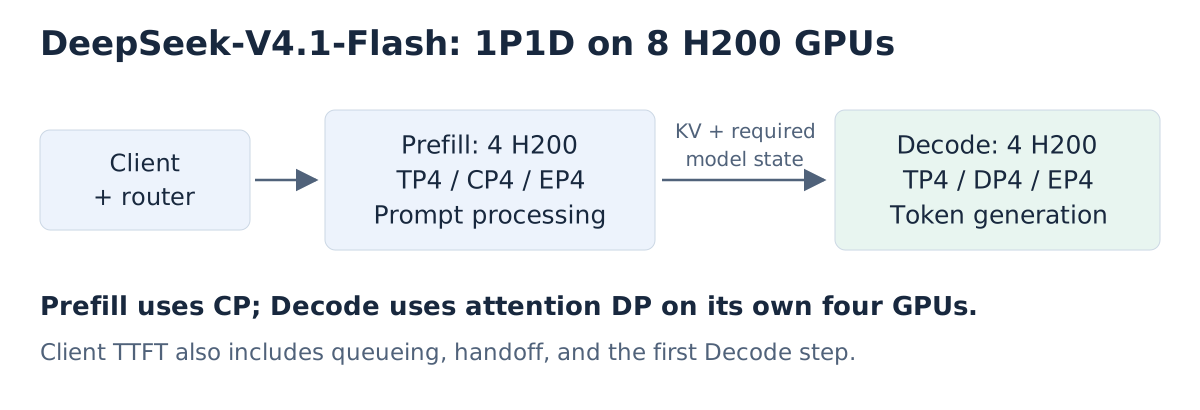
Figure 1. The measured 1P1D topology. The handoff includes the KV and model state required to continue generation. Client-visible TTFT includes queueing and handoff costs as well as Prefill computation.
We first identified a supply problem on the P side. Requests accumulated in the Prefill queue even at modest concurrency, while the Decode worker’s available cache capacity did not explain the queueing. We therefore concentrated on reducing Prefill service time before considering a different P/D ratio.
The evaluated H200 configuration uses the Torch BF16 Prefill Indexer scoring path. Its bottlenecks differ from the Blackwell path that uses DeepGEMM for the relevant Indexer operations. A representative early profile attributed 209.47 ms, or 39.06% of the reported per-forward breakdown, to the Indexer. MoE computation and NCCL each accounted for approximately another 18%.
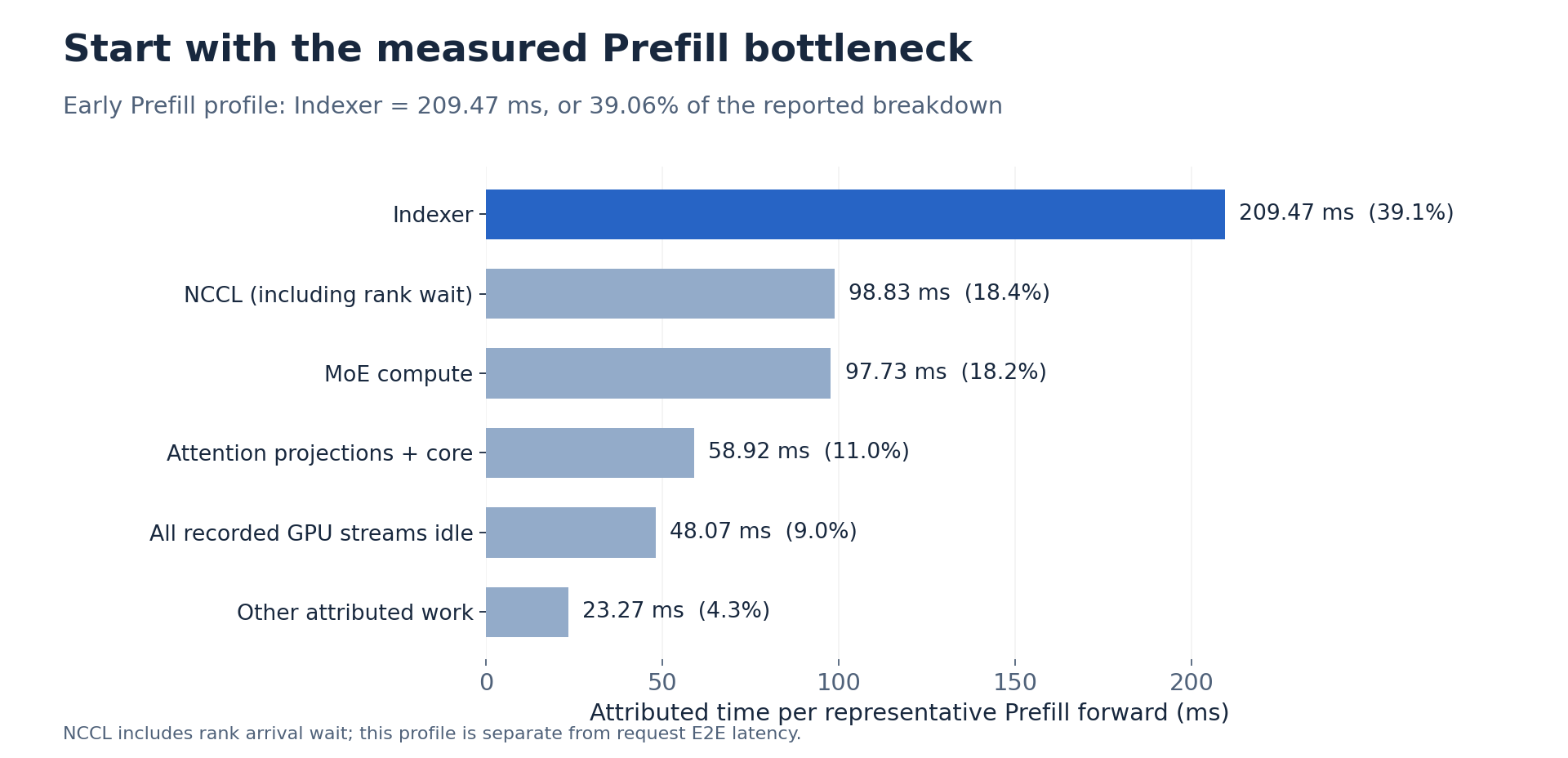
Figure 2. A representative early Prefill profile, separate from request E2E latency. NCCL attribution includes waiting for other ranks. The Attention category combines the reported projection and core-attention categories; the smaller remaining compute categories are grouped together.
Measurement Setup
We developed the optimizations in this article on top of our earlier PR #40323.
All baseline and optimized experiments in this article use the same model weights from deepseek-ai/DeepSeek-V4.1-Flash on Hugging Face.
The workload uses nominal 65,536-token inputs and 512-token outputs. The case labels 50%, 70%, and 90% correspond to configured shared-prefix lengths of 32,768, 46,080, and 61,440 tokens, respectively, with request-specific suffixes of 32,768, 19,456, and 4,096 tokens. Their concurrency levels are 4 and 8; 8 and 16; and 8, 16, 24, and 32. These are nominal case labels; the exact configured prefix fractions are 50.0%, 70.3%, and 93.75%. Figure 7’s original 0.93 label refers to the same 61,440-token-prefix case shown as nominal 90% elsewhere.
Each baseline and optimized serving configuration in this article is benchmarked three times per workload case, with 512 requests and 10 warmup requests per run. Each run produces request-level mean latencies, labeled TTFT-mean, TPOT-mean, and E2E-mean. For each metric, we compute the mean and sample standard deviation (SD) across the three per-run means. SD is calculated with Python’s statistics.stdev(), equivalent to ddof=1, with denominator 3 − 1 = 2. The reported latency means are therefore averages of three run means; SD describes variation between runs, rather than the spread of individual request latencies within a run.
The updated performance screenshots display optimized TTFT and TPOT as mean/SD. SD has the same units as its latency metric. The baseline and E2E columns show the three-run means without the corresponding SD values. Small differences in mean latency should be interpreted alongside run-to-run variation; these summaries alone do not establish statistical significance. This serving-benchmark protocol is separate from the kernel microbenchmarks, GPU trace samples, and GSM8K evaluations. The initial Indexer experiments explicitly disable Prefill BCG.
In the benchmark screenshots, TTFT and E2E latency are in milliseconds; TPOT is in milliseconds per output token. We calculate reductions from the displayed absolute values as (baseline − optimized) / baseline. These calculated reductions can differ slightly from the percentages printed in the original screenshots.
The experiments share a development starting point. Sections 1–3 each start from commit d0a75654368a470d8484e3ea45b06e500fee57af and evaluate their respective optimizations independently. Section 4 starts from that same commit with all three Indexer optimizations cherry-picked together. Sections 5 and 6 build on the optimizations from Sections 1–4, evaluating MoE output reduce-scatter and bounded replay, respectively. Section 5 reports a separate set of benchmark measurements; Section 6 uses Section 4’s reported results as its baseline. Runtime changes and chunk settings follow the individual experiments described below, and complete per-run SGLang revision records are not available for every table.
Pre-optimization performance baseline. Figure 3 reports the original serving baseline measured at commit d0a75654368a470d8484e3ea45b06e500fee57af, before the optimizations described in this article. SWA bounded replay is disabled: --enable-decoder-swa-bounded-replay is not passed. Both Prefill token limits are 8,192: --chunked-prefill-size 8192 and --max-prefill-tokens 8192. These original baseline values are used in the Sections 1–3 comparisons and the overall combined comparison; later sections identify their own baselines with earlier optimizations already applied.
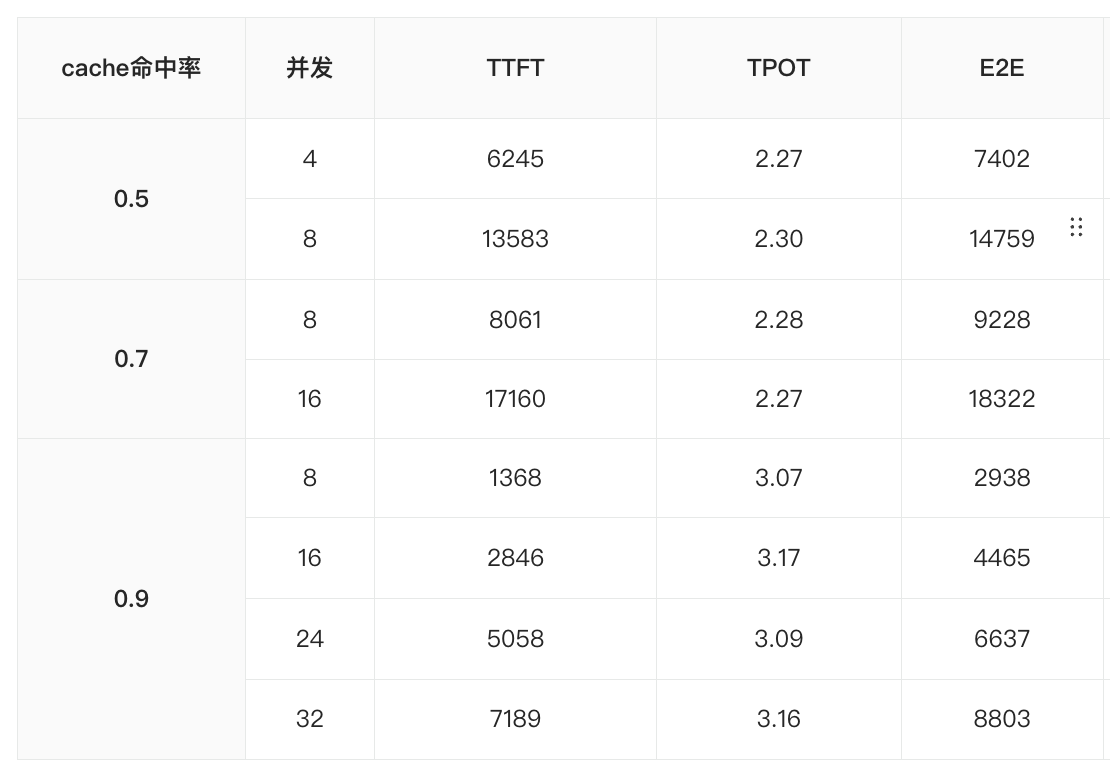
Figure 3. Pre-optimization performance baseline at d0a7565, with SWA bounded replay disabled and both Prefill token limits set to 8192. TTFT and E2E are in milliseconds; TPOT is in milliseconds per output token. Values are three-run means; SD is not shown.
The baseline GSM8K evaluation shown below uses 1,319 single-shot examples and scores 96.74%, with no request errors or truncated outputs.
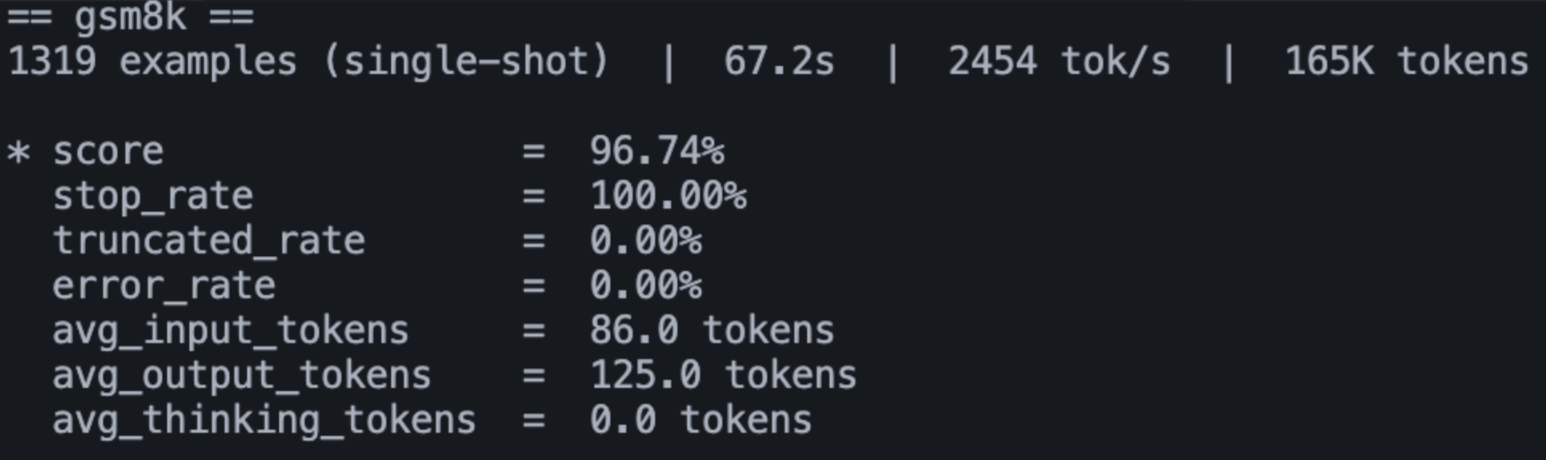
Figure 4. Baseline GSM8K evaluation: 96.74% accuracy on 1,319 single-shot examples, with 0.00% error and truncated rates.
Model Operations Behind the Optimizations
DeepSeek-V4.1 combines a 128-position sliding window (SWA) with sparse access to compressed history. Selected source layers produce compressed KV and Indexer keys; consumers reuse the latest source’s stored history while maintaining their own local window KV. The final compressed-KV source is layer 20. Layers 21–39 can therefore read that history without producing a new compressed representation. These layer roles are described in the model introduction.
The Indexer selects which compressed history positions attention will read. On the BF16 path discussed here, it computes per-head query–key dot products, applies ReLU and query-dependent head weights, and sums over heads before top-k selection. These are retrieval scores: the subsequent attention operation computes its own attention weights over the selected compressed KV and local window, then combines values to produce the attention output.
Sharing has two distinct meanings here. KV consumers share compressed KV and Indexer keys from a source layer. Layer 20 publishes up to 2,048 candidate blocks of eight compressed positions, while selecting its own top-512 from all visible positions. Later Indexer source layers share those candidate block IDs and compute their own scores and final top-k inside that domain. They do not copy the publisher’s scores or final top-k. Layers without their own Indexer reuse the most recent selection.
Bounded replay uses the fixed late-layer compressed history to limit Prefill computation in layers 21–39 to each request’s trailing window. It reconstructs those layers’ local SWA KV and retained hidden states; the compressed history is already available. DSpark, the speculative block drafter, additionally uses hidden states captured from selected target-model layers to populate its draft KV state and condition proposals. Its auxiliary states must refer to the same token positions as the retained model outputs. Section 6 explains the approximation at the replay boundary and the CP output fix. The DSpark Prefill injection path consumes both hidden states and their token indices.
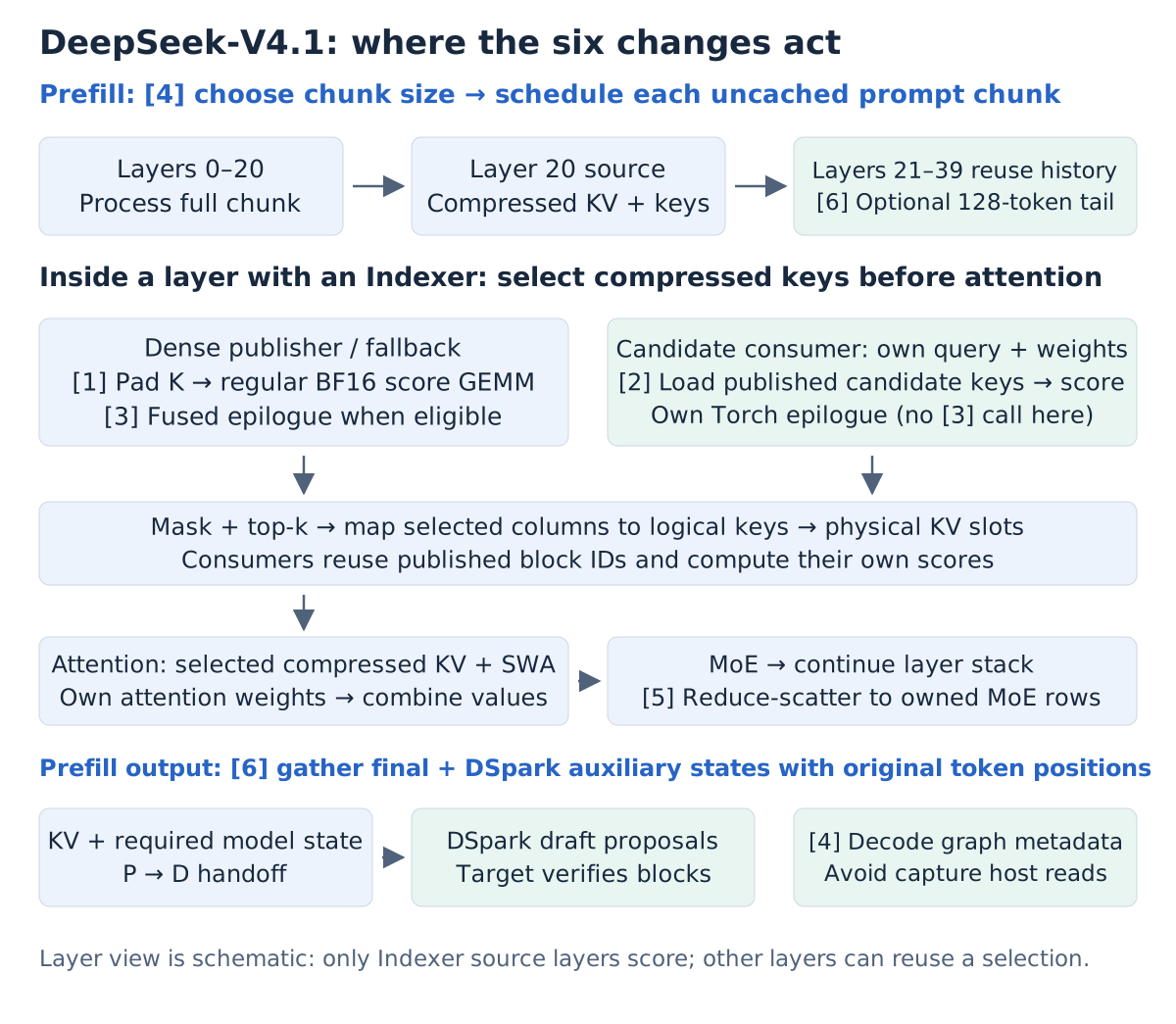
Figure 5. Model execution, separate from GPU allocation in Figure 1. Section numbers identify the six changes. The Indexer branches represent alternative scoring implementations; the detailed compatibility of alignment, candidate scoring, and epilogue fusion is explained after Section 3. MoE follows attention within each model layer. The late-layer tail is an opt-in Prefill approximation, and the Decode metadata change belongs to Section 4.
1. Align the BF16 Prefill Indexer Score Width
Baseline and comparison. Both configurations start from commit d0a75654368a470d8484e3ea45b06e500fee57af and include the same CP request-row mapping fix. The optimized run adds the score-width alignment change from PR #45794. This is an independent comparison with 8,192-token Prefill chunks.
PR #45794 addresses a surprising observation: nearby Indexer score widths could have very different GEMM costs. Cross-rank profiling showed much faster execution at a 64-aligned width than at neighboring unaligned widths. Almost identical dimensions and similar strides still resulted in different kernel behavior.
The scoring operation takes query rows across heads and compares them with the request’s visible compressed keys. Its large intermediate has shape [query_rows, heads, visible_keys]. Padding the physical key extent can improve the GEMM shape even though it adds a small amount of arithmetic. For example, one extra column changes width 28,799 to 28,800, a multiple of 64. The measured improvement is shape-dependent. More favorable kernel dispatch, tiling, or memory alignment could explain it, but the available traces do not establish the precise hardware cause.
For CUDA BF16 keys with at least 1,024 visible positions, the patch pads the dequantized key tensor to ceil(visible_keys / 64) × 64. It does this once per request and reuses that tensor across query chunks. Scores are sliced back to the logical extent before causal masking and top-k selection. The chunk-size calculation uses the padded width, keeping the existing intermediate-memory budget intact.
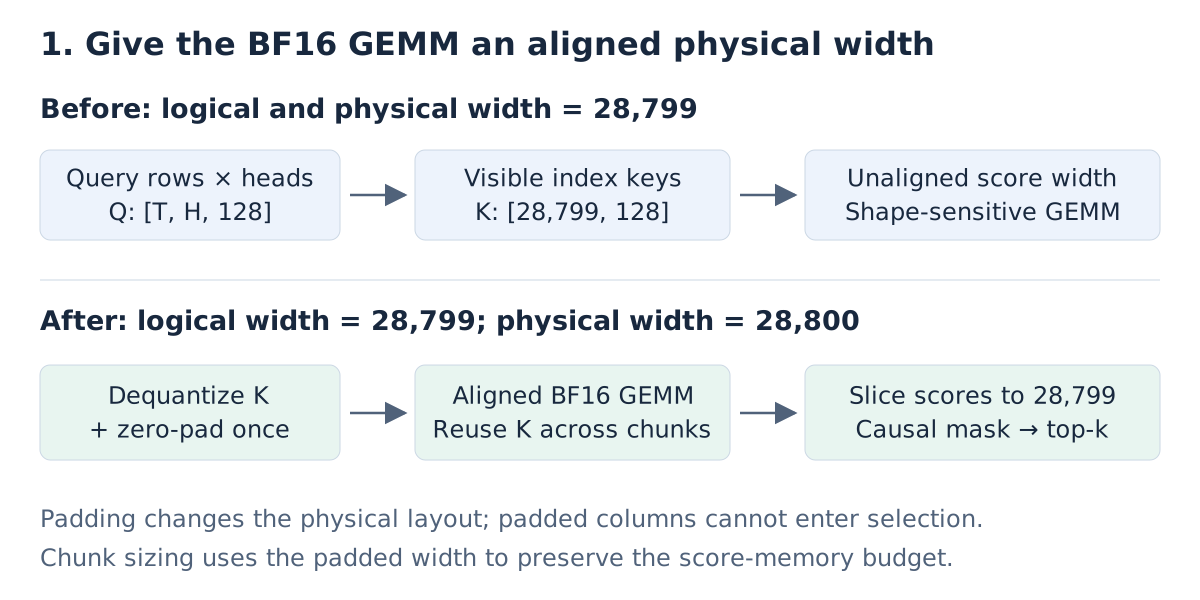
Figure 6. Physical padding improves the GEMM shape while selection still operates on the original logical positions. Padded columns never become eligible candidates.
The PR’s scoring microbenchmark includes the epilogue and the padding cost:
| Query rows | Logical score width | Baseline | Aligned | Reduction |
|---|---|---|---|---|
| 582 | 28,799 | 4.113 ms | 2.462 ms | 40.1% |
| 292 | 57,343 | 4.088 ms | 2.472 ms | 39.5% |
| 582 | 28,800 | 2.443 ms | 2.445 ms | Approximately unchanged |
The patch also reconstructs rank-local request-row mappings when CP supplies no explicit req_rows. Both the baseline and optimized runs include that mapping fix, isolating the score-width change in this experiment.
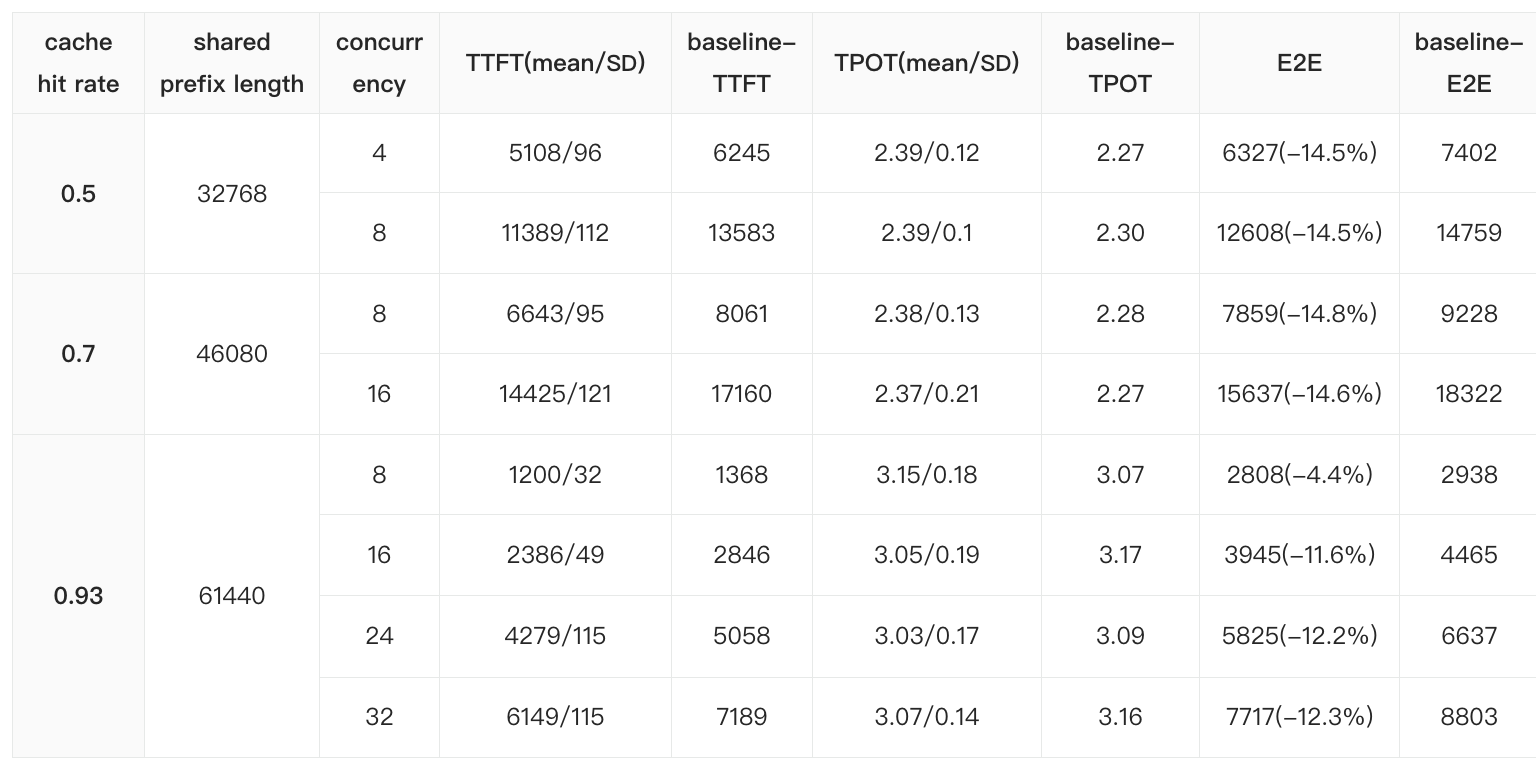
Figure 7. Serving benchmark for PR #45794. Optimized values appear before their baseline columns. TTFT and TPOT are shown as three-run mean/SD; E2E and baseline columns show means only. TTFT and E2E are in milliseconds, and TPOT is in milliseconds per token.
Across the eight displayed cases, TTFT falls by 12.3%–18.2% and E2E latency by 4.4%–14.8%. At the 50% cache-hit label and concurrency 4, TTFT changes from 6,245 to 5,108 ms, while E2E changes from 7,402 to 6,327 ms. The smaller E2E gain in the 90%/concurrency-8 case illustrates why a scoring-kernel improvement should be checked against the entire request path.
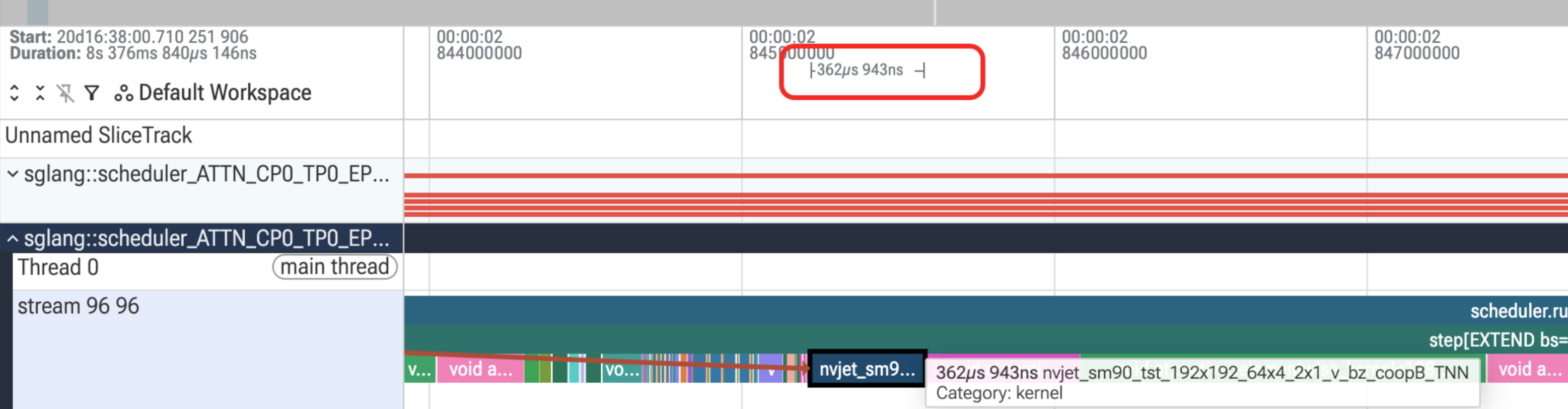
Figure 8. PR #45794 trace, with score-width alignment.
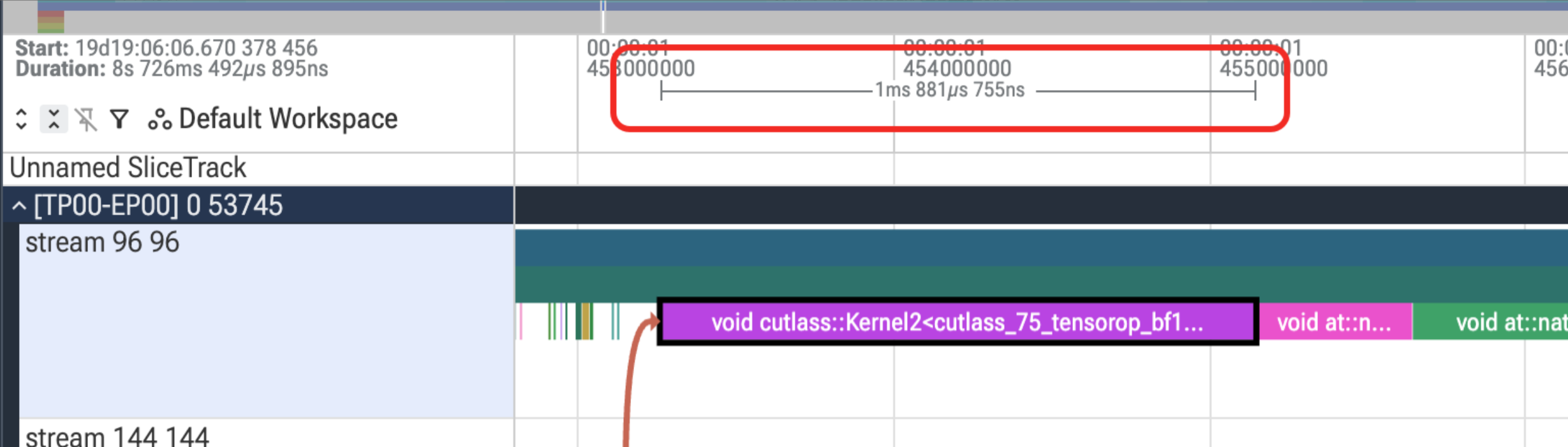
Figure 9. PR #45794 trace, before score-width alignment.
The CP rank 0 screenshots compare the scoring kernel at the same logical shape: its duration falls from 1.88 ms to 362 µs.
The supplied GSM8K evaluation for score-width alignment scores 96.74% on 1,319 single-shot examples, with no request errors or truncated outputs.
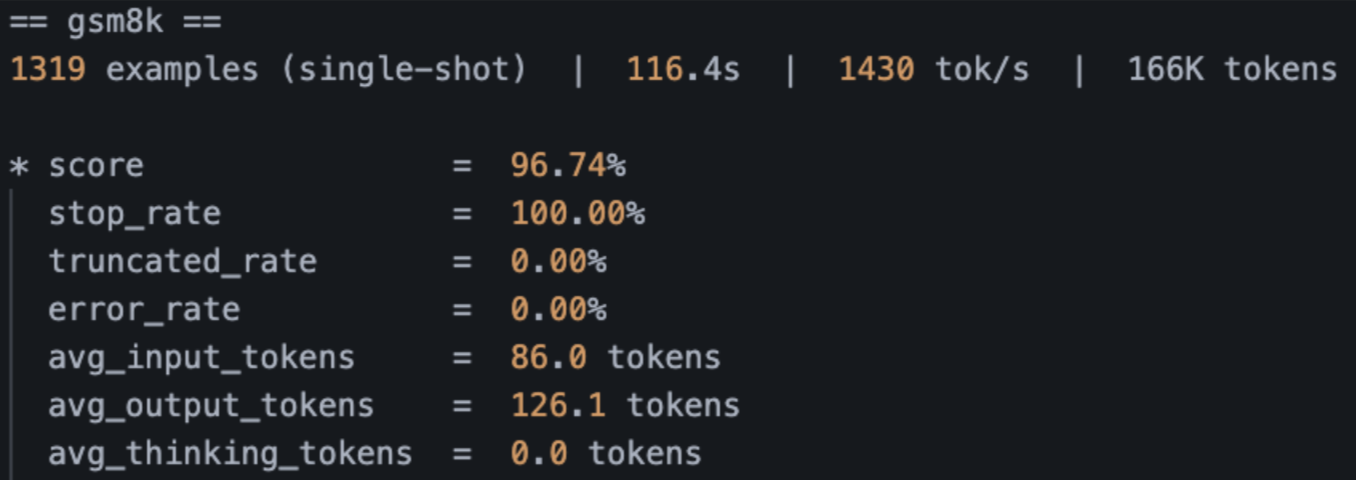
Figure 10. GSM8K evaluation with Section 1’s score-width alignment: 96.74% accuracy on 1,319 single-shot examples, with 0.00% error and truncated rates.
Launch settings: use the shared commands and configuration table for Section 1.
2. Score Only Candidate Positions in Indexer Consumers
Baseline and comparison. Both configurations start from commit d0a75654368a470d8484e3ea45b06e500fee57af. The optimized run adds candidate-only scoring from PR #46003, evaluated independently of the Indexer optimizations in Sections 1 and 3. Both runs use 8,192-token Prefill chunks.
PR #46003 removes work outside the consumer’s selection domain.
DeepSeek-V4.1 shares candidate blocks across Indexer source layers. A publisher produces candidate block IDs; later consumers select their final top-k only within those published blocks, using their own queries, head weights, and scores. The shared object is the candidate domain. The original Torch consumer still scored every visible key before gathering candidate scores. Positions that could never be selected consumed GEMM work and intermediate memory bandwidth.
For a small example, suppose there are 16 logical compressed Indexer key positions, numbered 0–15, and the publisher supplies blocks [1, 3]. Use block size 4 for this illustration; the model path uses blocks of eight. These indices address compressed Indexer keys, not original prompt tokens, whose relationship to compressed positions depends on compression.
| Published block | Eligible logical key positions | Compact score columns |
|---|---|---|
| 1 | 4, 5, 6, 7 | 0, 1, 2, 3 |
| 3 | 12, 13, 14, 15 | 4, 5, 6, 7 |
The consumer is already restricted to [4…7, 12…15]. The old implementation computes 16 scores per head, then gathers these eight; the new implementation directly computes the eight eligible scores. If compact top-k selects column 5, its candidate-list index is 5 // 4 = 1, which refers to published block 3, and its in-block offset is 5 % 4 = 1. The logical key position is therefore 3 × 4 + 1 = 13, followed by the request’s mapping from logical key position 13 to a physical KV slot. Treating compact column 5 as key position 5 would select the wrong history.
The patch moves the restriction before scoring. A Triton kernel uses the block IDs to load the corresponding keys directly, producing a compact per-head score tensor of width C rather than the full visible width L. ReLU, head weighting, and head reduction retain the reference operations. Causal and invalid-candidate masking operate on compact scores before top-k.
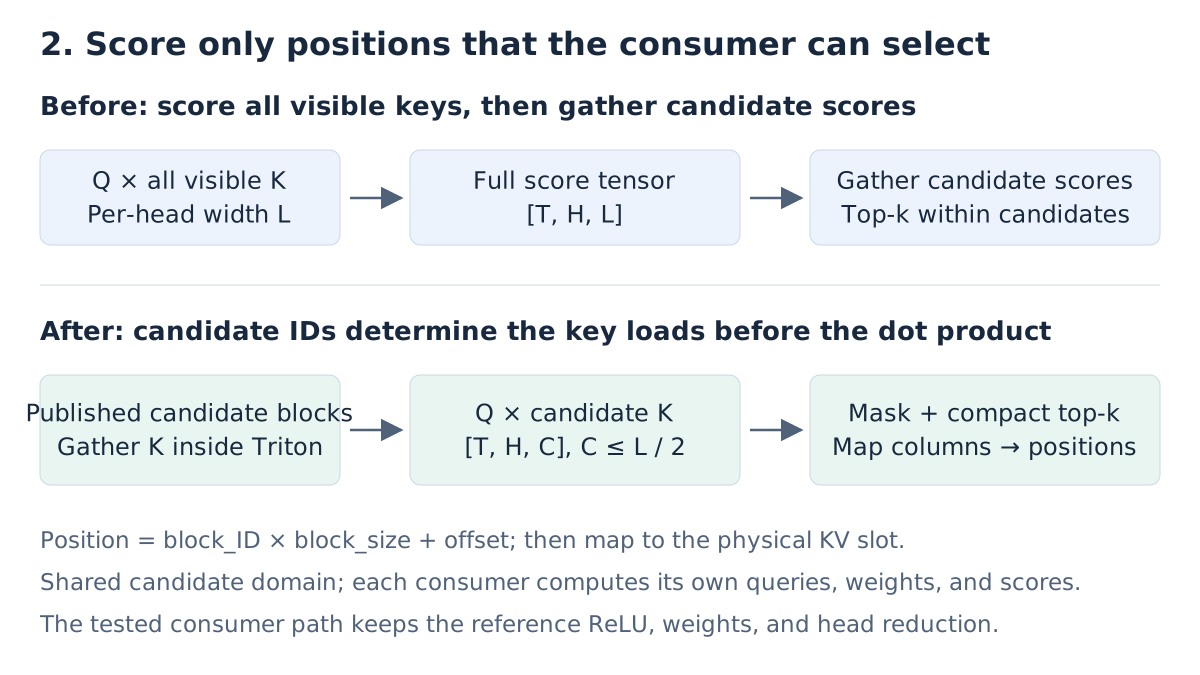
Figure 11. Candidate filtering moves ahead of the dot product. The publisher, candidate budget, and consumer selection domain remain unchanged.
Selected compact columns must then be translated back correctly. Each pick identifies a candidate block and an offset within that block; block_id × block_size + offset reconstructs the request-local key position, which is then mapped to the physical KV slot. An index in the compact score array is not itself a KV-cache address.
The optimized path requires CUDA BF16 operands, a head dimension of 128, at most 64 heads, and a candidate width no greater than half the visible key length. Wider candidate sets use the original path. This avoids paying the indirect-load cost when candidate restriction removes too little scoring work.
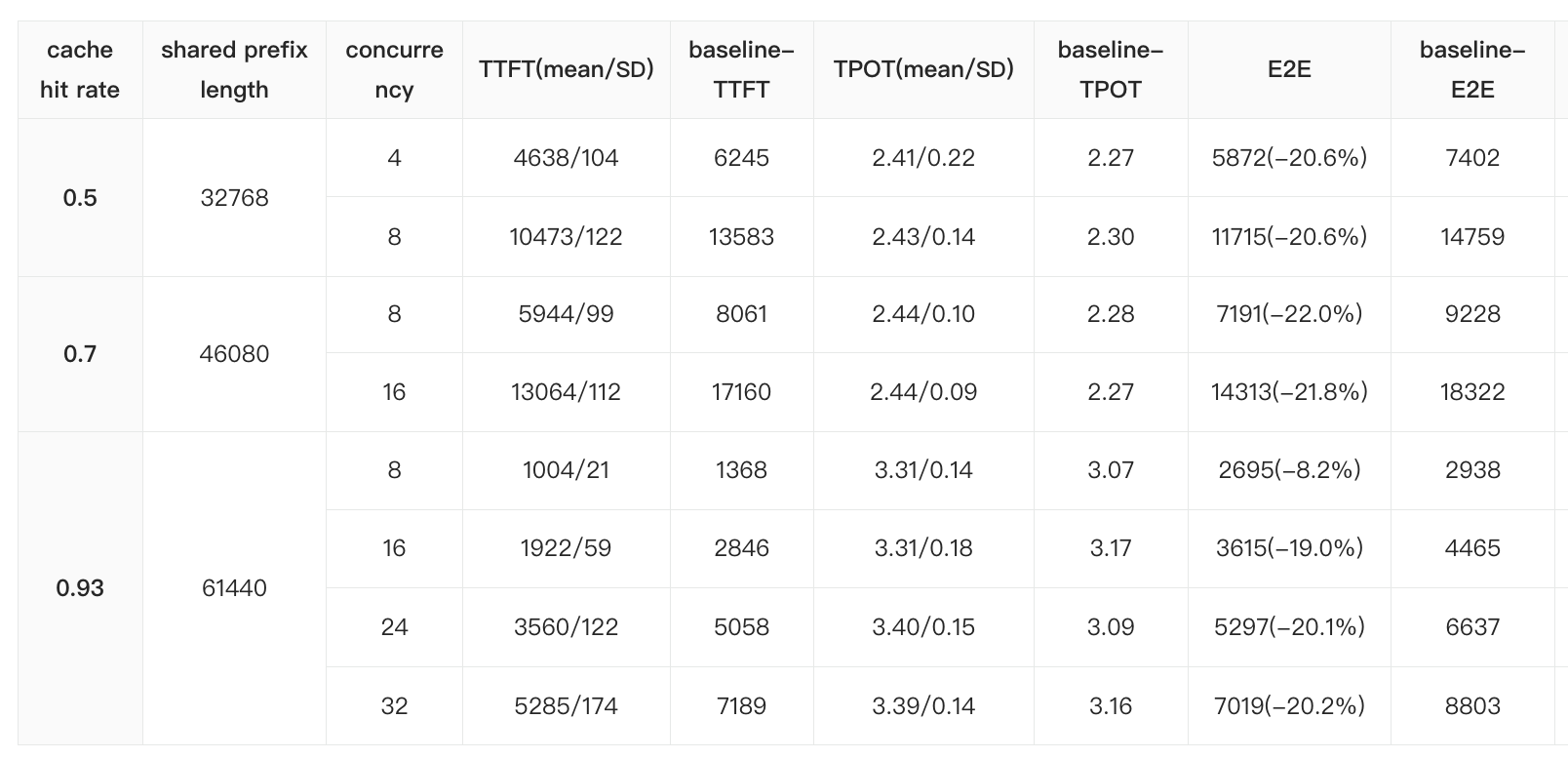
Figure 12. Serving benchmark for PR #46003. This independent experiment uses the same starting development revision as Sections 1 and 3.
The displayed TTFT reductions are 22.9%–32.5%, with 8.3%–22.1% lower E2E latency. At the 70% label and concurrency 8, TTFT changes from 8,061 to 5,944 ms and E2E from 9,228 to 7,191 ms. At the 90% label and concurrency 16, TTFT changes from 2,846 to 1,922 ms, a 32.5% reduction.
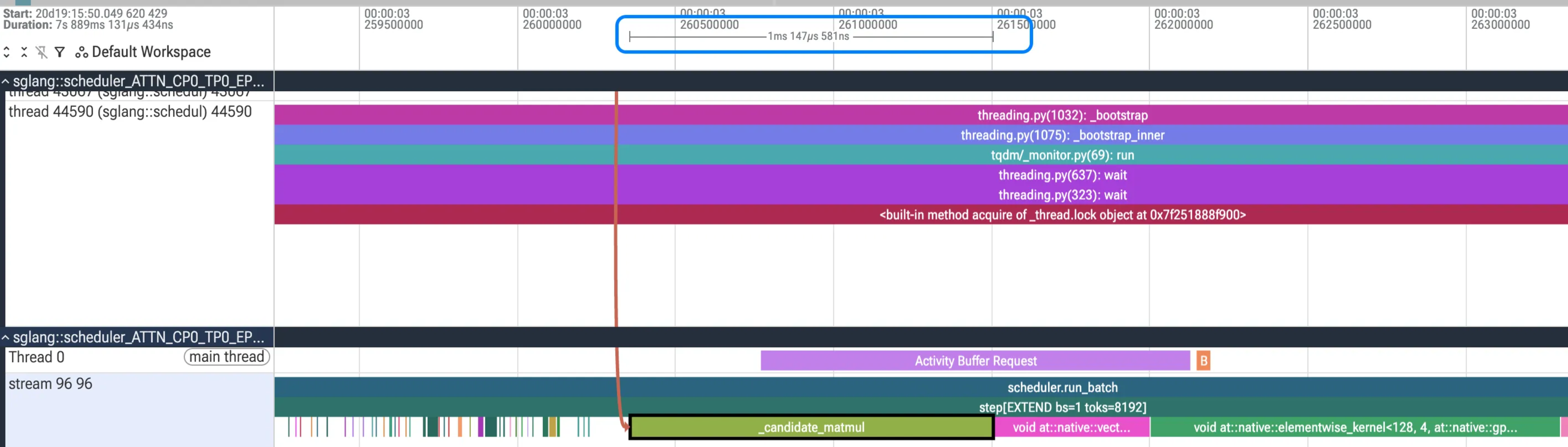
Figure 13. PR #46003 trace, with candidate-only scoring.
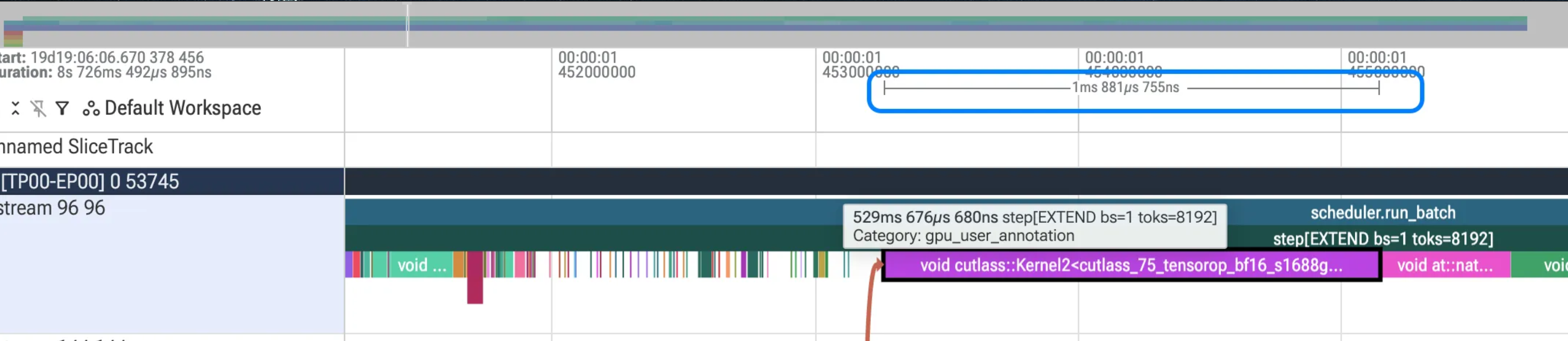
Figure 14. PR #46003 trace, before candidate-only scoring.
At the same logical problem shape, the displayed CP rank 0 scoring-kernel duration falls from 1.88 to 1.147 ms. The optimized kernel computes a smaller candidate domain, so its physical output shape differs from the baseline’s dense score tensor.
The local validation reported exact score/top-k agreement for tested model-style FP4 inputs and matching Indexer/KV-slot writeback in the integration cases. The attached 1,319-question GSM8K result is 96.74%, with zero request errors.
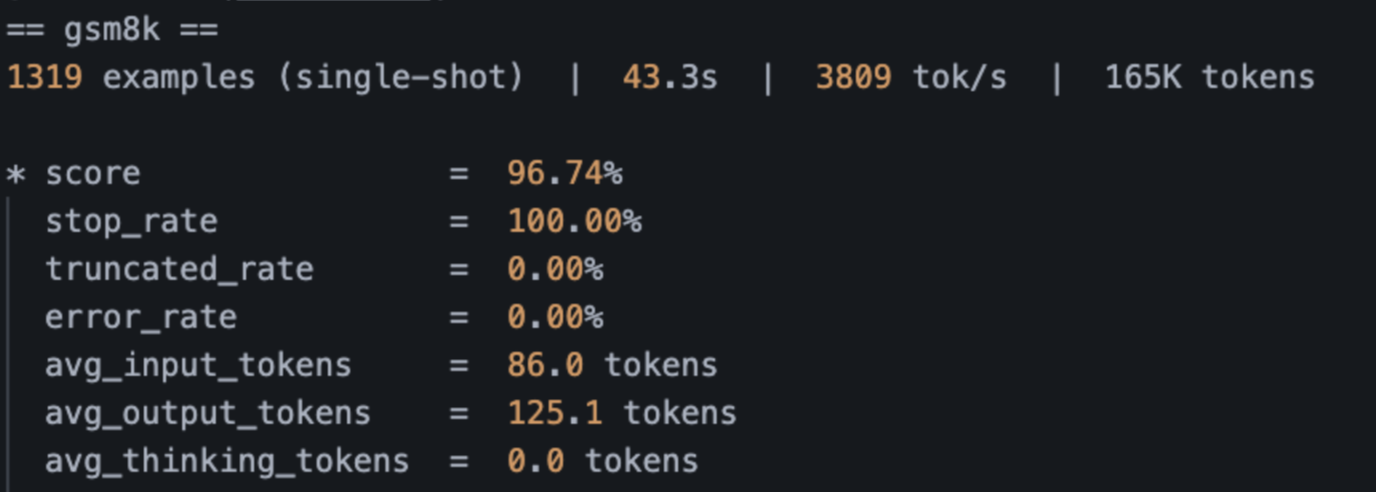
Figure 15. GSM8K evaluation with Section 2’s candidate-only scoring: 96.74% accuracy on 1,319 single-shot examples, with 0.00% error and truncated rates.
Launch settings: use the shared commands and configuration table for Section 2.
3. Fuse the BF16 Indexer Score Epilogue
Baseline and comparison. Both configurations start from commit d0a75654368a470d8484e3ea45b06e500fee57af. The optimized run adds score-epilogue fusion from PR #45807, evaluated independently of the Indexer optimizations in Sections 1 and 2. Both runs use 8,192-token Prefill chunks.
PR #45807 keeps the existing score GEMM and reduces the work that follows it.
The original sequence materializes the large BF16 per-head scores, applies ReLU, multiplies by head weights, reduces across heads, and converts the result to FP32. Separate elementwise operations repeatedly read and write [query_rows, heads, context] tensors. Profiling attributed approximately 104.8 ms per representative forward to the multiplication, clamp/ReLU, and reduction operations, making this a substantial target after inspecting the GEMM itself.
The patch replaces that epilogue with one Triton kernel for the supported 32-head CUDA BF16 path. The GEMM’s per-head output still exists; the later full-sized intermediates disappear.
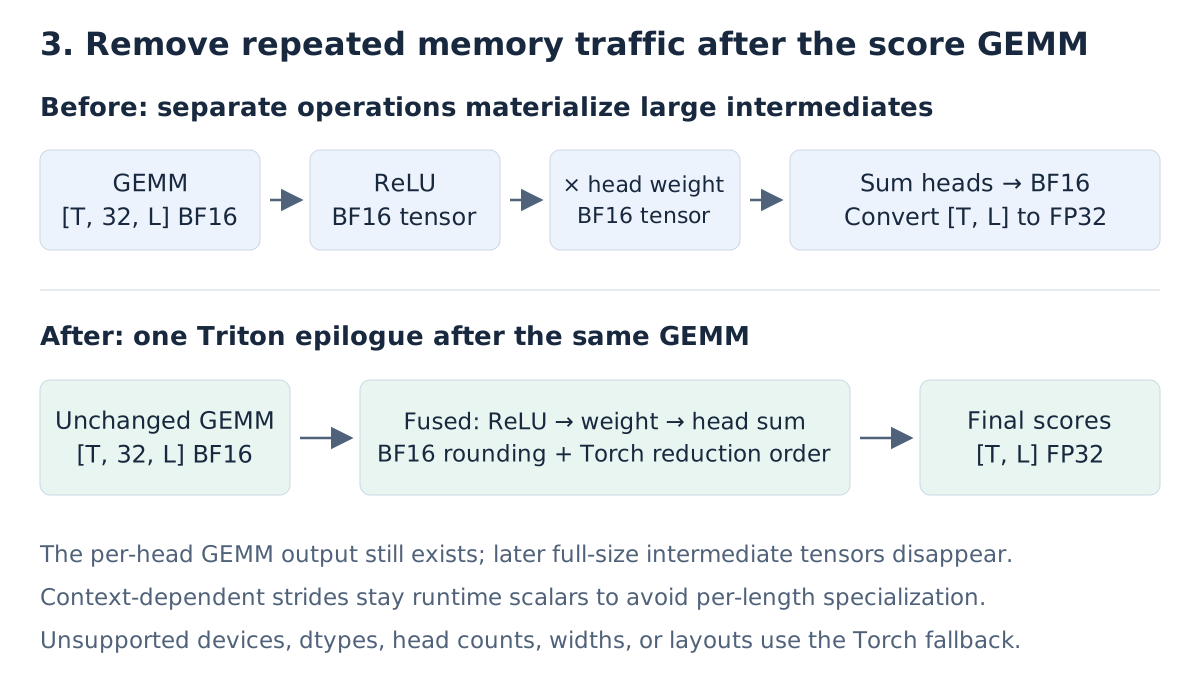
Figure 16. Fusion removes intermediate memory traffic and launches after GEMM. It preserves the numerical effects of the reference operations.
Numerical behavior matters because top-k consumes these scores. Two nearly tied keys can swap order at the selection threshold after a small rounding change, altering which KV entries attention reads. The kernel preserves BF16 rounding after multiplication and reduction and uses four interleaved accumulators to reproduce the tested Torch/CUDA 32-head accumulation order. A final conversion to FP32 cannot restore precision already lost at an earlier BF16 cast. Keeping the same mathematical formula while changing these rounding points or the summation order can therefore change selection. The reported parity applies to the tested reference implementation and supported layouts.
Context-dependent row and head strides remain runtime arguments, avoiding a separate kernel specialization for each context-dependent stride. The implementation uses the Torch fallback for unsupported devices, dtypes, head counts, widths, and layouts. In particular, width-one and head-contiguous reduction layouts require their own fallback because the reference reduction order differs.
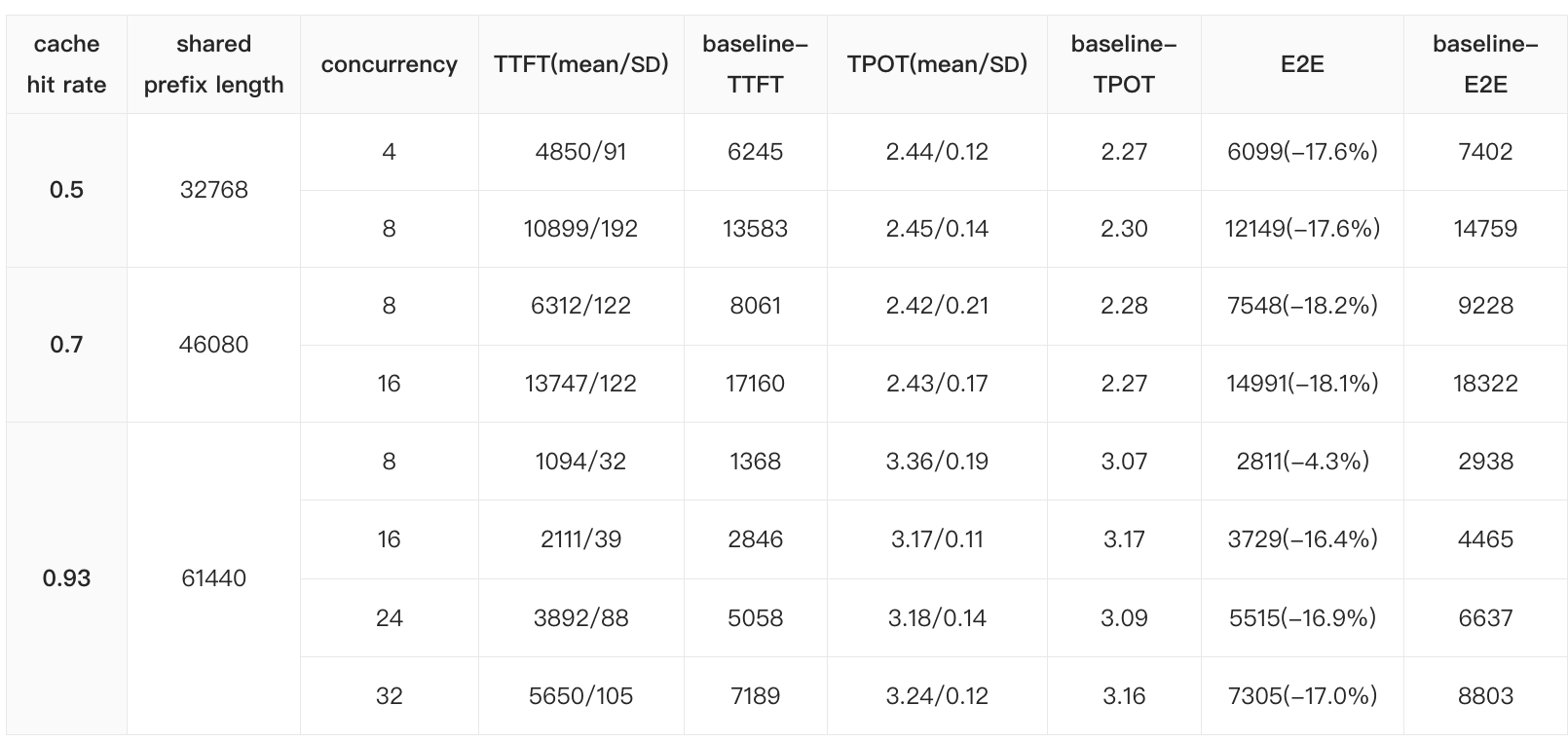
Figure 17. Serving benchmark for PR #45807. The fused epilogue comparison retains the existing GEMM.
Across the displayed cases, TTFT falls by 19.8%–25.8% and E2E by 4.3%–18.2%. At the 50% label and concurrency 4, TTFT changes from 6,245 to 4,850 ms and E2E from 7,402 to 6,099 ms. At the 90% label and concurrency 16, TPOT remains 3.17 ms/token; it increases in the other seven displayed cases.
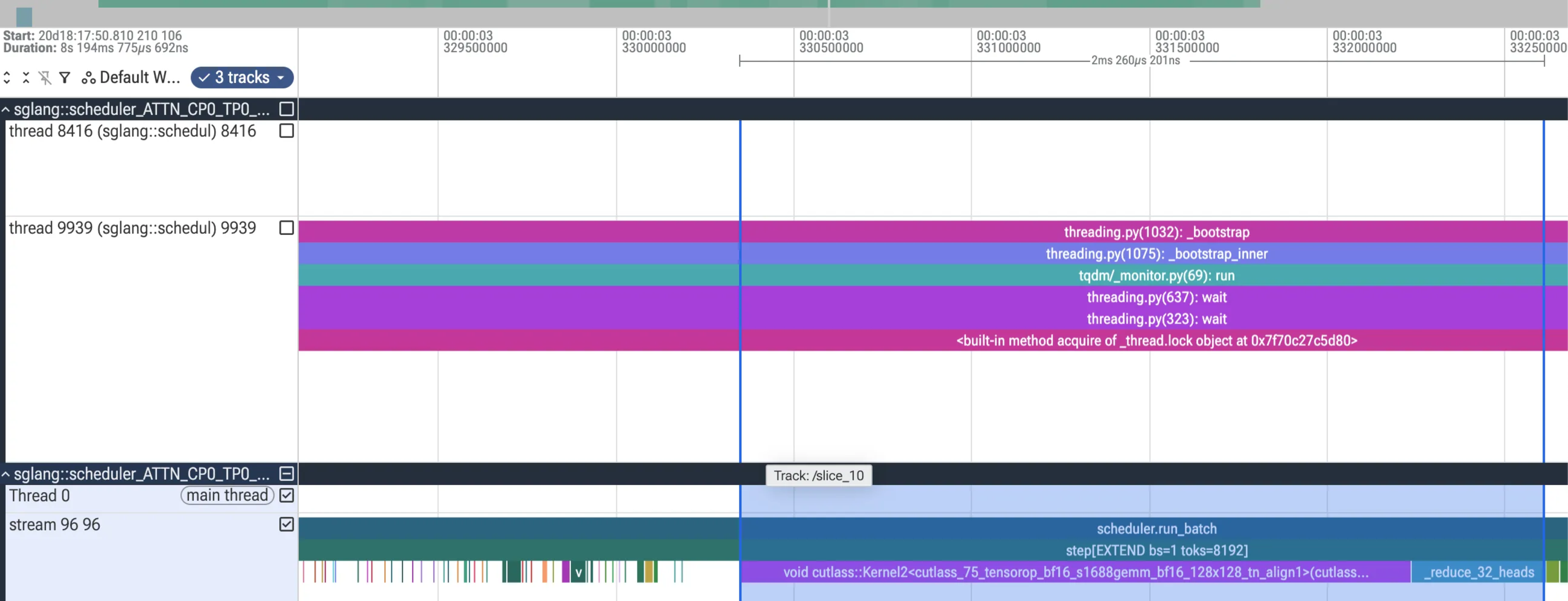
Figure 18. PR #45807 trace, showing GEMM followed by the fused epilogue.

Figure 19. PR #45807 trace, showing GEMM and separate score postprocessing.
The selected CP rank 0 trace interval, covering GEMM and score postprocessing, falls from 4.243 to 2.26 ms. This is the displayed region’s elapsed duration, rather than the duration of the epilogue alone or the entire forward pass.
The PR reports exact agreement in its local scoring, rounding-boundary, and integration checks, and GSM8K at 96.59%, compared with baseline runs at 96.74% and 96.36%.
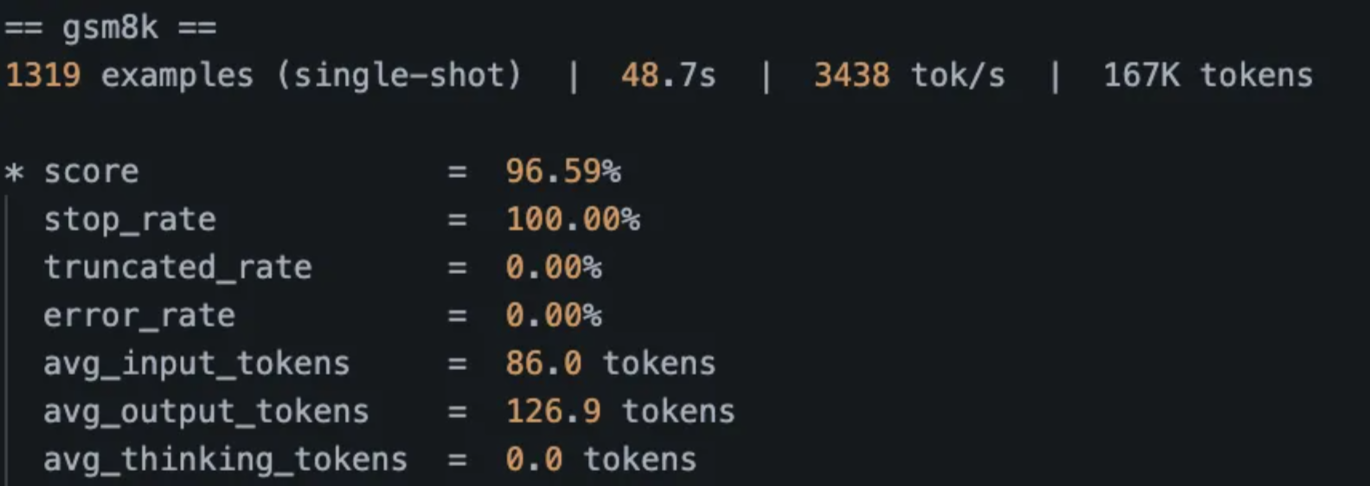
Figure 20. GSM8K evaluation with Section 3’s fused score epilogue: 96.59% accuracy on 1,319 single-shot examples, with 0.00% error and truncated rates.
How the Three Indexer Changes Combine
The changes address three different costs: Section 1 changes the physical width of dense scoring; Section 2 reduces the set of keys scored; Section 3 reduces memory traffic after scoring. Their call paths determine which benefits can combine:
| Scoring path | Dot product | Postprocessing | Applicable combination |
|---|---|---|---|
| Dense publisher or dense fallback | Regular indexer.scores GEMM over visible keys, optionally padded by Section 1 | Section 3’s fused reduce_head_scores when its 32-head BF16/layout gate passes; Torch otherwise | Alignment and epilogue fusion can combine on the eligible dense path. |
| Eligible candidate consumer | Section 2’s _candidate_matmul over candidate keys only | Its own Torch ReLU, weighting, and head reduction | Candidate-only scoring replaces the dense GEMM; the inspected implementation does not call Section 3’s fused epilogue. |
This distinction follows the inspected dense scoring code and candidate scoring code. Padded key storage can still be prepared upstream for a candidate consumer, but its compact output width is determined by the candidate blocks; it does not execute the dense GEMM whose alignment gain is measured in Section 1. A single model run can use an aligned, fused dense path at publishers or fallbacks and the separate candidate kernel at eligible consumers.
Launch settings: use the shared commands and configuration table for Section 3.
We cherry-picked the optimizations from Sections 1–3 onto commit d0a75654368a470d8484e3ea45b06e500fee57af and benchmarked the combined configuration with 8K Prefill chunks. Against the common early baseline, TTFT is 29.7%–46.3% lower and E2E 9.5%–34.5% lower, while TPOT is 8.1%–20.6% higher across the eight cases. This combined configuration supplies the baseline for Section 4.
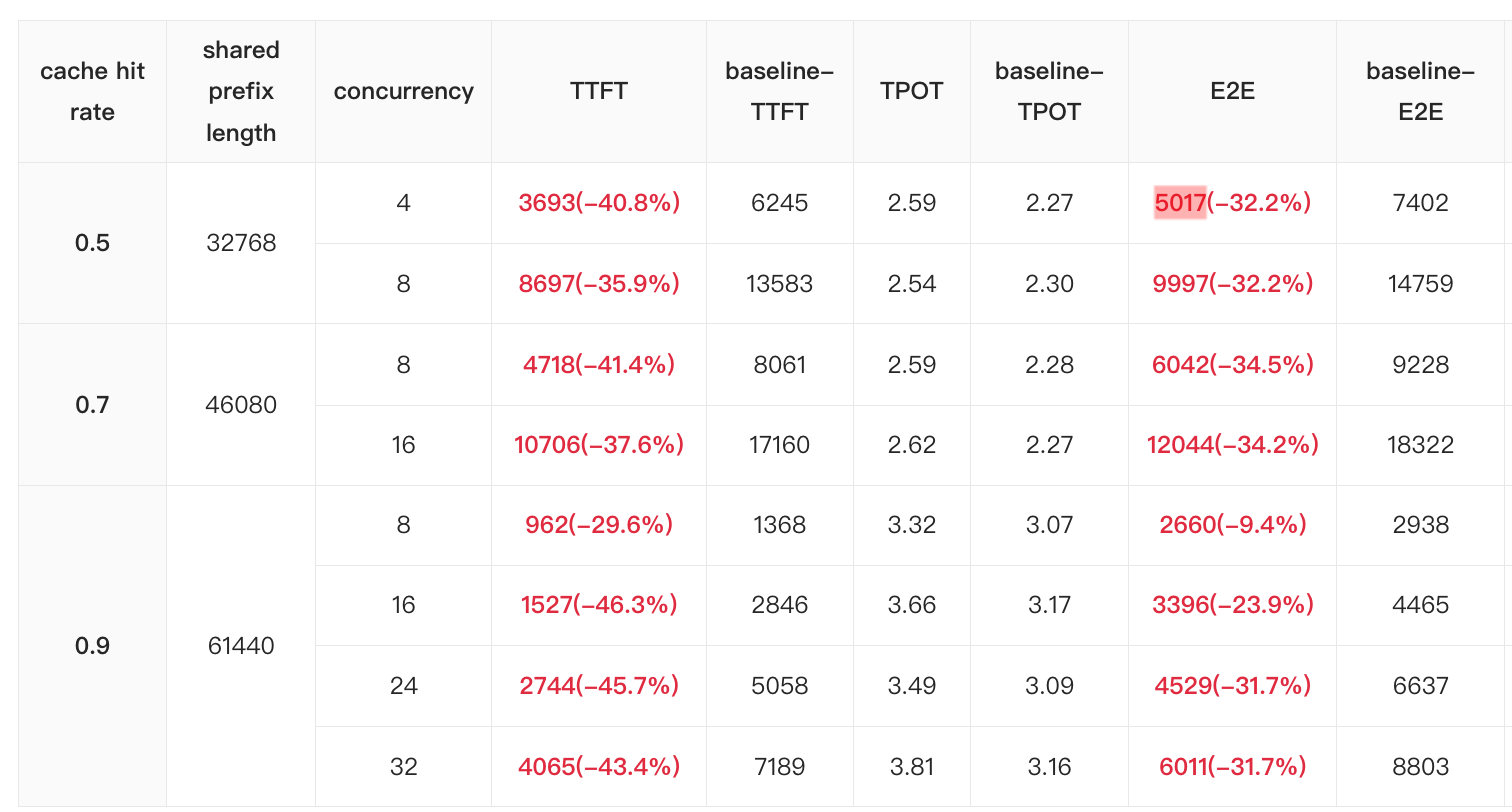
Figure 21. Sections 1–3 combined, with 8K Prefill chunks. The original baseline is shown in the baseline columns; the combined results become Section 4’s 8K baseline.
4. Larger Prefill Chunks and Decode Graph Metadata
Baseline and comparison. Both configurations start from commit d0a75654368a470d8484e3ea45b06e500fee57af, with the Indexer changes from PR #45794 (Section 1), PR #46003 (Section 2), and PR #45807 (Section 3) cherry-picked together. This combined configuration uses 8,192-token Prefill chunks for the baseline and 16,384-token chunks for the optimized comparison. The associated Decode graph-metadata work is described below.
With an 8,192-token chunk, a long uncached suffix requires several Prefill forward passes and scheduling rounds. Increasing the chunk to 16,384 tokens lets each forward pass process more of that suffix and reduces the number of rounds. This targets scheduling and chunk boundaries alongside the kernel work optimized above.
The same investigation exposed a Decode-side CUDA graph metadata problem: reading CUDA sequence lengths back to the host with .tolist() during capture could fail and force the metadata path to run eagerly. This work was tracked in PR #46777.
The merged PR prevents the draft metadata glue graph from running when a backend requires host sequence lengths and removes an unused seq_lens.sum().item() read during Decode graph capture. Its description notes that the original host-read fixes landed separately in #46891 and #46897. Under the current DSpark configuration, the host-length guard is defensive because needs_cpu_seq_lens is already false. The table below reports the chunk-size experiment; it does not isolate the performance impact of the guard.
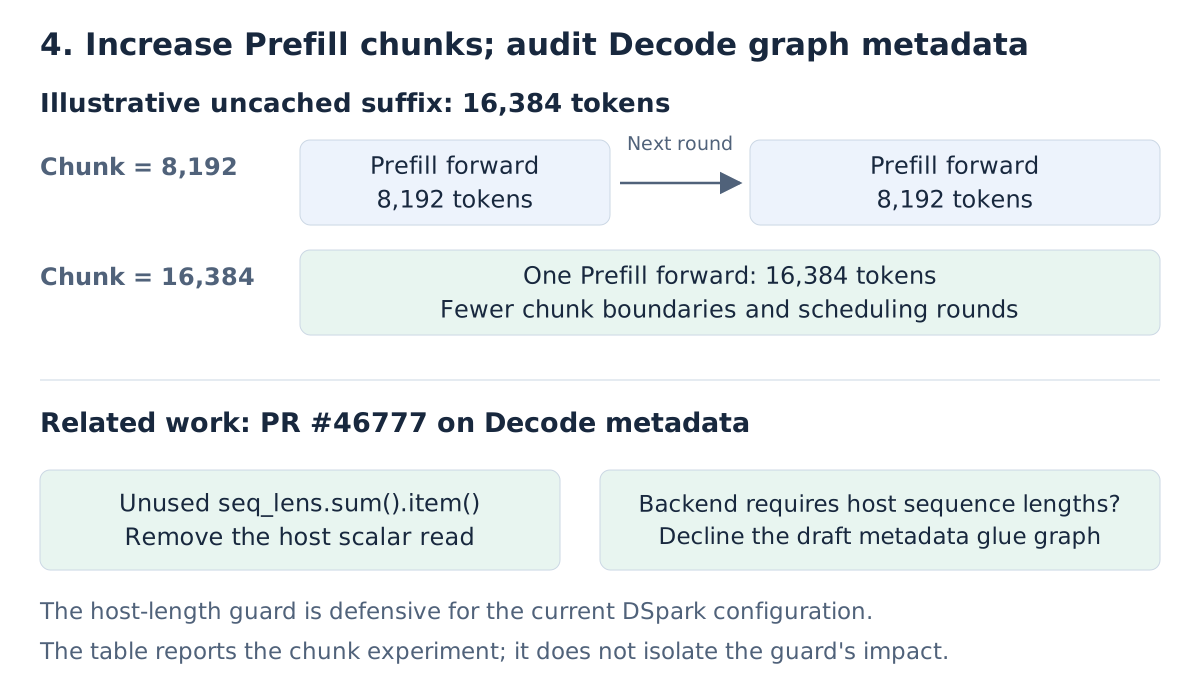
Figure 22. An illustrative 16,384-token uncached suffix requires two 8,192-token chunks or one 16,384-token chunk. The Decode metadata work tracked in PR #46777 addresses graph-capture constraints separately from the choice of Prefill chunk size.
Data Summary: 8,192 → 16,384 Prefill Tokens
The optimized columns use 16,384-token chunks; the baseline columns use 8,192-token chunks. TTFT and E2E are in milliseconds; TPOT is in milliseconds per output token. The E2E percentage is (16K result / baseline − 1) × 100%, so a negative value means lower latency.
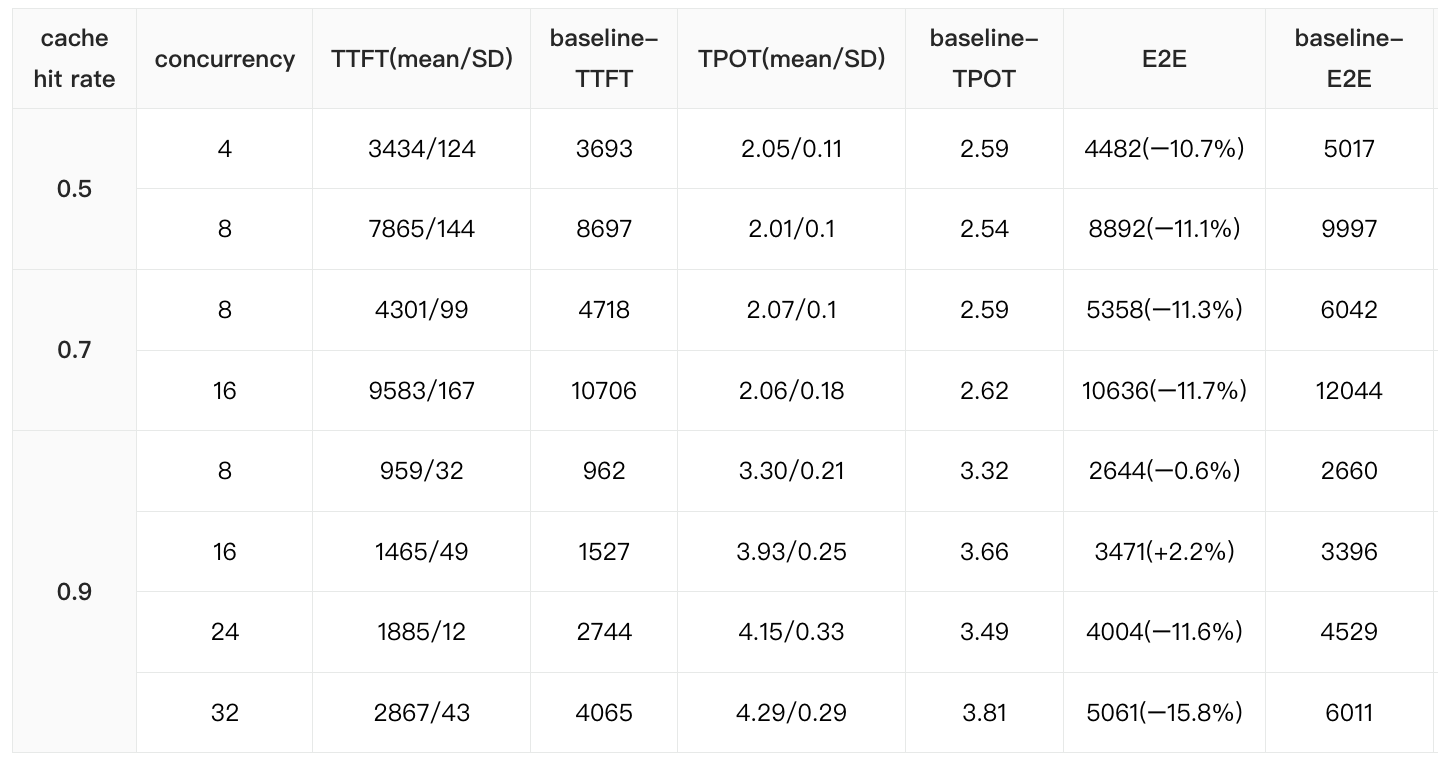
Figure 23. Section 4’s chunk-size comparison. The baseline is the 8K configuration with the three Indexer changes from Sections 1–3; the optimized columns use 16K chunks. Optimized TTFT and TPOT are three-run mean/SD; E2E and baseline columns show three-run means only.
TTFT falls in every displayed case, with the largest reduction of 31.3% at the 90% label and concurrency 24. E2E improves in seven of eight cases, with the largest reduction of 15.8% at the 90% label and concurrency 32. At the 50% and 70% labels, TPOT also decreases by approximately 20.1%–21.4%.
At the 90% label and concurrency 16, however, TTFT improves by 4.1% while TPOT increases by 7.4%. The generation-side increase outweighs the input-side gain, and E2E rises from 3,396 to 3,471 ms, a 2.2% regression. TPOT also rises at concurrency 24 and 32, although their larger TTFT reductions still produce lower E2E latency.
For the cases in this chunk-size comparison where TTFT decreased but TPOT increased, our serving metrics showed that raising the Prefill chunk size from 8,192 to 16,384 increased the mean number of running requests on each Decode DP rank by approximately 10%–20%. We believe this higher Decode concurrency contributed to the TPOT increase: faster Prefill delivered requests to Decode sooner, leaving more requests active on each rank during token generation.
The supplied GSM8K evaluation for the Section 4 configuration scores 96.59% on 1,319 single-shot examples, with a 0.15% truncated-output rate and 0.00% request errors.
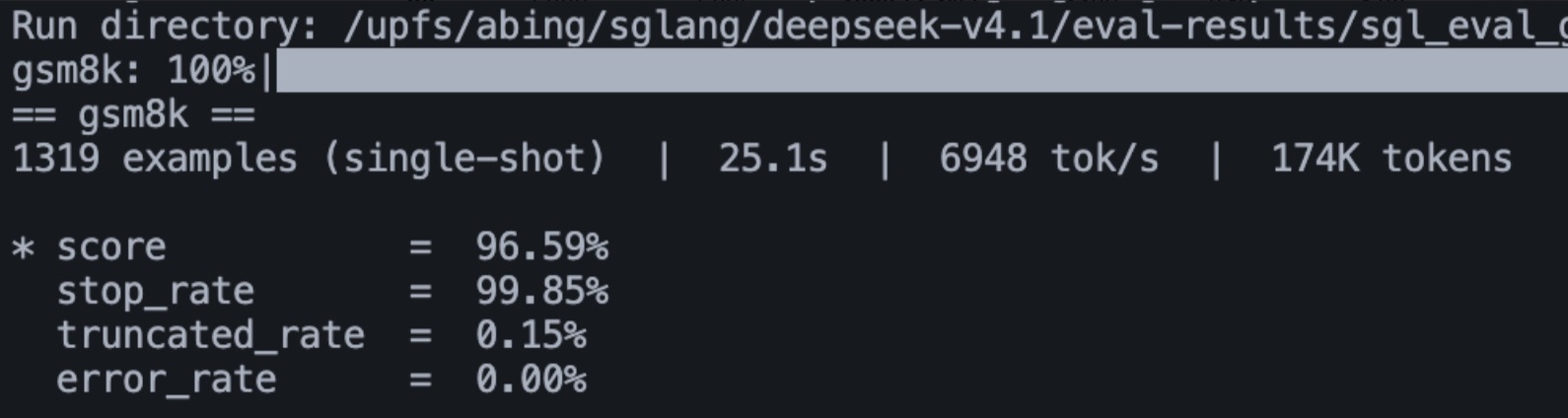
Figure 24. GSM8K evaluation for Section 4: 96.59% accuracy on 1,319 single-shot examples, with a 0.15% truncated rate and 0.00% error rate.
Launch settings: use the shared commands and configuration table for Section 4.
5. Use Reduce-Scatter for CP MoE Output Shards
Baseline and comparison. The baseline starts from commit d0a75654368a470d8484e3ea45b06e500fee57af with the optimizations from Sections 1–4 already applied: the Indexer changes from PR #45794, PR #46003, and PR #45807, together with the larger-chunk and Decode graph-metadata setup described in Section 4. Both configurations use 16,384-token Prefill chunks. The optimized configuration adds the MoE output reduce-scatter change from PR #47247.
Once the largest Indexer costs were reduced, a subsequent profiling pass shifted attention toward MoE and collectives. PR #47247 examines the ownership of the MoE output rows.
On DeepSeek-V4.1’s CP MoE return path, the original implementation first all-reduced the full expert output. Every rank received all reduced rows, then selected its CP shard and made it contiguous. When TP=CP=4 and both span the same GPU group, each rank ultimately needs only one quarter of those rows.
Here contiguous return rows and interleaved token ownership describe different layouts. The launch option --cp-strategy interleave assigns original prompt positions round-robin to CP ranks. Before MoE, attn_cp_interleave_gather packs those local shards in rank order. Each rank’s rows therefore occupy one contiguous block in the gathered buffer, even though their original prompt positions are interleaved. For 16 tokens at CP4, the buffer is [0,4,8,12 | 1,5,9,13 | 2,6,10,14 | 3,7,11,15]; rank 0 owns the first four buffer rows, which correspond to prompt positions [0,4,8,12].
The model sets cp_return_contiguous from model_type == "deepseek_v41", independently of the CLI strategy name. Thus an interleave launch can use this contiguous-return branch. This follows the inspected model transport selection and rank-order gather.
For four ranks, let Y_r be rank r’s partial full-row output and let their sum be Y = [S0 | S1 | S2 | S3]. With all-reduce, every rank receives all four reduced shards and then keeps only S_r. With reduce-scatter, rank 0 receives S0, rank 1 receives S1, and so on. The input contributions can still cover the full row extent; the reduced output stored on each rank is one quarter as large. This does not imply 75% less network traffic or a fourfold latency reduction.
Reduce-scatter expresses that requirement directly: reduce the full input contributions and return only the rows owned by the receiving rank. The optimization removes full-result replication and the subsequent local output slicing/copying step.
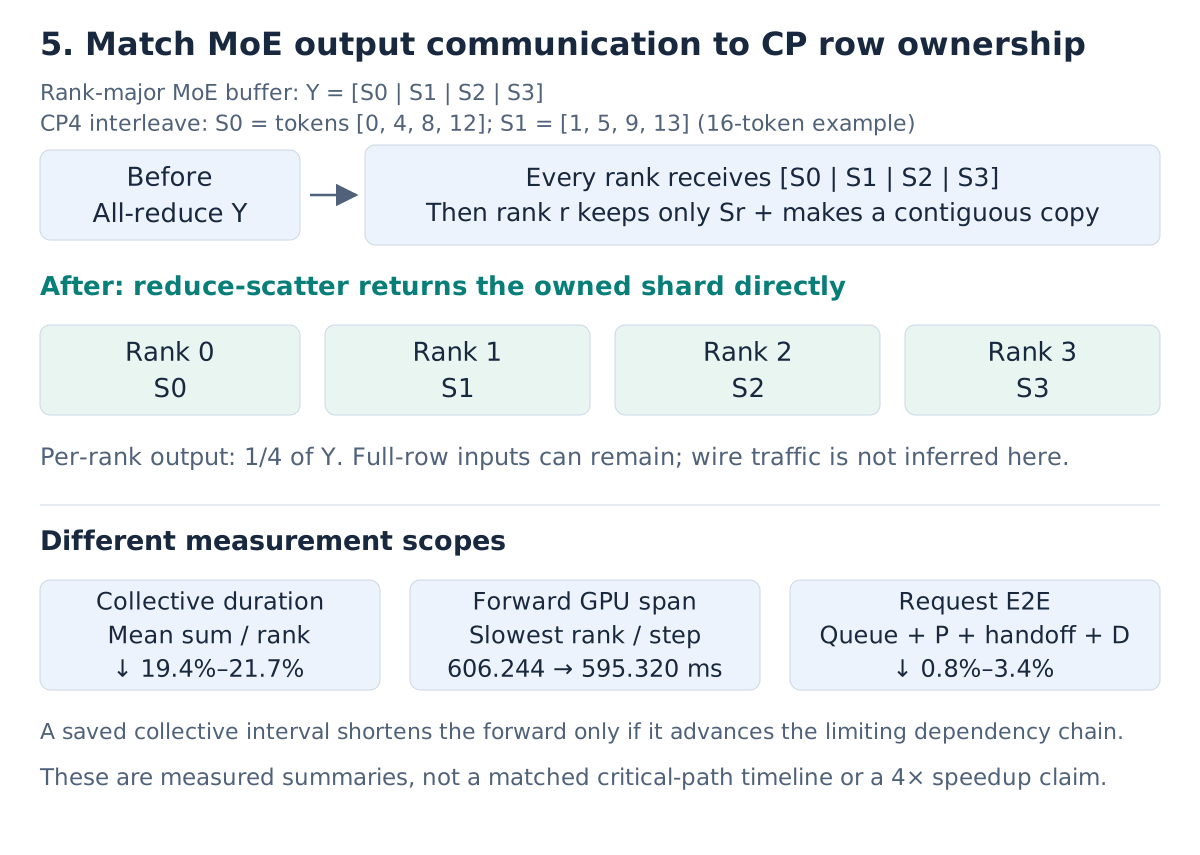
Figure 25. The change targets DeepSeek-V4.1’s cp_return_contiguous MoE branch with no MoE all-to-all backend. Each shard is contiguous within the packed, rank-major buffer; its original prompt positions can remain interleaved. The separate cp_return_contiguous=False branch already uses a reduce-scatter helper. That branch selection is distinct from the CLI option --cp-strategy interleave.
The gate requires CUDA/non-HIP tensors, matching TP/CP/group sizes, and a nonzero row count divisible by CP size. Other configurations retain the original fallback. The quarter-sized output at CP4 describes ownership, not a fourfold collective speedup.
In matched profiled steps with a BF16 input of shape [16240, 5120] and 40 MoE output collectives per rank, the summed communication-kernel durations were:
| Rank | All-reduce, sum of 40 calls (ms) | Reduce-scatter, sum of 40 calls (ms) | Reduction |
|---|---|---|---|
| 0 | 68.346 | 52.673 | 22.9% |
| 1 | 71.672 | 57.369 | 20.0% |
| 2 | 59.915 | 50.691 | 15.4% |
| 3 | 60.526 | 44.981 | 25.7% |
Across a separate set of nearby sampled steps—six baseline and seven optimized—the mean per-rank reduction was 19.4%–21.7%. Mean GPU forward duration, taking the slowest rank’s span for each step, decreased from 606.244 to 595.320 ms: 10.924 ms, or approximately 1.8%. These means and the matched collective totals above use different sample scopes.
The denominator already explains much of the apparent gap: as a simple illustration, cutting 20% from a stage that occupies one tenth of a forward reduces total time by only about 2%, even without overlap. This is scale intuition, rather than a measured decomposition of the forward’s critical path.
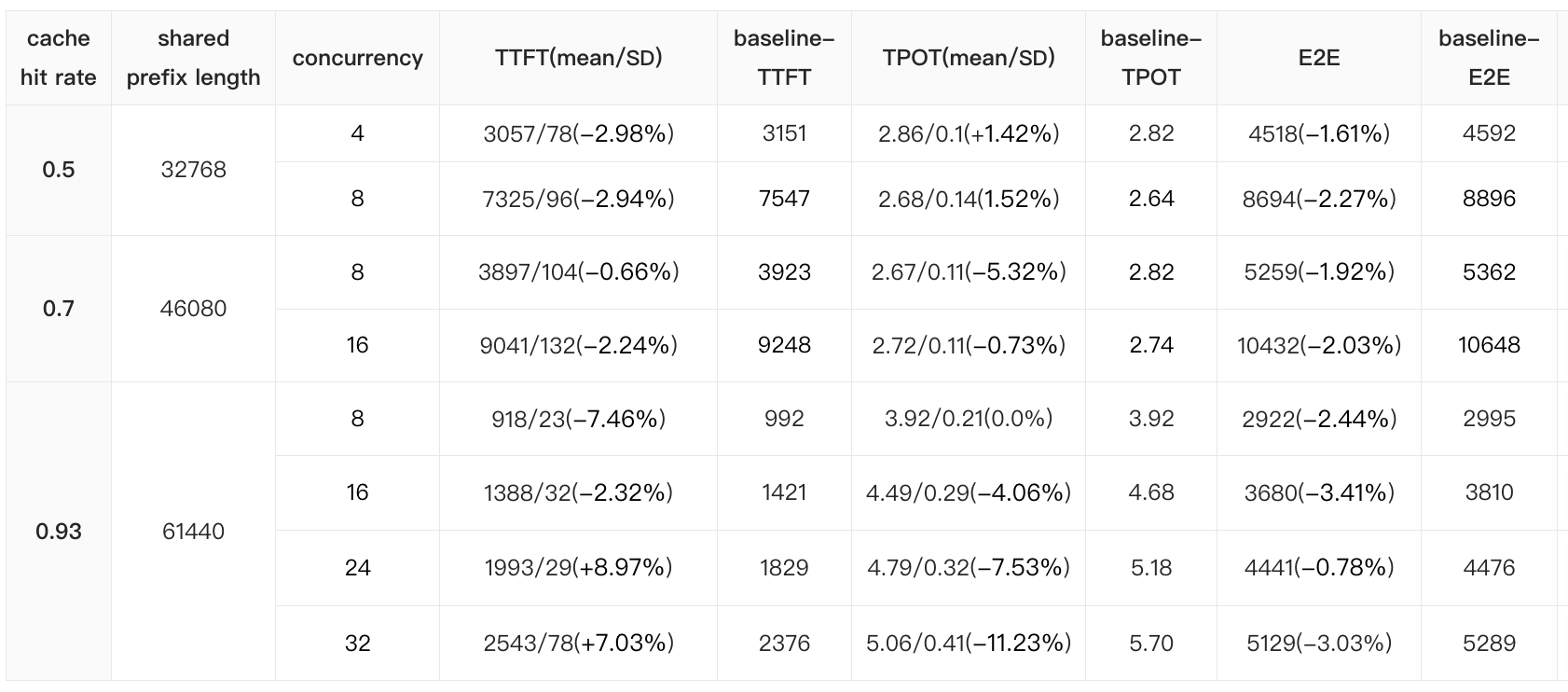
Figure 26. Serving benchmark for PR #47247, with the optimizations from Sections 1–4 already included in the baseline. Percentages discussed here are recalculated from the displayed absolute values.
These serving measurements were recorded separately from Section 4’s chunk-size comparison, and their baseline latencies differ from the results in Figure 23. The exact final runtime revisions for these runs are not pinned in this article, so the remaining numerical differences cannot be attributed to a specific runtime change here.
The serving table shows 0.8%–3.4% lower E2E latency. At the 90% label and concurrency 24, TPOT improves from 5.18 to 4.79 ms/token, but TTFT increases from 1,829 to 1,993 ms. E2E therefore improves by only 0.8%, from 4,476 to 4,441 ms.
The supplied full GSM8K evaluation for MoE reduce-scatter scores 96.59% on 1,319 single-shot examples, with no request errors or truncated outputs.
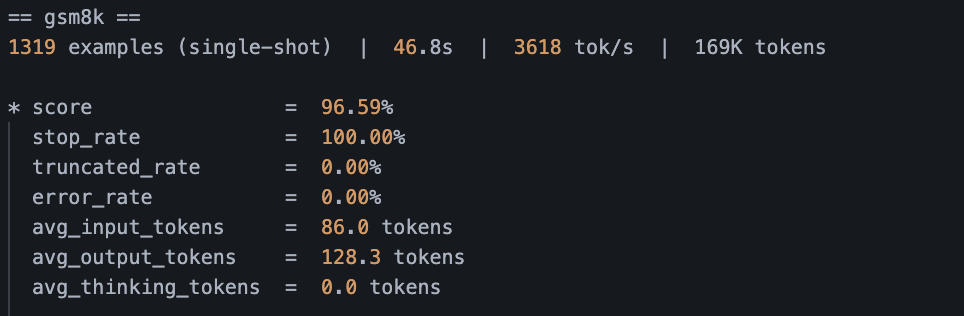
Figure 27. GSM8K evaluation with Section 5’s MoE reduce-scatter: 96.59% accuracy on 1,319 single-shot examples, with 0.00% error and truncated rates.
Launch settings: use the shared commands and configuration table for Section 5.
6. Enable Bounded Replay with CP and DSpark
Baseline and comparison. Both configurations start from commit d0a75654368a470d8484e3ea45b06e500fee57af, with the Indexer changes from PR #45794, PR #46003, and PR #45807 cherry-picked together. The baseline is the resulting Section 4 configuration, including its 16,384-token Prefill chunks. The optimized run additionally cherry-picks the CP and DSpark compatibility fix from PR #47406 and enables bounded replay on the Prefill worker.
DeepSeek-V4.1’s final compressed-KV source is layer 20. Once that layer has processed the full chunk, the long-range compressed KV and Indexer keys needed by layers 21–39 already exist. Those later layers reuse the shared history while producing their own window KV. This creates an opportunity to retain the shared long-range history and rebuild only the local state needed for generation.
The existing decoder-side bounded replay optimization processes the full prompt chunk through layers 0–20, then executes layers 21–39 on at most the last 128 tokens per request. Here 128 is the configured SWA window length, rather than the CP partition size or the Indexer top-k budget. The tail execution reconstructs each late layer’s window KV and retained hidden states, using the already-computed layer-20 history. The option is enabled on the Prefill worker, despite its decoder-side name.
This is an approximation at the tail boundary. A retained token near the start of the tail would normally attend to some local-window keys preceding that boundary, but those late-layer rows are not reconstructed. Its hidden state can therefore differ, and differences can propagate through later layers. Preserving compressed long-range history does not restore the omitted local-window computation or make the result equivalent to full Prefill. The speed/quality tradeoff belongs to bounded replay itself.
PR #47406 makes that existing optimization usable with eager CP and DSpark by fixing the compact-output layout. It does not introduce the bounded-tail algorithm or eliminate its boundary approximation.
With CP and DSpark auxiliary-state capture, the model returns compact tail outputs. The eager CP runner previously gathered them with the original full-chunk layout. For a single 16,384-token chunk at CP4, that layout expects 4,096 local rows; a 128-token tail supplies only 32 rows per rank. The output tensor and the gather metadata therefore describe different token sets.
For a single request with no cached prefix and zero-based prompt positions 0…16383, the retained tail maps as follows:
| Compact row after CP gathering | Original prompt position |
|---|---|
| 0 | 16,256 |
| 1 | 16,257 |
| 127 | 16,383 |
Thus compact rows 0…127 correspond to original positions 16256…16383. Both final hidden states and DSpark auxiliary hidden states must preserve this mapping: compact row 0 cannot be interpreted as prompt position 0. Before gathering, the 32 local rows on each CP rank follow that rank’s tail layout; their local row numbers are not global prompt positions. Cached-prefix offsets, multiple requests, and padding require explicit per-request/token mappings rather than a single batch-wide offset.
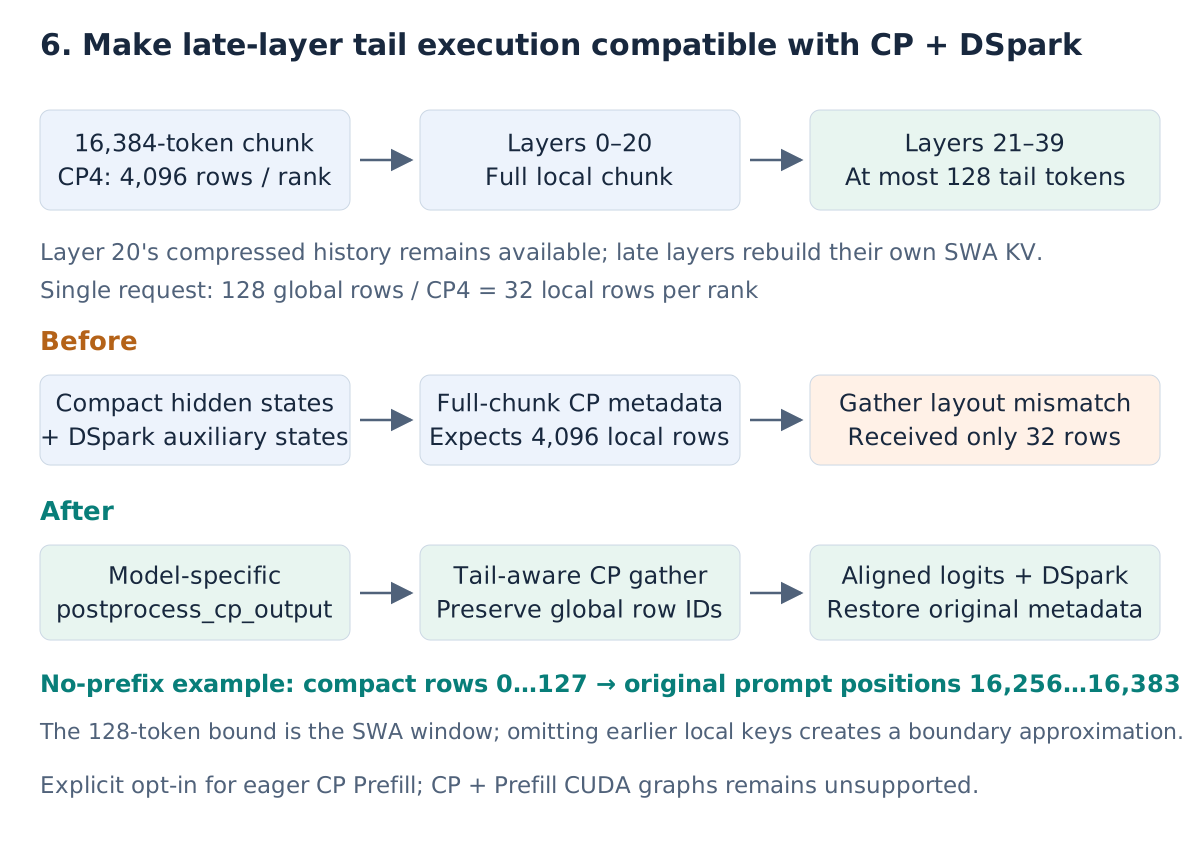
Figure 28. The compatibility fix preserves compact hidden states, DSpark auxiliary states, and their original global token indices. The illustrated 32-row local tail is a single-request example; mixed requests require their own tail metadata.
The patch adds a model-specific postprocess_cp_output hook. DeepSeek’s hook gathers hidden and auxiliary states using tail-specific CP metadata, aligns logits and DSpark consumers with the original global token indices, and restores the original batch metadata in a finally block. The ordinary forward path and the eager CP path share this output postprocessing.
This allows bounded replay to be explicitly enabled for eager CP Prefill. The default CP policy is unchanged, and the combination of CP, bounded replay, and Prefill CUDA graphs remains unsupported.
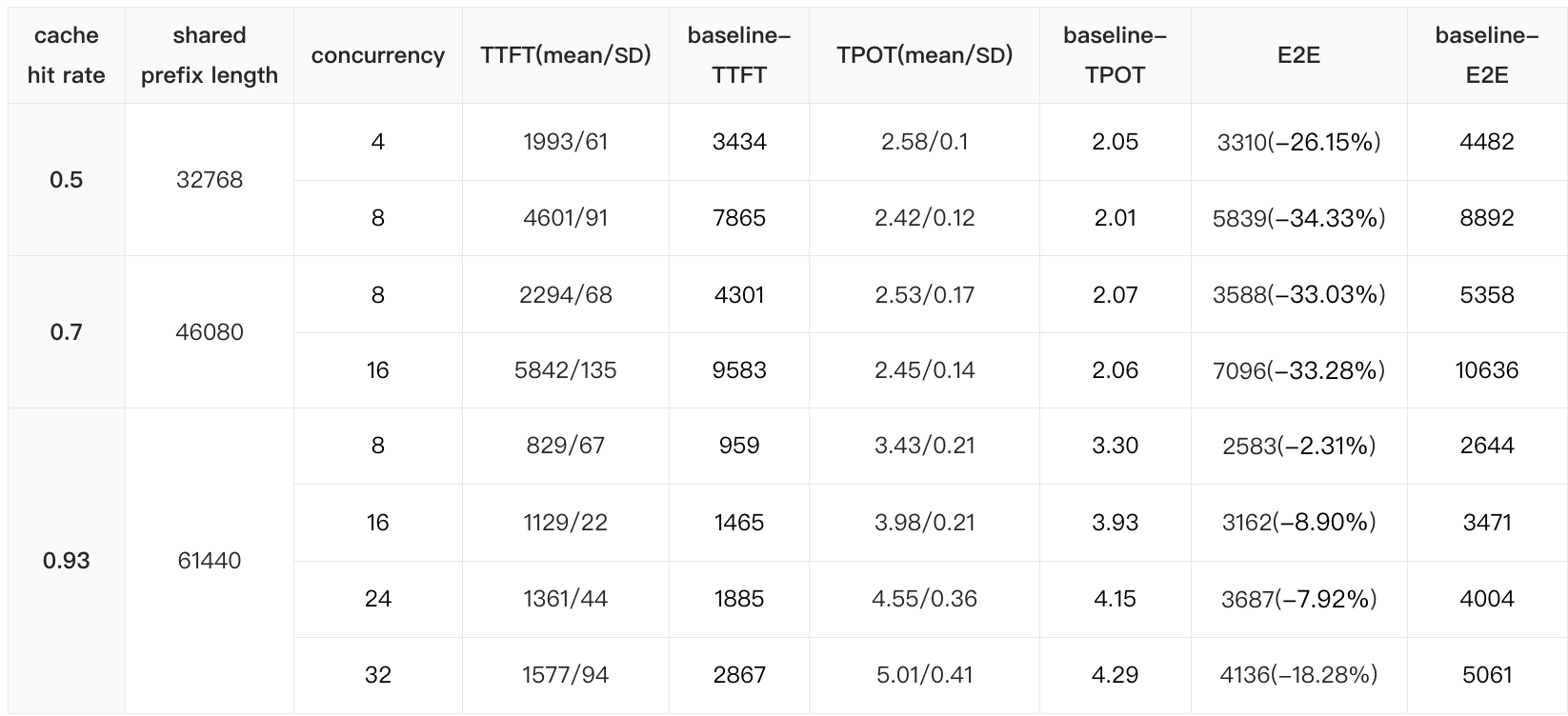
Figure 29. Serving benchmark for PR #47406. Its baseline is the resulting configuration from Section 4.
The reported TTFT reduction ranges from 13.6% to 46.7%. At the 70% label and concurrency 8, TTFT drops from 4,301 to 2,294 ms and E2E from 5,358 to 3,588 ms. The largest E2E reduction is 34.3%, at the 50% label and concurrency 8.
The table also records TPOT increasing from 2.07 to 2.53 ms/token in the 70%/concurrency-8 case. Prefill gains therefore do not imply faster token generation. The available measurements do not isolate the cause of this TPOT change.
The PR reports four-rank validation of token mappings and metadata restoration, nine full-model functional requests, and a 32-question GSM8K smoke test. The supplied full 1,319-question single-shot evaluation shown below scores 95.38%, with a 0.08% truncated-output rate and 0.00% request errors. The full GSM8K run extends the evidence beyond the original smoke test, but does not establish broad long-context accuracy parity for the boundary approximation described above.
SWA bounded replay is an approximate algorithm. We suspect that differences in numerical computation along this execution path contribute to the lower GSM8K score. This has not been confirmed by an otherwise matched replay-on/off accuracy comparison. The screenshot reports 86 input tokens on average, below the 128-token tail.
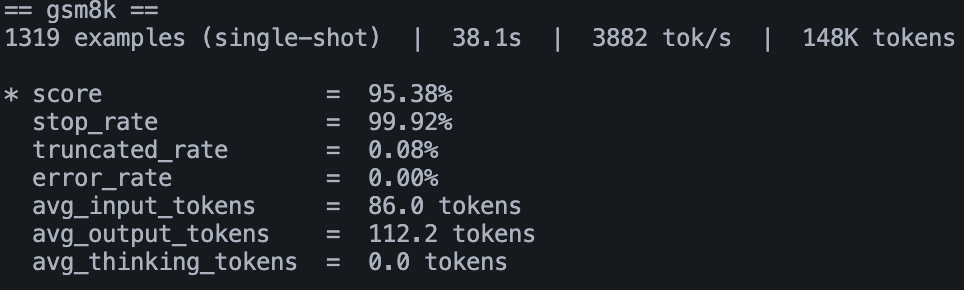
Figure 30. Full GSM8K evaluation for Section 6’s bounded-replay configuration: 95.38% accuracy on 1,319 single-shot examples, with a 0.08% truncated rate and 0.00% error rate.
Launch settings: use the shared commands and configuration table for Section 6.
Performance Results: Separate PR Comparisons from the Combined Configuration
The five PR comparisons in Sections 1–3, 5, and 6 act at different levels: tensor shape, candidate scoring domain, memory traffic, collective output ownership, and late-layer token extent. Sections 1–3 evaluate individual changes independently from the common starting revision. Section 4 combines the three Indexer changes before evaluating larger Prefill chunks. Sections 5 and 6 each evaluate an additional optimization on top of the changes from Sections 1–4; Section 5 reports separate baseline measurements, while Section 6 uses Section 4’s reported results. The chunk-size experiment is reported separately in Section 4 because it also involves configuration and graph-metadata work. The reported percentages use these distinct baselines and cannot be added to obtain a cumulative gain.
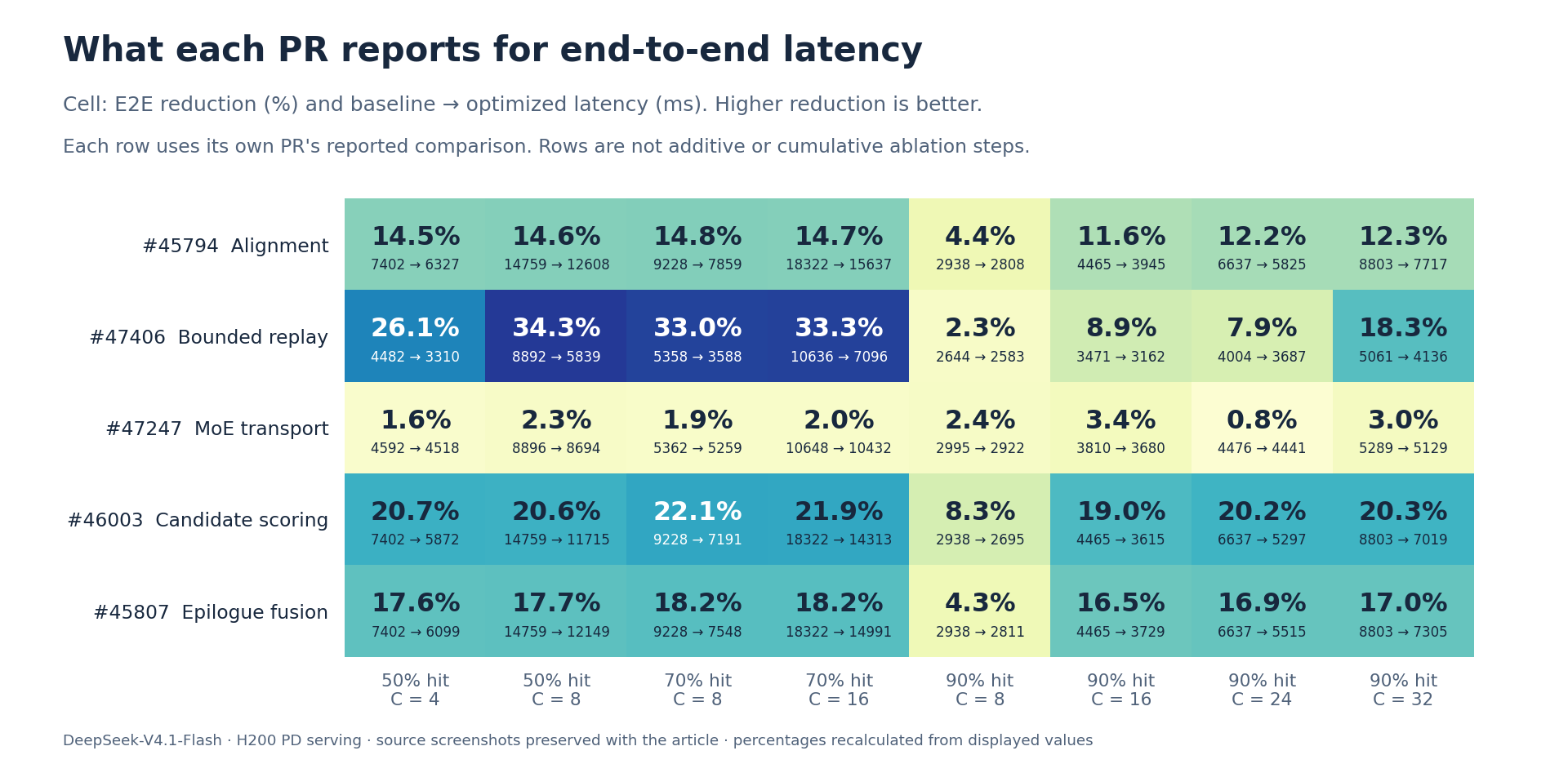
Figure 31. Redrawn from the five per-PR serving benchmark screenshots. Rows retain the order #45794, #47406, #47247, #46003, and #45807, corresponding to Sections 1, 6, 5, 2, and 3. Each cell shows the reduction and baseline → optimized three-run mean E2E latency in milliseconds. Sections 1–3 use independent comparisons from the common starting revision. The baselines for Sections 5 and 6 include the optimizations from Sections 1–4; Section 5 uses separately recorded measurements, while Section 6 uses Section 4’s reported results. The row percentages cannot be added or multiplied to infer a combined result.
The following table compares the original baseline shown in Figure 3, measured at commit d0a75654368a470d8484e3ea45b06e500fee57af, with the recorded combined serving configuration, showing three-run mean latencies without the corresponding SD values. The baseline has SWA bounded replay disabled and uses 8,192 for both --chunked-prefill-size and --max-prefill-tokens; the combined configuration enables bounded replay and uses 16,384-token chunks. These are configuration-level results, rather than an isolated measurement of any single runtime change.
| Cache-hit label / concurrency | TTFT, baseline → combined (ms) | TPOT, baseline → combined (ms/token) | E2E, baseline → combined (ms) | E2E reduction |
|---|---|---|---|---|
| 50% / 4 | 6,245 → 1,876 | 2.27 → 2.56 | 7,402 → 3,182 | 57.0% |
| 50% / 8 | 13,583 → 4,249 | 2.30 → 2.36 | 14,759 → 5,457 | 63.0% |
| 70% / 8 | 8,061 → 2,097 | 2.28 → 2.46 | 9,228 → 3,352 | 63.7% |
| 70% / 16 | 17,160 → 5,359 | 2.27 → 2.47 | 18,322 → 6,623 | 63.9% |
| 90% / 8 | 1,368 → 807 | 3.07 → 3.30 | 2,938 → 2,495 | 15.1% |
| 90% / 16 | 2,846 → 1,104 | 3.17 → 3.94 | 4,465 → 3,115 | 30.2% |
| 90% / 24 | 5,058 → 1,302 | 3.09 → 4.32 | 6,637 → 3,511 | 47.1% |
| 90% / 32 | 7,189 → 1,512 | 3.16 → 4.80 | 8,803 → 3,967 | 54.9% |
The highest E2E reduction is 63.9% at the 70% label and concurrency 16, with a baseline/combined latency ratio of 2.77 for that recorded case. The largest TTFT reduction is 79.0% at the 90% label and concurrency 32. These maxima occur in different cases. They do not establish a throughput increase or a joint tail-latency SLA.
TPOT is 2.6%–51.9% higher in all eight cases. At 90%/concurrency 32, it rises from 3.16 to 4.80 ms/token, even though TTFT falls from 7,189 to 1,512 ms. One possible explanation is that faster Prefill increases the number of requests simultaneously active on Decode; matched Decode running-batch metrics would be needed to test that hypothesis. DSpark tokens per verify step would help distinguish a change in speculative acceptance from a change in Decode load. Those matched measurements are not reported here, so the cause of the TPOT increase remains unresolved. The overall latency gain describes this input-heavy 64K-input/512-output workload and should be read together with the generation-side cost.
GSM8K Accuracy of the Combined Configuration
The supplied final combined configuration scores 95.38% on 1,319 single-shot GSM8K examples, compared with 96.74% in the baseline screenshot—an observed difference of 1.36 percentage points. The final run has 0.00% request errors and a 0.08% truncated-output rate. The cause of the lower score remains unconfirmed; Section 6 discusses our bounded-replay hypothesis and its limitations. These screenshots report GSM8K outcomes; they do not by themselves establish long-context quality parity or numerical equivalence.
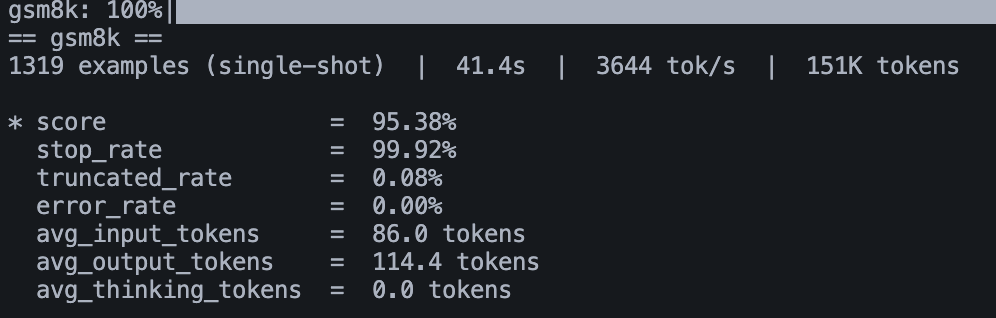
Figure 32. GSM8K evaluation with all optimizations combined: 95.38% accuracy on 1,319 single-shot examples. The baseline result is shown in Figure 4.
Reproduction
To reproduce the 1P1D experiments, start from the common development commit d0a75654368a470d8484e3ea45b06e500fee57af and apply the changes and settings listed at the beginning of the relevant section. Follow that section’s baseline and optimized configurations for each comparison.
Launch the Prefill and Decode servers, start the router, and run the accuracy and performance evaluations below. Use the shared model weights linked in Measurement Setup throughout. Record the exact SGLang revision and applied patches, model-weight revision, tokenizer version, and CUDA and dependency versions for each run.
Prefill and Decode Launch Commands
Assign four H200 GPUs to Prefill with TP4 / CP4 / EP4 and four to Decode with TP4 / DP4 / EP4. All configurations below use interleave CP and disabled Prefill CUDA graphs. Select the experiment’s code and settings as described in its section; this table consolidates the launch-parameter differences.
| Comparison | Prefill chunk size, baseline → optimized | Bounded replay on Prefill, baseline → optimized |
|---|---|---|
| Original baseline (Figure 3) | 8192 (baseline only) | off (baseline only) |
| Section 1: score-width alignment | 8192 → 8192 | off → off |
| Section 2: candidate-only scoring | 8192 → 8192 | off → off |
| Section 3: epilogue fusion | 8192 → 8192 | off → off |
| Figure 21: Sections 1–3 combined | 8192 → 8192 | off → off |
| Section 4: larger chunks | 8192 → 16384 | off → off |
| Section 5: MoE reduce-scatter | 16384 → 16384 | off → off |
| Section 6: bounded replay and CP/DSpark fix | 16384 → 16384 | off → on |
| Overall combined comparison | 8192 → 16384 | off → on |
Set CHUNK_SIZE to the required column. Keep BOUNDED_REPLAY_ARGS=() when bounded replay is off; set it to (--enable-decoder-swa-bounded-replay) when it is on. For the original baseline in Figure 3, use commit d0a75654368a470d8484e3ea45b06e500fee57af, CHUNK_SIZE=8192, and BOUNDED_REPLAY_ARGS=(). The shared Prefill command applies CHUNK_SIZE to both --chunked-prefill-size and --max-prefill-tokens. The bounded-replay flag is enabled on the Prefill worker despite its decoder-side name. Keep Prefill graphs disabled for this CP/bounded-replay recipe.
The server commands and benchmark script use /models/DeepSeek-V4.1-Flash/ for a local copy of the model weights linked in Measurement Setup. Update --model-path and MODEL_PATH together if your local directory differs.
Shared Prefill launch command
# Default: original baseline, Sections 1–3, Figure 21, or Section 4's 8K baseline.
CHUNK_SIZE=8192
BOUNDED_REPLAY_ARGS=()
# Set CHUNK_SIZE=16384 where required by the table.
# When bounded replay is on, also use:
# BOUNDED_REPLAY_ARGS=(--enable-decoder-swa-bounded-replay)

GLOO_SOCKET_IFNAME=bond0 NCCL_SOCKET_IFNAME=bond0 CUDA_VISIBLE_DEVICES=0,1,2,3 MC_TE_METRIC=1 MC_SLICE_SIZE=262144 MC_TE_METRIC_INTERVAL_SECONDS=1 MC_INTRA_NVLINK=true \
MC_INTRANODE_NVLINK=true SGLANG_MOONCAKE_CUSTOM_MEM_POOL=INTRA_NODE_NVLINK SGLANG_DISAGGREGATION_ALL_CP_RANKS_TRANSFER=1 SGLANG_HUMMING_INPUT_QUANT_CONFIG='{"dtype": "float8e4m3"}' \
sglang serve --trust-remote-code --language-model-only --model-path /models/DeepSeek-V4.1-Flash/ --tp 4 --ep 4 --enable-prefill-cp --cp-strategy interleave \
--cuda-graph-backend-prefill disabled --moe-runner-backend humming --moe-a2a-backend none --nnodes 1 --node-rank 0 --disaggregation-mode prefill \
--dist-init-addr 127.0.0.1:5557 --disaggregation-transfer-backend mooncake --speculative-algorithm DSPARK --max-running-requests 256 \
--chunked-prefill-size "${CHUNK_SIZE}" --max-prefill-tokens "${CHUNK_SIZE}" --swa-full-tokens-ratio 0.05 --mem-fraction-static 0.85 --detokenizer-worker-num 8 \
--tokenizer-worker-num 8 "${BOUNDED_REPLAY_ARGS[@]}" --host 127.0.0.1 --port 30011
Shared Decode launch command (run in a separate terminal)
GLOO_SOCKET_IFNAME=bond0 NCCL_SOCKET_IFNAME=bond0 CUDA_VISIBLE_DEVICES=4,5,6,7 MC_TE_METRIC=1 MC_SLICE_SIZE=262144 MC_TE_METRIC_INTERVAL_SECONDS=1 MC_INTRA_NVLINK=true \
MC_INTRANODE_NVLINK=true SGLANG_MOONCAKE_CUSTOM_MEM_POOL=INTRA_NODE_NVLINK SGLANG_DISAGGREGATION_ALL_CP_RANKS_TRANSFER=1 SGLANG_HUMMING_INPUT_QUANT_CONFIG='{"dtype": "float8e4m3"}' \
SGLANG_ENABLE_DSV41_ENGRAM_HOST_TABLE=1 SGLANG_DSV41_ENGRAM_HOST_TABLE_LAYOUT=per_rank \
sglang serve --trust-remote-code --language-model-only --model-path /models/DeepSeek-V4.1-Flash/ --tp 4 --dp 4 --ep 4 --enable-dp-attention --enable-dp-lm-head \
--moe-runner-backend humming --moe-a2a-backend none --disaggregation-mode decode --cuda-graph-max-bs-decode 256 --disaggregation-transfer-backend mooncake \
--speculative-algorithm DSPARK --max-running-requests 384 --swa-full-tokens-ratio 0.05 --mem-fraction-static 0.85 --detokenizer-worker-num 8 --tokenizer-worker-num 8 \
--host 127.0.0.1 --dist-init-addr 127.0.0.1:5757 --port 30012
Router Launch Command
Start the router after both workers are ready, using their respective Prefill and Decode endpoints. Send the accuracy and performance requests through the router so that they exercise the complete PD serving path. Keep the router configuration fixed within each baseline/optimized comparison.
python -m sglang_router.launch_router \
    --pd-disaggregation \
    --prefill-policy round_robin \
    --decode-policy round_robin \
    --prefill http://127.0.0.1:30011 8761 \
    --decode http://127.0.0.1:30012 \
    --host 127.0.0.1 \
    --disable-circuit-breaker \
    --port 8009
Accuracy Evaluation Script
Run GSM8K through the router endpoint. Use the evaluation configuration and sample count associated with the result being reproduced, and keep the prompt format and generation settings consistent across baseline and optimized runs. Record accuracy, request errors, and truncated outputs.
sgl-eval run gsm8k --base-url http://127.0.0.1:8009/v1 --num-threads 64 --max-tokens 2048
Performance Benchmark Script
The script below invokes the benchmark three times for each cache-hit and concurrency case for the selected server configuration, with 512 requests and 10 warmup requests in each run. Send the workload through the router and keep the input data, model weights, generation settings, and streaming configuration fixed when isolating an optimization. Retain each run’s TTFT-mean, TPOT-mean, E2E-mean, and successful and failed request counts. After the three runs, aggregate each metric’s three per-run means with statistics.mean() and statistics.stdev() (sample SD, equivalent to ddof=1), using the screenshots’ mean/SD format where both statistics are reported. The script runs the benchmarks; aggregation of their results is a separate step. Apply the same protocol to both the baseline and optimized configurations.
MODEL_PATH="/models/DeepSeek-V4.1-Flash"
DATASET_PATH="/dataset/ShareGPT_V3_unfiltered_cleaned_split.json"

HOST="127.0.0.1"
PORT="8009"
BACKEND="sglang"

SYS_INPUT_LENS=(61440 46080 32768)
QUE_INPUT_LENS=(4096 19456 32768)
OUTPUT_LENS=(512)
NUM_PROMPTS=512

for i in "${!SYS_INPUT_LENS[@]}"; do
  sys_input_len=${SYS_INPUT_LENS[$i]}
  que_input_len=${QUE_INPUT_LENS[$i]}

  if [[ $i -eq 0 ]]; then
    CONCURRENCY_LIST=(8 16 24 32)
  elif [[ $i -eq 1 ]]; then
    CONCURRENCY_LIST=(8 16)
  else
    CONCURRENCY_LIST=(4 8)
  fi

  for osl in "${OUTPUT_LENS[@]}"; do
    for concurrency in "${CONCURRENCY_LIST[@]}"; do

      for ((iii=1; iii<=3; iii++)); do
        python3 -m sglang.bench_serving \
          --model "${MODEL_PATH}" \
          --host "${HOST}" \
          --port "${PORT}" \
          --backend "${BACKEND}" \
          --dataset-path "${DATASET_PATH}" \
          --num-prompts "${NUM_PROMPTS}" \
          --dataset-name generated-shared-prefix \
          --gsp-num-groups 1 \
          --gsp-prompts-per-group "${NUM_PROMPTS}" \
          --flush-cache \
          --gsp-system-prompt-len "${sys_input_len}"  \
          --gsp-question-len "${que_input_len}"  \
          --gsp-output-len "${osl}" \
          --max-concurrency "${concurrency}" \
          --warmup-requests 10
      done
    done
  done
done
Appendix: Evidence and PR Links
The common starting development commit is d0a75654368a470d8484e3ea45b06e500fee57af. Sections 1–3 evaluate their changes independently from this revision. Section 4 starts from this revision with the changes from Sections 1–3 cherry-picked together. Sections 5 and 6 each build on the optimizations from Sections 1–4, adding MoE output reduce-scatter and bounded replay, respectively. Section 5’s baseline measurements are reported separately; Section 6 uses Section 4’s reported results as its baseline.
As of November 10, 2026, the foundational PR #40323 and all six PRs discussed here (#45794, #46003, #45807, #47247, #46777, and #47406) are merged. The commit ID 2d93fbfe5115131dd443dcbccde4426270119d6b on the main branch already includes all the above-mentioned PRs. The inspected revisions below pin the implementations used for the explanations; they are not a complete benchmark revision manifest and can precede a PR’s final head: