MiniMax-H3 on 8×H200: 1.95× Lossless, Up to 6.24× at 0.76–0.91 SSIM
TL;DR
We benchmarked MiniMax-H3 video generation on 8× NVIDIA H200 with SGLang Diffusion, holding prompts, seeds, resolution, frame rate, and denoising steps fixed across six workloads.
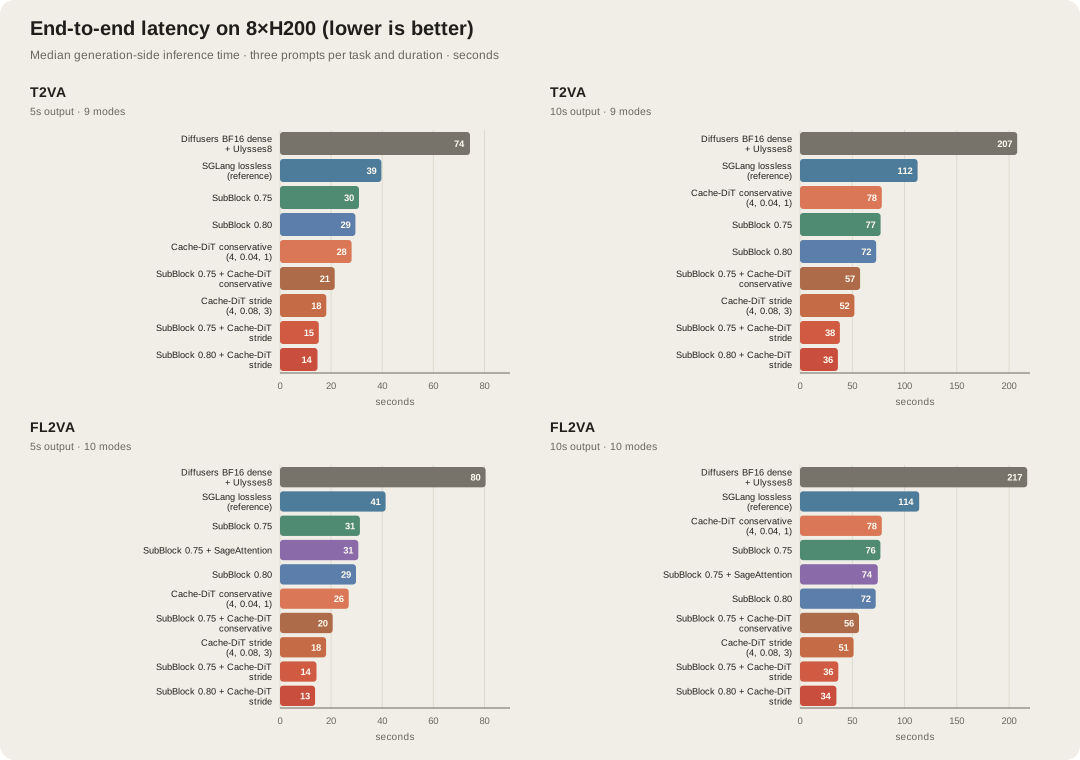
- SGLang's dense, lossless path is 1.85–1.95× faster than Diffusers with no approximation: the same denoising work, on a faster runtime.
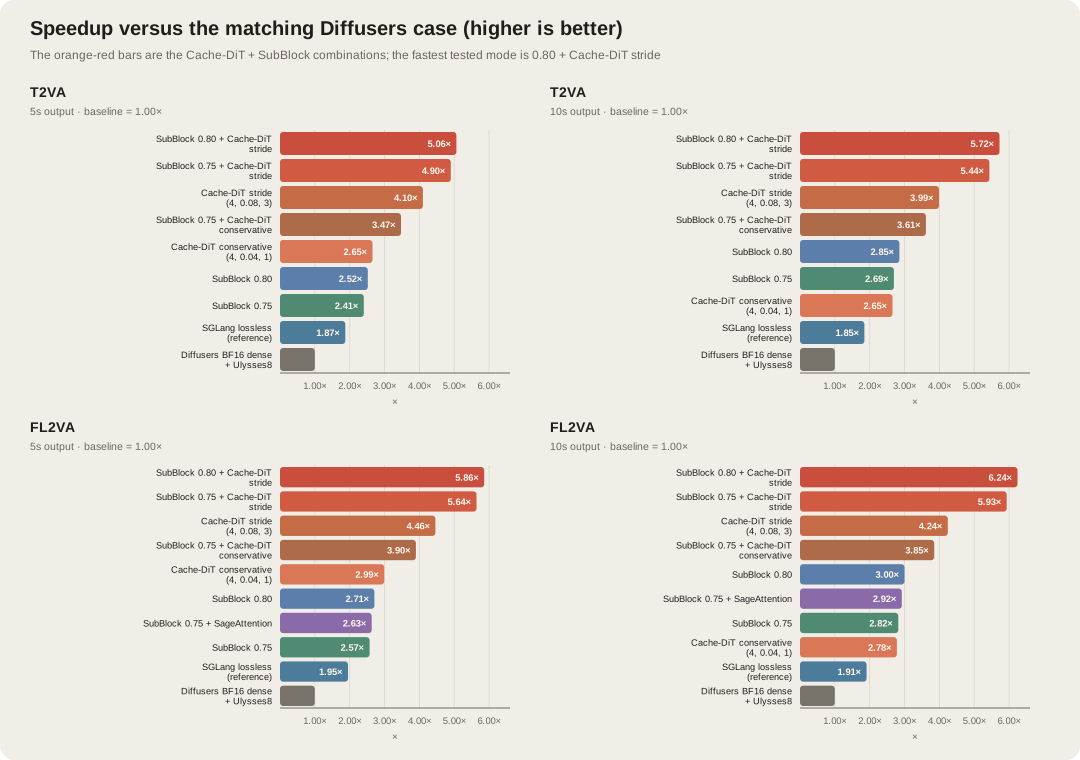
- Stacking step reuse and sparse attention reaches up to 6.24×, at 0.76–0.91 mean SSIM. The fastest tested profile, SubBlock 0.80 + Cache-DiT stride, delivers 5.06×/5.72× on 5 s/10 s T2VA and 5.86×/6.24× on FL2VA. The cost is not uniform: FL2VA holds 0.85–0.91 SSIM there, while T2VA drops to 0.76–0.78.
- For a quality-first default, use Cache-DiT alone (up to 2.99×, mean SSIM 0.90–0.92). For a balanced trade-off, SubBlock 0.75 + Cache-DiT stride gives 4.90–5.93× at SSIM 0.79–0.90.
- The gains come from three layers that compose: fused kernels (2.00–12.16× on individual non-GEMM sites in isolation — microbenchmarks, not additive end-to-end), step reuse (Cache-DiT skips redundant denoising steps), and SubBlock sparse attention (NVIDIA's block-sparse forward, which cuts the cost of the steps that do run).
Scope. This comparison covers three of SGLang Diffusion's acceleration knobs. It supports more lossy paths that are not part of this run — quantization and progressive resolution among them — so the numbers here are a slice of the available envelope, not its ceiling. Everything below is measured, not projected; the clips at the end let you judge the quality cost yourself.
| Hardware | 8× NVIDIA H200 (141 GB) |
| Workload | MiniMax-H3 · 1344×768 · 24 FPS · 50 denoising steps · 5 s and 10 s outputs |
| Parallelism | All modes use 8 GPUs; Diffusers uses CP8, and SGLang uses SP/Ulysses degree 8 |
| Version | SGLang v0.5.18 (d90318b3e2) |
| Measured | 2026-08-18 |
Background
While SGLang Diffusion already delivers a fast lossless path for MiniMax-H3, faster lossy generation of high-quality video has long been sought after by the community. Building on its long-standing stack of versatile knobs for lossy acceleration, SGLang Diffusion has been actively working on this over the past weeks; this post is the first measured account of where those knobs land.
Video diffusion is dominated by two costs: the denoising loop runs the same transformer dozens of times, and each step spends most of its budget in attention over a very long token sequence. A 5-second 1344×768 clip at 24 FPS with 50 denoising steps is far past the point where a single GPU is practical, so the question is not whether to parallelize but how much of the remaining work can be avoided.
Three accelerations attack that from different directions, and they compose:
- Fused kernels cut the fixed cost of every step without changing its math.
- Cache-DiT reuses results between denoising steps, so some steps never run.
- SubBlock sparse attention reduces the cost of the steps that do run, by skipping attention blocks whose contribution is below a threshold.
The first is lossless. The other two trade similarity against speed, which is why every number in this post is reported with SSIM against the lossless baseline.
At a Glance
The answer depends on the baseline. Against the matched Diffusers case, SGLang's dense, lossless path is already about 2× faster for both tasks and both durations. Cache-DiT reuses work between denoising steps, while SubBlock sparse attention reduces the cost of the steps that still run. Together they form the fastest path in this matrix.
For a quality-first accelerated default, use Cache-DiT conservative or Cache-DiT stride without SubBlock. For a balanced speed/quality trade-off, use SubBlock 0.75 + Cache-DiT stride, delivering 4.90–5.64× speedup at 5 s and 5.44–5.93× at 10 s.
The charts below summarize the aggregate benchmark tables.
Detailed Results
Every configuration in this post is reproducible with the SGLang cookbook page for MiniMax-H3, which carries the exact launch flags for each mode.
We report generation-side inference time; server startup, warmup, HTTP polling, and MP4 download time are excluded. For each task and duration, latency and SSIM are evaluated across three distinct prompts. Speedup is measured against the matching Diffusers case. SSIM is computed over all frames in YUV420 against the matching SGLang lossless video.
T2VA
| Mode | 5 s median / speedup | 10 s median / speedup | 5 s mean SSIM | 10 s mean SSIM |
|---|---|---|---|---|
| Diffusers | 74.34 s / 1.00× | 207.71 s / 1.00× | — | — |
| SGLang lossless | 39.67 s / 1.87× | 112.44 s / 1.85× | 1.0000 | 1.0000 |
| Cache-DiT conservative | 28.02 s / 2.65× | 78.28 s / 2.65× | 0.8986 | 0.9179 |
| SubBlock 0.75 | 30.90 s / 2.41× | 77.12 s / 2.69× | 0.8006 | 0.8301 |
| SubBlock 0.75 + Cache-DiT conservative | 21.41 s / 3.47× | 57.48 s / 3.61× | 0.7936 | 0.8288 |
| Cache-DiT stride | 18.13 s / 4.10× | 52.07 s / 3.99× | 0.8037 | 0.8078 |
| SubBlock 0.75 + Cache-DiT stride | 15.16 s / 4.90× | 38.21 s / 5.44× | 0.7713 | 0.7834 |
| SubBlock 0.80 | 29.49 s / 2.52× | 72.85 s / 2.85× | 0.7858 | 0.8193 |
| SubBlock 0.80 + Cache-DiT stride | 14.68 s / 5.06× | 36.29 s / 5.72× | 0.7584 | 0.7765 |
FL2VA
| Mode | 5 s median / speedup | 10 s median / speedup | 5 s mean SSIM | 10 s mean SSIM |
|---|---|---|---|---|
| Diffusers | 80.44 s / 1.00× | 217.31 s / 1.00× | — | — |
| SGLang lossless | 41.31 s / 1.95× | 114.02 s / 1.91× | 1.0000 | 1.0000 |
| Cache-DiT conservative | 26.90 s / 2.99× | 78.24 s / 2.78× | 0.9389 | 0.9771 |
| SubBlock 0.75 | 31.27 s / 2.57× | 76.95 s / 2.82× | 0.8946 | 0.9385 |
| SubBlock 0.75 + Cache-DiT conservative | 20.64 s / 3.90× | 56.39 s / 3.85× | 0.8924 | 0.9414 |
| SubBlock 0.75 + SageAttention | 30.64 s / 2.63× | 74.42 s / 2.92× | 0.8827 | 0.9219 |
| Cache-DiT stride | 18.02 s / 4.46× | 51.31 s / 4.24× | 0.8903 | 0.9248 |
| SubBlock 0.75 + Cache-DiT stride | 14.27 s / 5.64× | 36.62 s / 5.93× | 0.8629 | 0.9202 |
| SubBlock 0.80 | 29.74 s / 2.71× | 72.44 s / 3.00× | 0.8837 | 0.9350 |
| SubBlock 0.80 + Cache-DiT stride | 13.73 s / 5.86× | 34.80 s / 6.24× | 0.8498 | 0.9144 |
Key takeaways
- SGLang's dense path is the first easy win. It delivers a 1.85–1.95× speedup over Diffusers across both tasks and durations, with the workload held constant.
- SubBlock 0.75 + Cache-DiT stride is the balanced profile. It maintains good output quality while delivering 4.90–5.64× speedup at 5 seconds and 5.44–5.93× at 10 seconds.
- Stride caching adds the largest throughput gain. It reaches 3.99–4.46× on its own, compared with 2.65–2.99× for the conservative profile.
- FL2VA benefits slightly more from cache + sparse combinations. The fastest FL2VA case reaches 5.86×/6.24×, versus 5.06×/5.72× for T2VA.
- The speed–quality trade-off is clear. Conservative Cache-DiT retains 0.8986–0.9771 SSIM; the aggressive 0.80 + stride profile gives up some of that margin for the lowest latency.
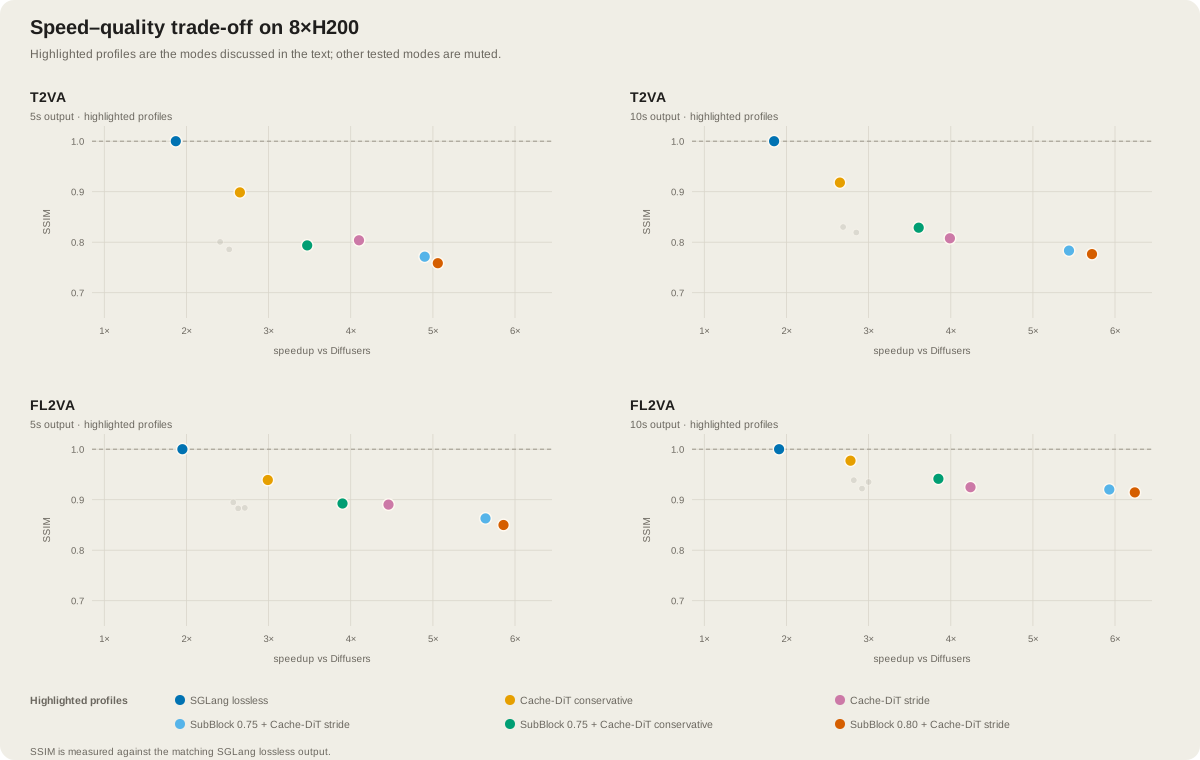
Where the Speedup Comes From
Three mechanisms drive the profile-level gains.
Fused kernels reduce the cost of each step that still runs. The H3 path fuses indexed AdaLN updates, gated residuals, SwiGLU activation, and QK RMSNorm with 3D RoPE, reducing intermediate tensors, memory traffic, and kernel launches. The next section reports these isolated kernel measurements; they are part of the per-step implementation, while Cache-DiT and SubBlock determine how much of that implementation is executed.
Cache-DiT attaches one DBCache context to MiniMax-H3's shared DiT block
stack. After the warmup steps, it evaluates the configured boundary blocks and
compares the normalized residual change with the previous cached state. If the
change stays below the threshold and the consecutive-cache limit allows it, the
middle blocks reuse their cached result; otherwise the stack is recomputed and
the cache is refreshed. All cache modes use Fn=1, Bn=0, and four warmup
steps:
- conservative: shared packed-stack RDT
0.04, maximum consecutive cached steps1; - stride: shared packed-stack RDT
0.08, maximum consecutive cached steps3.
MiniMax-H3 has one MiniMaxH3DiTModel whose block stack carries packed video
and audio tokens. Cache-DiT therefore makes one shared decision for the whole
packed stack; it does not maintain independent video and audio caches. The
worker records one combined Cache-DiT step list, and the trace legend follows
that execution model.
SubBlock sparse attention reduces the KV blocks read on computed steps. It
uses n_k=n_q=4; the first ten denoising steps use dense attention, and SubBlock
is enabled afterward. The minimum sequence length is 4096. The matrix tests
sparsity 0.75 and 0.80; the latter is faster but has lower SSIM on several
T2VA cases.
The aggregate profile results show how the profiles behave end to end; they do not isolate kernel time or provide a per-step cost breakdown. The trace below is a request-level execution trace, not an operator timing measurement.
One measured 49-step trace
The workload is configured with 50 inference steps. Because the sigma schedule
includes both interval endpoints, the denoising loop performs 49 model
evaluations (len(sigmas) - 1); “49-step trace” refers to these model
evaluations.
To make the execution pattern concrete, one 5-second T2VA request was run for
six profiles: lossless, Cache-DiT conservative,
SubBlock 0.75, SubBlock 0.75 + conservative Cache-DiT, Cache-DiT stride, and
SubBlock 0.80 + stride. The worker recorded the actual cached_steps list for
each request. Because video and audio tokens share one packed H3 block stack,
a cache hit reuses the combined output; there is no separate “video cached,
audio computed” state in this path. Blue cells in the SubBlock rows mark
computed steps that use sparse attention after the first ten denoising steps.
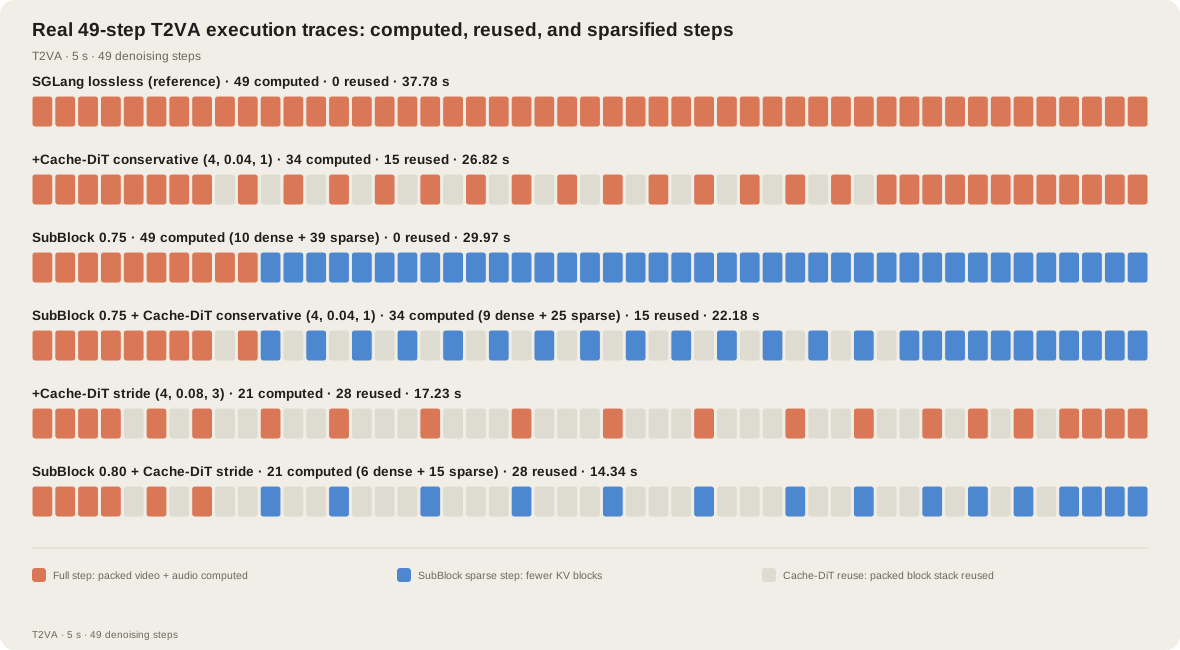 The trace-run timings are 37.78 s (lossless), 26.82 s (Cache-DiT conservative),
29.97 s (SubBlock 0.75), 22.18 s (SubBlock 0.75 + conservative Cache-DiT),
17.23 s (Cache-DiT stride), and 14.34 s (SubBlock 0.80 + stride). These numbers
identify the trace run; they do not replace the three-prompt aggregate medians.
The trace-run timings are 37.78 s (lossless), 26.82 s (Cache-DiT conservative),
29.97 s (SubBlock 0.75), 22.18 s (SubBlock 0.75 + conservative Cache-DiT),
17.23 s (Cache-DiT stride), and 14.34 s (SubBlock 0.80 + stride). These numbers
identify the trace run; they do not replace the three-prompt aggregate medians.
The Kernel Layer
Caching determines how many denoising steps run; kernels determine how fast
each computed step is. MiniMax-H3 packs video and audio tokens into one
sequence, so the non-GEMM path benefits from the same basic principle
throughout: less memory traffic, fewer intermediate tensors, and fewer kernel
launches. AdaLN modulation and gated residuals look up parameters by token
index and update the activation in one pass. SwiGLU operates directly on the
fused gate_up buffer. QK RMSNorm and 3D RoPE are fused into a single kernel
instead of running as separate eager operations.
The table below uses the real per-rank shape for a 5-second T2VA request at 1344×768×124 frames: 4,722 rows after SP/Ulysses-8 padding, hidden size 5,376, 56 attention heads, head dimension 128, RoPE dimension 96, and BF16 inputs. Each number is the median per-call CUDA-event time across 10 rounds of 20 calls. The baseline is the corresponding eager composition.
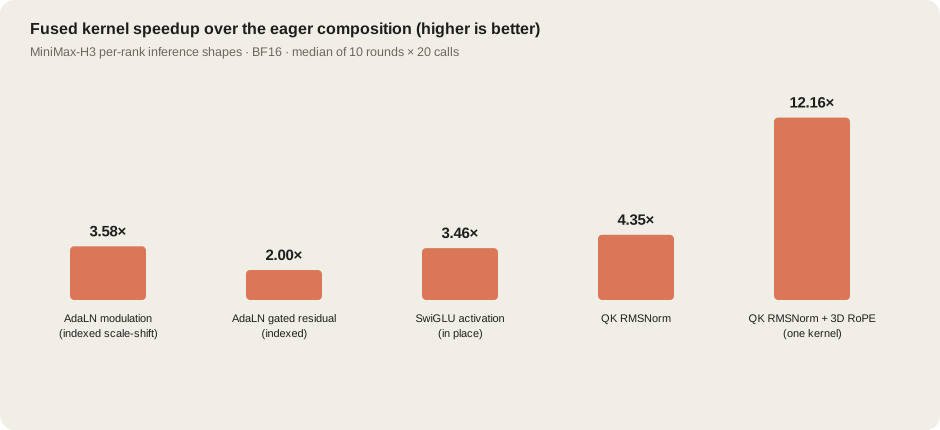
| Operator | Eager composition | SGLang kernel | Speedup |
|---|---|---|---|
| AdaLN modulation (indexed scale-shift) | 136.7 μs | 38.2 μs | 3.58× |
| AdaLN gated residual (indexed) | 93.2 μs | 46.6 μs | 2.00× |
| SwiGLU activation (in place) | 364.5 μs | 105.2 μs | 3.46× |
| QK RMSNorm | 334.0 μs | 76.9 μs | 4.35× |
| QK RMSNorm + 3D RoPE, one kernel | 1335.6 μs | 109.8 μs | 12.16× |
These are microbenchmarks of the isolated sites, not additive end-to-end
latency savings. The fused QK-Norm + RoPE result uses the exact-rounding path
available on main (round_norm_before_rope=True).
How SubBlock Sparse Attention Works
SubBlock is a training-free router for block-sparse attention. It divides the
sequence into 64-token query and key blocks, then splits each block into four
16-token sub-blocks on both sides (n_q=n_k=4). A lightweight pooling and
log-sum-exp score estimates each key block's unnormalized softmax mass for each
query block and head. The router keeps the highest-scoring key
blocks and passes their indices to the block-sparse attention kernel; the full
attention matrix is never materialized.
The sparsity value is the fraction of key blocks allowed to be dropped, not
the fraction retained. Thus sparsity=0.75 keeps roughly 25% of key blocks per
query block. The more aggressive 0.80 setting is faster but has a larger
approximation error budget, which is consistent with the lower SSIM observed
in the most aggressive rows.
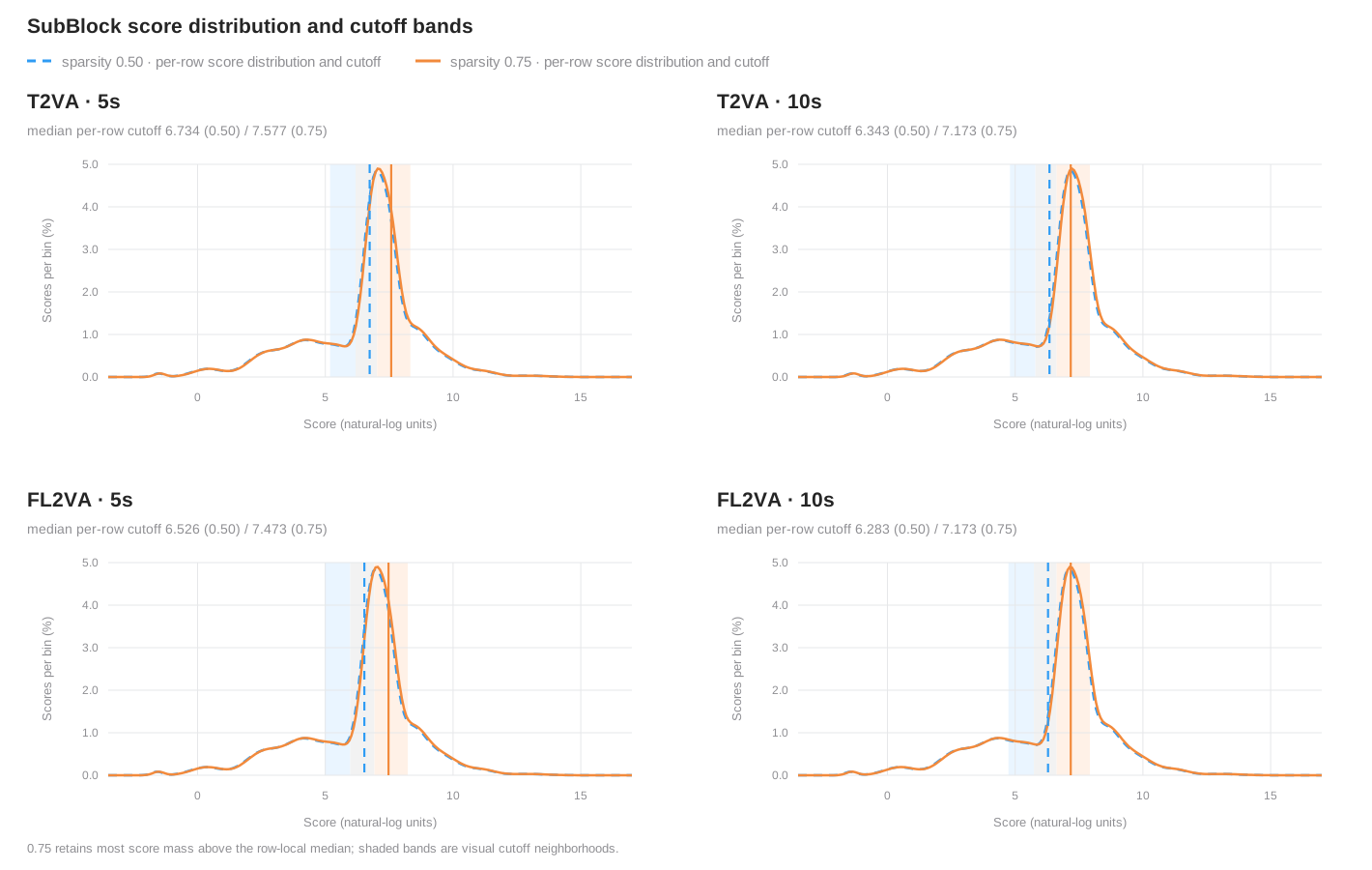
The curves below show the score distributions; the vertical lines show the
medians of the per-row routing cutoffs for the two displayed budgets. Here,
sparsity=0.50 is included as a diagnostic reference; the benchmark profiles
use 0.75 and 0.80. Because the router ranks key blocks independently for
each query block and head, sparsity=0.50 and 0.75 retain roughly the top
half and top quarter of that row's available key blocks, subject to 8-block
budget rounding. Across these workloads, the 0.75 budget retains most of the
score mass above the row-local median while concentrating selection on the
high-score tail.
 The sparse path is enabled only for the long, non-causal DiT attention calls
that the kernel supports: BF16 inputs, head dimension 128, and sequences of at
least 4096 tokens. The first ten denoising steps use dense attention; short
segments, the token refiner, and unsupported calls use the dense fallback. On
H200/SM90, the selected 64×64 routing plan is executed by SGLang's CuTe
block-sparse FlashAttention kernel.
The sparse path is enabled only for the long, non-causal DiT attention calls
that the kernel supports: BF16 inputs, head dimension 128, and sequences of at
least 4096 tokens. The first ten denoising steps use dense attention; short
segments, the token refiner, and unsupported calls use the dense fallback. On
H200/SM90, the selected 64×64 routing plan is executed by SGLang's CuTe
block-sparse FlashAttention kernel.
Demos
The demo set contains four modes for each selected prompt:
- Prompt 1 · T2VA · 5 s · three cats carrying brass instruments and playing beside a sleeping owner;
- Prompt 2 · T2VA · 10 s · a rainy cyberpunk city at night;
- Prompt 3 · FL2VA · 5 s · a clay fox continuation.
The four modes are SGLang lossless, Cache-DiT conservative, SubBlock 0.75 + Cache-DiT stride, and SubBlock 0.80 + Cache-DiT stride. Filenames encode the prompt, task, mode, and duration; the SVG figures are in the same folder.
Prompt 1 · T2VA · 5 s
Prompt 2 · T2VA · 10 s
Prompt 3 · FL2VA · 5 s
Prompt 1 · full prompt
integrated_multimodal_description: [Shot 1] Live-action, whimsical cinematic, a medium-wide shot frames a dim bedroom at night where the owner sleeps under the covers. A bedroom door opens and three cats enter in single file, each carrying a tiny brass instrument. The camera tracks sideways with small amplitude at slow speed as the cats march beside the bed and play a short, lively diegetic brass tune in synchrony; the sleeping owner shifts slightly but does not wake. The cats finish with one crisp flourish, pivot together, and abruptly file back out through the doorway, with the last cat's tail disappearing from frame. No character speaks and no human voice is heard.

overall_soundscape: Quiet nighttime room tone, the owner's steady breathing, soft pawsteps on the floor, a faint door creak, and light bedding rustle as the procession passes.

non_diegetic_music: N/A
Prompt 2 · full prompt
integrated_multimodal_description: [Shot 1] Live-action, cinematic, a wide establishing shot frames a futuristic cyberpunk city at night as rain falls across dense towers, elevated transit lines, and a crowded street lined with vivid neon light. The camera pushes forward with small amplitude at slow speed above the wet pavement while pedestrians in reflective coats pass beneath transparent umbrellas, a compact hovering vehicle glides through the intersection, and saturated magenta, cyan, and amber reflections ripple across puddles. Steam drifts from a street vent and briefly catches the neon glow as the vehicle recedes between the towers. No dialogue or voiceover is heard.

overall_soundscape: Steady rainfall, distant traffic, the low hum of elevated transit, electrical buzzing from signs, soft footsteps through shallow water, and a brief rush of air as the hovering vehicle passes.

non_diegetic_music: A slow electronic pulse with deep analog bass, sparse metallic percussion, and sustained synthesizer tones that gradually increase in volume before fading.
Prompt 3 · full prompt
For the target video, at 0.00 seconds into the target video, <Picture 1> is fully referenced.

integrated_multimodal_description:
[Shot 1] A handcrafted stop-motion clay animation begins from <Picture 1>. A small orange clay fox with large expressive eyes trots along a mossy path through a warm, richly detailed miniature forest. The camera tracks the fox smoothly at eye level while layered clay trees and shrubs create gentle parallax. The fox looks curiously toward the camera, slows near the middle of the path, flicks its tail, then continues toward the small wooden cabin in the distance. Preserve the exact clay textures, warm amber lighting, forest layout, fox proportions, and family-friendly whimsical tone established by <Picture 1>. Motion remains coherent and physically plausible for stop-motion animation.

overall_soundscape:
Soft clay footsteps, rustling leaves, distant birds, and a light forest breeze accompany the fox's movement.

non_diegetic_music:
A gentle playful score with pizzicato strings, wooden percussion, and soft flute.
Acknowledgement
This benchmark is the result of work by several teams, and we are grateful to all of them.
- SGLang Diffusion Team — wrote the first version of this post, drives the SGLang kernel work these results build on, and provides the diffusion runtime, the fused kernels, and the parallelism measured here.
- Ji Huang (@IPostYellow), Ant Group — ran the H200 benchmark, brought SubBlock sparse attention into SGLang Diffusion, and revised this post.
- Cache-DiT Team — @DefTruth and the vipshop.com team, for Cache-DiT and for support integrating its cache profiles into SGLang Diffusion.
- MiniMax — for open-sourcing MiniMax-H3, the model every measurement here runs on.
- NVIDIA — for the underlying SubBlock sparse attention support, including the block-sparse attention forward these results depend on.
Measured 2026-08-18 on 8× NVIDIA H200. Reproduction details and the raw per-prompt numbers are in the benchmark repository.