SGLang and Miles Add Day‑0 Support for Kimi K3
On this page
- Bringing up Kimi K3
- Hybrid KDA Memory Management
- Safe and efficient state reuse
- Unified memory: one pool for both kinds of state
- Speculative decoding with DSpark
- Verify only what is worth verifying
- ReplaySSM: raw-input replay for the KDA state
- Kernels
- Parallelizing K3
- Prefill: chunked pipeline parallelism
- Decode: context parallelism
- Combining all strategies together
- RL: LoRA Training on the Native MXFP4 Base
- LoRA serving and weight sync
- Parallelism
- Memory
- Validation
- Training result
- Acknowledgments
We are excited to announce Day-0 support for Kimi K3 in SGLang and Miles. K3 is the first open-source model in the 3-trillion-parameter class, and its hybrid architecture departs from convention in almost every place a serving stack has assumptions. In collaboration with the Moonshot AI and NVIDIA teams, the two cover K3 in full on launch day: SGLang for inference, Miles for RL training. This post covers what it took.
Highlights
- A new hybrid architecture. 2.8T parameters, 69 KDA linear-attention layers interleaved with 24 MLA, LatentMoE, and Attention Residuals; most of a serving stack’s assumptions break somewhere.
- Memory management for two kinds of state, including a recurrent state that overwrites itself in place, with prefix caching, overlap scheduling and paging rebuilt on top, and a unified pool design that removes the last sizing guess.
- A kernel ladder reaching ~113 tok/s at batch 1, before speculation.
- DSpark speculative decoding, with a draft model we trained for K3: batch-1 decode reaches ~423 tok/s. ReplaySSM handles the KDA state, replaying raw inputs instead of snapshotting per step, a roughly 32x cut in draft-window memory.
- Parallelism split by phase: chunked pipeline-parallel prefill and tensor-parallel decode, composing under PD disaggregation to 2,808 tok/s per GPU.
- LoRA RL with Miles on the native MXFP4 checkpoint, colocated trainer and rollout on the same GPUs: AIME-2024 43.3% to 76.7% over a 12-hour run.
Launch commands and per-workload configuration guidance live in the Kimi K3 cookbook.
Bringing up Kimi K3
Kimi K3 is the first open-source model in the 3-trillion-parameter class: 2.8T parameters, a 1M-token context window, and native visual understanding. Its predecessor K2.5 was architecturally a close relative of models SGLang already served well, so most of the stack simply applied. K3 is not like that — it departs from convention in several independent places at once:
| Kimi K2.5 | Kimi K3 | |
|---|---|---|
| Scale | ~1T parameters | 2.8T parameters |
| Attention | all-MLA, 61 layers | hybrid: 69 KDA linear attention + 24 MLA, 93 layers |
| Attention Residuals | none | every attention output banked, aggregated per block |
| MoE | 384 experts, top-8 | LatentMoE: 896 experts, top-16, run in a 3584-dim latent space |
| Expert activation | SwiGLU | SiTU |
| Vision tower | MoonViT | MoonViT3d, a new K3-specific stack |
Each of these rows is a serving problem. The hybrid attention stack is what makes the 1M context affordable, but it means the server holds two kinds of state at once: one fixed-size KDA state per request next to MLA’s per-token KV — the memory-management sections below are about exactly this. Attention Residuals thread a bank of attention outputs through the whole stack, which breaks the assumptions SGLang’s standard layer plumbing makes and forced K3-specific paths in places like DP attention. LatentMoE routes 16 of 896 experts inside a down-projected latent space with the SiTU activation instead of SwiGLU, so no existing MoE kernel applied out of the box. And the vision path — tower, projector, processor, and Kimi’s XTML media format — was brought up from scratch. The sections below all build on this bring-up.
Hybrid KDA Memory Management
K3’s hybrid KDA and MLA architecture creates two memory management challenges. The first is making prefix caching safe and efficient for mutable KDA recurrent state. The second is dynamically sharing capacity between KDA state and MLA KV.
Safe and efficient state reuse
Attention KV is append-only. Once computed, it never changes, so the scheduler can safely share cached prefixes across requests in the radix tree. KDA state is different. Each layer maintains a fixed-size recurrent buffer that is overwritten in place at every token, so prefix caching must manage mutable state rather than immutable KV.
In SGLang, we use three explicit state moves between the radix tree and a request’s working slot to cache and reuse mutable KDA state safely. Copy-on-write restores a shared checkpoint into a private slot before the forward mutates it. Snapshot captures the advanced state, and donate transfers that snapshot to the tree.

The three state moves. Copy-on-write, snapshot, and donate, and where each one sits relative to the serial forward stream.
The design is race-free by construction. Restore and snapshot copies are enqueued on the forward stream between the operations that produce and consume the state, so stream ordering prevents races with in-place updates. Snapshots alternate between the two slots of the ping-pong extra buffer, so the next snapshot cannot overwrite state being attached to the tree. Donate transfers only a slot index and copies no state. The second slot is allocated lazily at a boundary and released immediately afterward, avoiding a permanent slot per request. This requires neither device-wide synchronization nor a lock on the hot path.
Checkpoint placement determines the cache hit rate. A recurrent state cannot run backwards and must be replayed forward from an earlier checkpoint. We take checkpoints only at aligned radix tree nodes, at chunk boundaries during prefill and at a fixed token interval during decode, and keep a sparse set under a per-path cap and LRU. Inspired by Marconi, we prioritize branching points because their prefixes are shared by all child branches. When a request diverges mid-edge, it replays from the nearest checkpoint above and plants one at the aligned fork, allowing later branches to restore there directly.

Checkpoints on the radix tree. The sparse checkpoint overlay and the branching point.
Race-free state movement and branch-aware checkpoint placement provide high-reuse KDA prefix caching that composes cleanly with the overlap scheduler, speculative decoding, and paged KV.
Unified memory: one pool for both kinds of state
Everything above manages each kind of state inside its own pool, and the pools themselves are the one guess left in the design. The two allocation units are three orders of magnitude apart: one large KDA state block per request (about 54 MB under TP=8, covering all 69 KDA layers) and one small MLA KV block per token (about 27 KB, covering all 24 MLA layers), so today they live in two separate pools, sized at startup. That sizing is a bet on the traffic, and when the bet is off the server runs out of memory in one pool while the other still has room to spare.
Unified memory replaces the two pools with one: KDA states fill in from one end, MLA KV blocks from the other, and the unused bytes between them form a single free region.
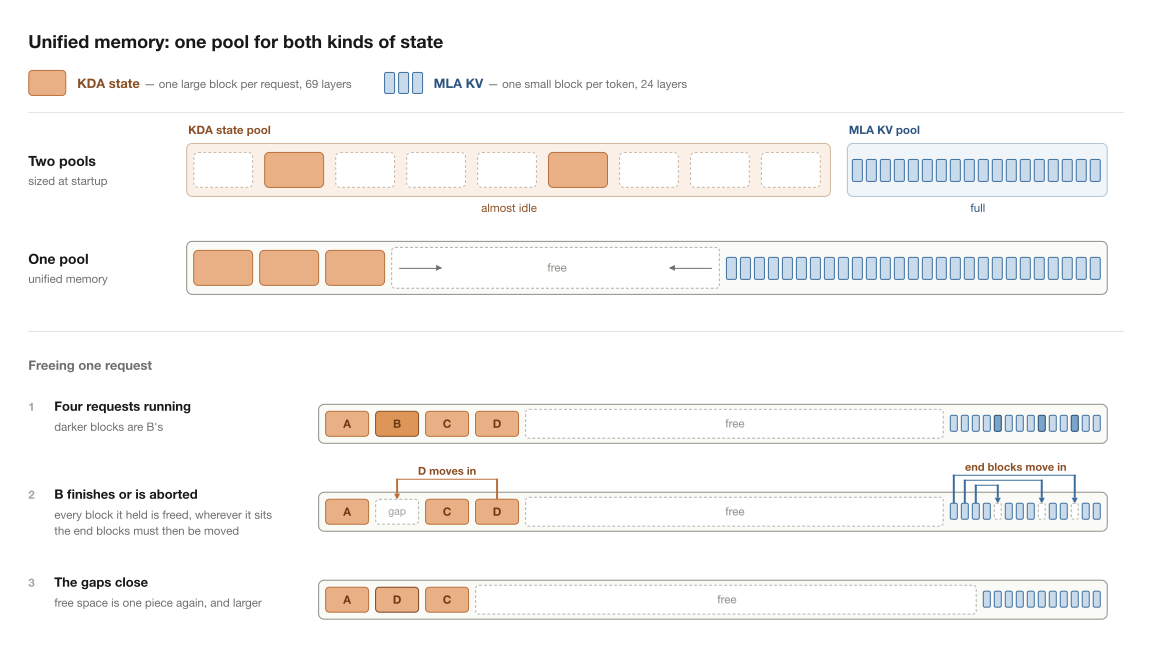
Unified memory. Top: today the two kinds of state have separate pools, sized at startup, so one can sit idle while the other is full. Middle: with unified memory both kinds allocate from the same pool, growing in from opposite ends with a single free region between them. Bottom: freeing a state block in the middle leaves a gap, and a block from the end is moved into it so the free region stays in one piece.
Freeing is just as simple. When a request finishes, is aborted, or is retracted under pressure, its blocks are released. If that leaves a gap in the middle, a block from the end is moved into it so the free region stays in one piece.
This layout gives us flexible page sizes and no memory fragmentation: a 54 MB KDA state block and a 27 KB MLA KV block draw from the same bytes with no common page size forced on them, and the moves above keep each end packed at a negligible cost for state movement, so the free space is always one contiguous region usable by either kind. Capacity therefore follows the workload rather than a startup flag: many short requests fill the pool with state blocks, a few long contexts fill it with KV, and neither case needs anything reconfigured.
Unified memory ships opt-in behind --enable-unified-memory. A follow-up post will go through the
implementation in detail.
Speculative decoding with DSpark
K3 ships with DSpark block speculative decoding, driven by a draft model we trained for K3. Two parts of the integration deserve their own story: spending the verification budget only where it pays, and making K3’s recurrent KDA state survive speculation at all.
Verify only what is worth verifying
DSpark proposes a block of draft tokens per step, and the target verifies the whole block in one forward. At batch size 1 the extra verify positions are essentially free: the step is latency-bound, and a few more tokens ride along. As the batch fills, that stops being true. Verify tokens now compete with every other request for the same step time, and most of them lose their bet anyway: on a chat workload the accept length is around 2.7, so five of the eight verified positions on a typical step get rejected. Verifying everything pays full price for tokens the server then throws away.
The pieces to fix this were already in the system. The draft carries a trained confidence head that predicts, per position, how likely each token is to survive verification. On the other side, a one-time profile of the server records what an extra verify token actually costs at each load level. A per-step planner joins the two: each request keeps verify tokens only while their expected value covers the marginal cost, and the rest of the window is trimmed before the target forward launches. What remains is verified exactly as before, so outputs stay lossless. The trade is a slightly shorter accepted run for a cheaper step.
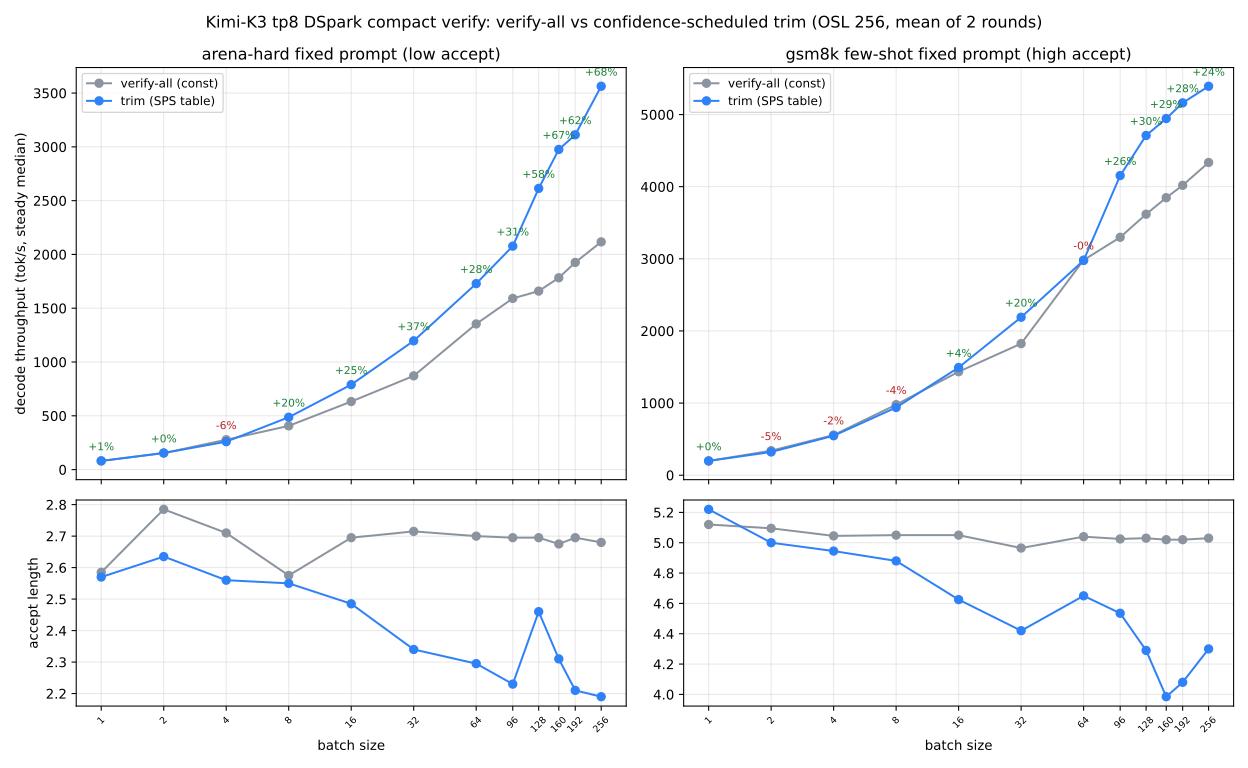
Trimming wins under load. Decode throughput, verify-all vs trim, on a chat panel (accept ~2.7, left) and a few-shot math panel (accept ~5.0, right). Break-even through bs 8, then the gap opens with batch size: +68% and +24% at bs 256, with accept length easing from 2.7 to 2.2 and from 5.0 to 4.3 while throughput climbs.
The measured cost curve turned out to be the interesting part. The marginal cost of a verify token is not smooth. It is a staircase: flat shelves where another token slots into the current kernel waves for almost nothing, and steep risers where it starts a new one. The planner reads this surface. When a request’s next tokens sit on a cheap shelf it keeps them; when they would start a riser it cuts there. In the data this shows up as small wiggles in the accept-length curve while throughput stays smooth and monotone: the planner is surfing real hardware shelves, not noise.
Below batch size 8 there is little pressure to relieve, so trimming is break-even to mildly negative there; a small-batch early-exit in the planner is the known follow-up.
ReplaySSM: raw-input replay for the KDA state
Speculative decoding verifies γ+1 draft tokens at once and may accept only a prefix, so the state has to be rewindable. A KDA layer’s state overwrites itself every token, so the baseline snapshots the whole K×V state after every draft step, 64 KB per request, layer and head at K=V=128, times γ+1 steps. Across K3’s 69 KDA layers that scratch is reserved per running request, so it competes with the persistent state pool and caps concurrency.
ReplaySSM keeps each draft step’s raw inputs Sᵢ = (vᵢ, kᵢ, gkᵢ, βᵢ) instead, about 1 KB, written by the verify kernel on its way through. Once the sampler fixes the accepted length, one fold kernel covering every layer and head replays just the accepted prefix from the committed checkpoint and advances it in place. The fold is a verbatim clone of the verify recurrence and consumes the gate values the verify kernel stored rather than recomputing them, so the rebuilt state is bit-identical to what the recurrent baseline would have committed.
- Memory: the draft window goes from 512 KB to 16 KB, roughly 32×. Handing that memory back to the state pool lifts the concurrency ceiling several-fold.
- Speed: the verify kernel no longer writes a snapshot per step, which cuts its memory access, and the replay is one fused launch for all layers and heads, so per-step time improves even at small batch sizes.
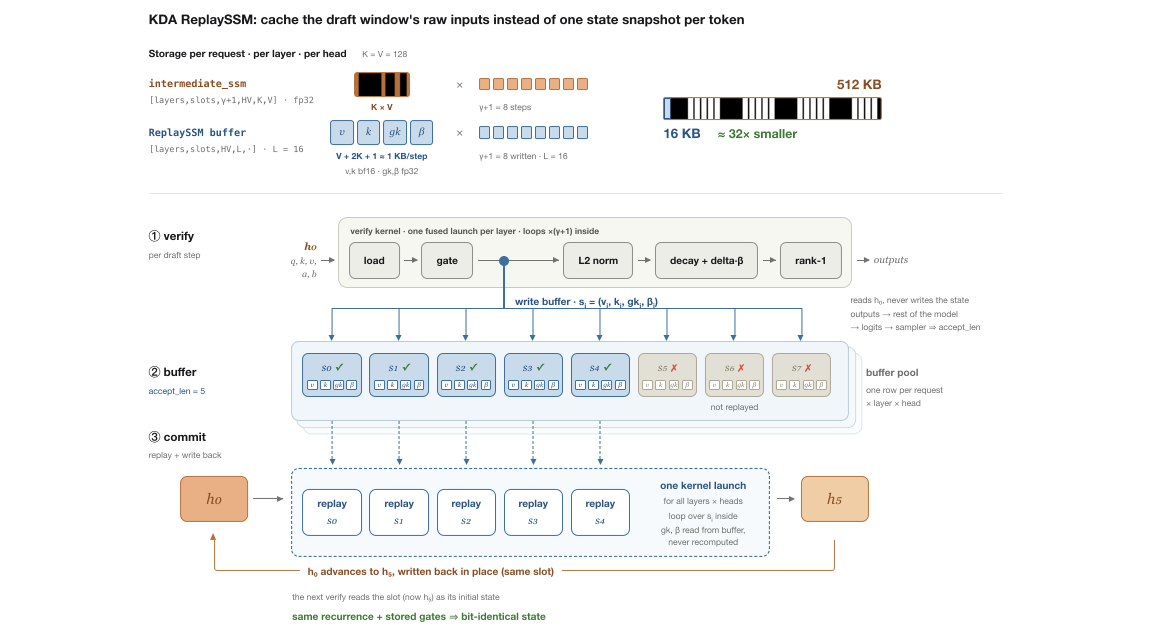
KDA ReplaySSM. Verify reads the checkpoint h₀ without writing it and stores each draft step’s raw inputs into a per-slot buffer, one per layer and head. The fold kernel then replays only the accepted prefix and overwrites the slot in place.
Kernels
A single-sequence decode step on a 2.8T hybrid model is not compute-bound — it is a launch-count and latency problem: 93 attention layers (69 KDA + 24 MLA) plus 92 latent-MoE layers per token, and at bring-up the step fired hundreds of tiny kernels. The campaign was profile-driven: fuse one thing, A/B it on the fixed protocol, gate on GSM8K, repeat.
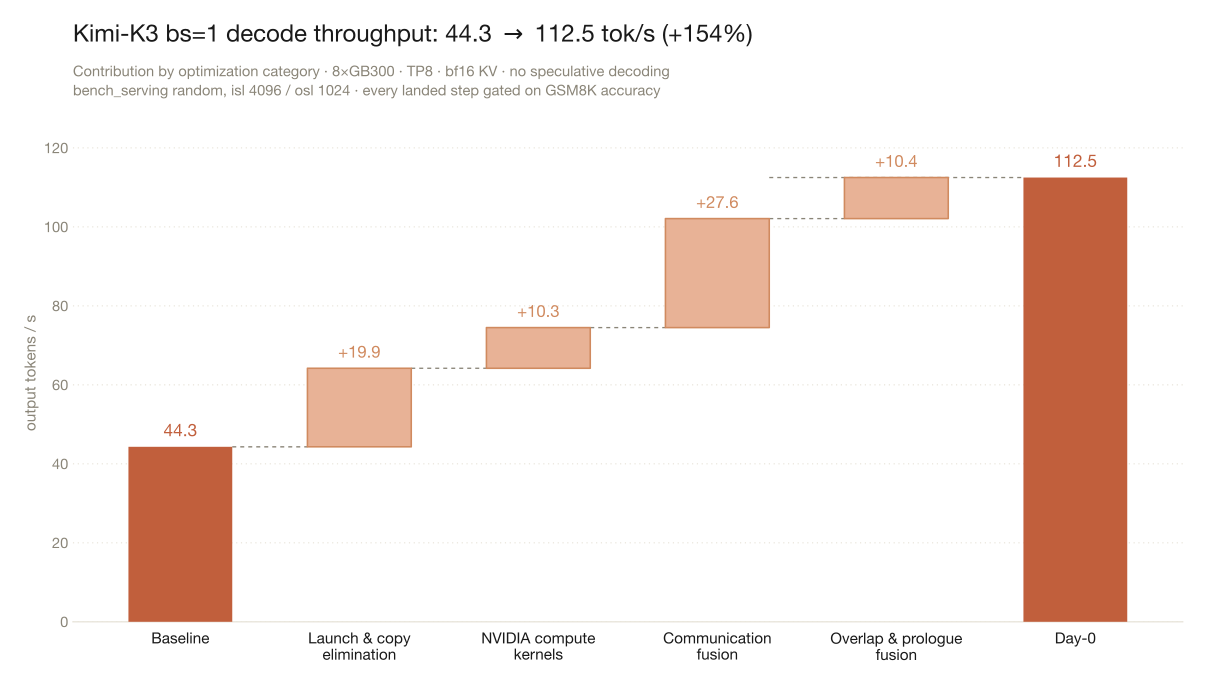
Launch & copy elimination (P1–P4, +19.9 tok/s). Make the step smaller, not the kernels faster: the MoE front collapses into one GEMM and KDA’s paired skinny projections merge (P1); a profile-guided sweep removes per-layer upcasts, copies and spare launches (P2, P3); routing becomes a one-pass register-resident radix select over the [M, 896] logits (P4).
NVIDIA compute kernels (P5–P8, +10.3 tok/s). Four stages swap in kernels co-developed with or provided by NVIDIA where the default was wrong for the bs=1 shape: the fused KDA decode kernel, the trtllm-gen W4A8 SiTU MoE cubins behind our routing bypass, the TMA attention-residual aggregation, and the CuTe-DSL TGV bf16 GEMMs that replace cuBLAS at small M — each through the same A/B and accuracy gate as everything else.
Communication fusion (P9, P12, P13, +27.6 tok/s). The largest era: a fused all-reduce family for the MNNVL fabric on CustomAllReduceV2’s symmetric-memory plane — one-shot multicast stores for small messages, NVLS in-switch reduction for large ones, with the residual add and RMSNorm riding inside the collective (P9). The MoE finalize then moves into the collective’s staging pass (P12), and the up-projection flips from a replicated to a column-parallel GEMM completed by a multicast all-gather (P13).
Overlap & prologue fusion (P10, P11, P14, P15, +10.4 tok/s). The rest trims the remaining critical chain: a strided-input MXFP8 quant (P10), residual write-back fused into upstream kernel tails with independent branches on a side stream (P11), KDA’s GEMV chain overlapped with the qkvg GEMM (P14), and the MLA decode prologue fused into one kernel with PDL arming the attention kernel behind it (P15).
The chronological ladder behind the four bars:
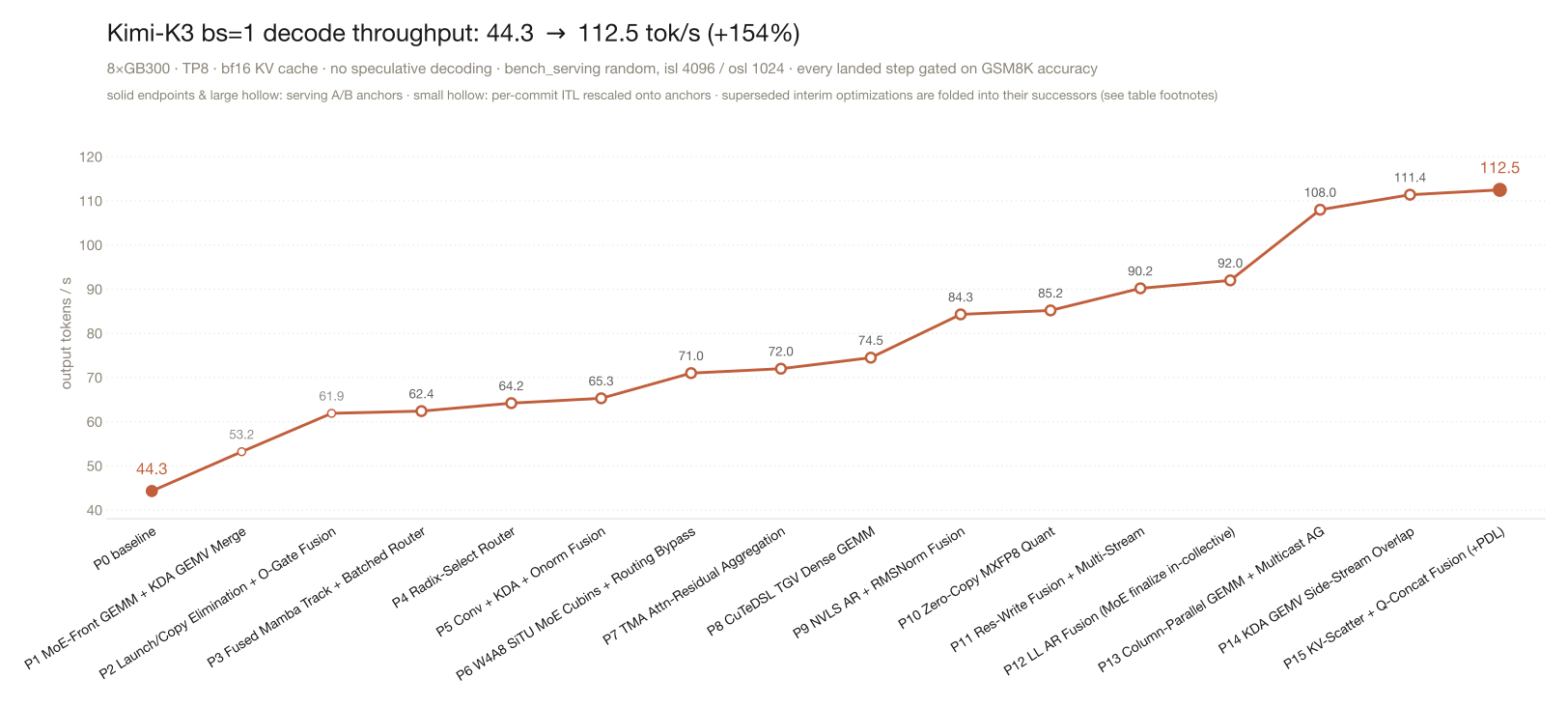
The lesson that generalizes. All-reduce is a synchronization point, so a microsecond saved there converts one-for-one into step time; a kernel sitting in another stream’s overlap slack converts at roughly one-tenth. Checking critical-path membership in the trace before writing a kernel was the single highest-leverage habit of this campaign.
¹ A rebase moved the P5 baseline 64.2 → 63.8; the step is measured against the post-rebase base. ² P13 is a re-calibrated canonical baseline after a merge window, not a single-PR attribution. ³ Segments leading into P1–P4 also carry interim optimizations later superseded (concat all-reduce → P9; tiny/1-CTA GEMV → P8; radix router v1 → P4; Marlin top-k-sum → P6/P12; early attn-res add → P7); their transient gains are in the curve but have no named point.
Parallelizing K3
For K3’s hybrid architecture, the conventional parallelism choices do not hold up. Tensor parallelism cannot shard MLA’s KV cache (one KV head, nothing to split by), so every rank holds a full copy; it also slices every GEMM eight ways and pays a collective per layer. Pure DP attention instead replicates the attention weights on every rank, around 61 GB for KDA plus 11 GB for MLA, memory the KV cache and KDA states need. Prefill and decode fail differently under these costs, so K3 splits the answer by phase: chunked pipeline parallelism for prefill, context parallelism for decode.
Prefill: chunked pipeline parallelism
In TP prefill, every layer ends in an AllReduce, a barrier that cannot overlap with compute. Pipeline parallelism cuts the model by layer instead: K3’s 93 layers become 8 stages, and the prompt is cut into chunks that stream through them:
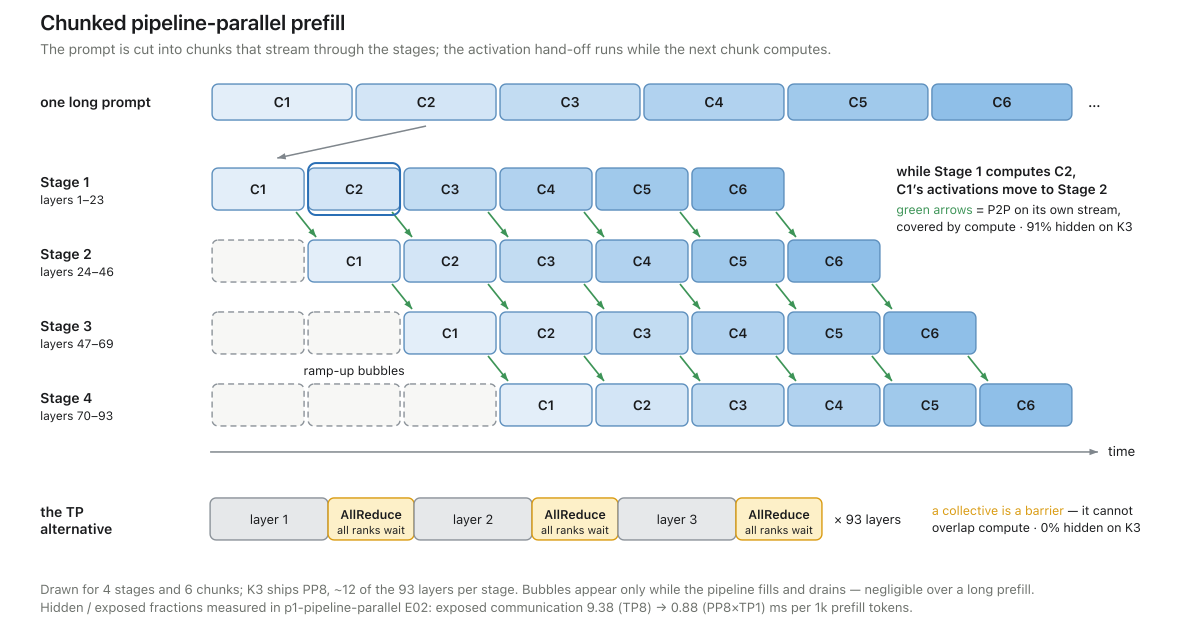
Chunked pipeline-parallel prefill. The stages work on different chunks at the same time. The hand-off between stages runs while the stage computes its next chunk, so 91% of it is hidden on K3. Under TP (bottom strip), every layer ends in an AllReduce that all ranks wait for.
This wins three ways. The only communication left, the hand-off to the next stage, hides behind the next chunk’s compute. Each rank runs whole layers, so the GEMMs are eight times wider and more efficient. And each stage holds KV and activations for only its ~12 layers, which makes very long prompts comfortable to prefill. The pipeline does have to be deep: a shallow PP4×TP2 cannot cover its hand-offs and still pays TP2’s AllReduce, and it benchmarks no better than TEP8.
Measured on 8K prefill across 2×4 GB300, with topology as the only variable:
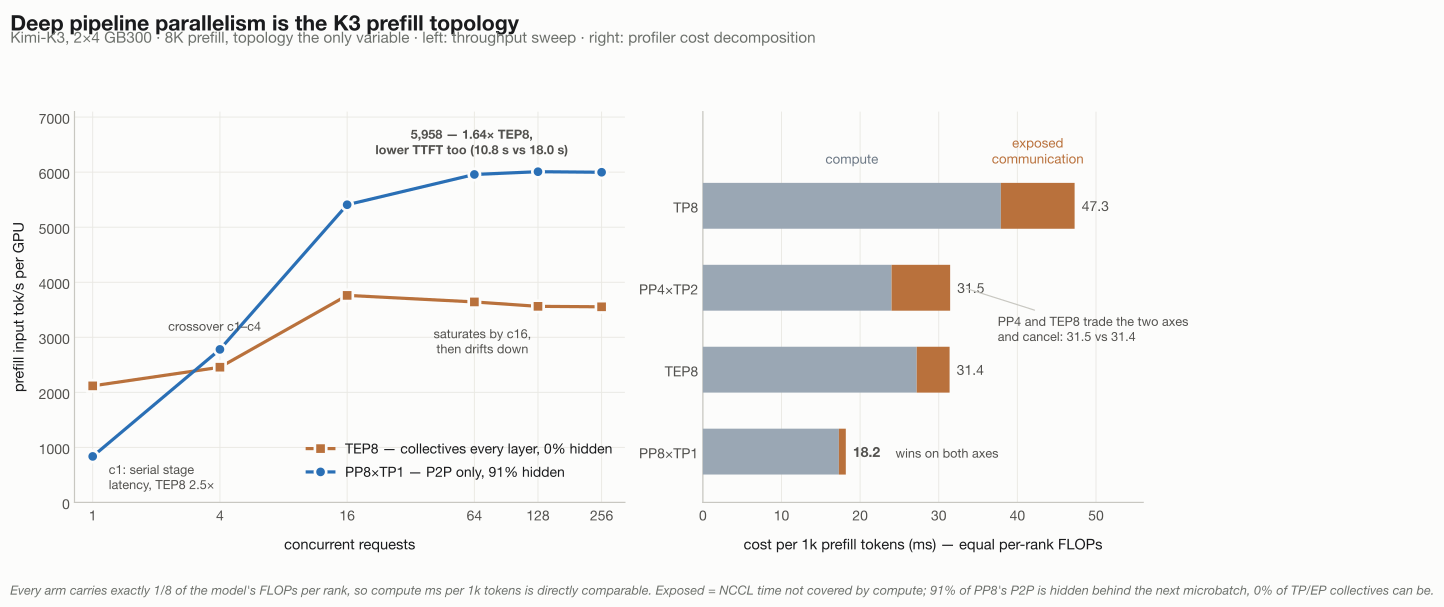
Deep PP wins on both axes. Left: past the c1–c4 crossover, PP8×TP1 climbs to about 1.7× TEP8’s ceiling, with lower TTFT. Right: cost per 1k prefill tokens at equal per-rank FLOPs; PP4×TP2 and TEP8 trade compute against communication and tie, PP8 is cheapest on both.
PP8 loses only at a single request, and a prefill worker that idle is misconfigured anyway. In K3’s disaggregated serving, the prefill nodes run PP8. Each of them has 1.45 to 1.72 times the prefill capacity of a TEP8 node, so one prefill node can keep several decode nodes fed. The decode nodes run TP or DCP, which the next part covers.
Decode: context parallelism
Decode is where the replicated KV cache binds: under TP, admitting one more request or one more thousand tokens of context costs the same bytes on every rank. Decode Context Parallelism (DCP) shards MLA’s KV by token position instead of by head. Rank r owns position p when p mod N equals r, so every rank holds an interleaved 1/N of every request’s context, and the sharding is invisible above the attention kernel:
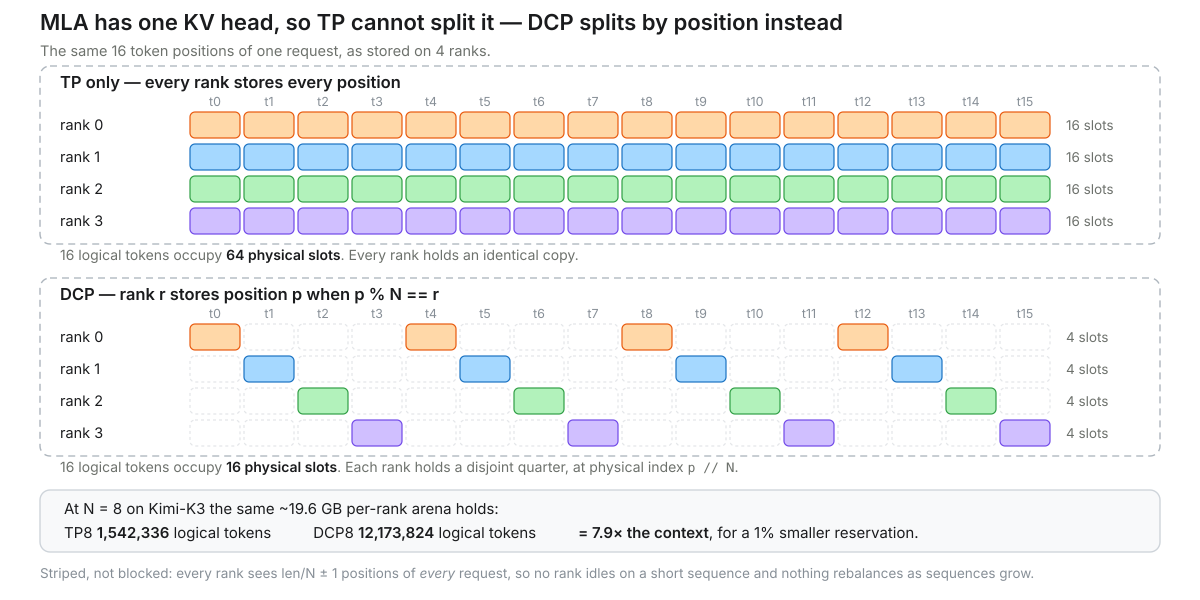
Sharding by position. The same 16 token positions on 4 ranks: TP stores 64 physical copies, DCP stores 16. The freed bytes become logical KV capacity, about 7.9× on K3 with DCP8.
Position-sharding breaks the softmax, since each rank sees only 1/N of the keys and partial softmaxes do not add. The fix is FlashAttention’s own: each rank returns its partial attention output together with a log-sum-exp per head, and one all-to-all per layer exchanges them so that each rank ends up with 1/N of the heads over the full context. A local merge by log-sum-exp is then exact, and the result is already the head layout the output projection expects under TP. One collective per layer is the entire communication cost:
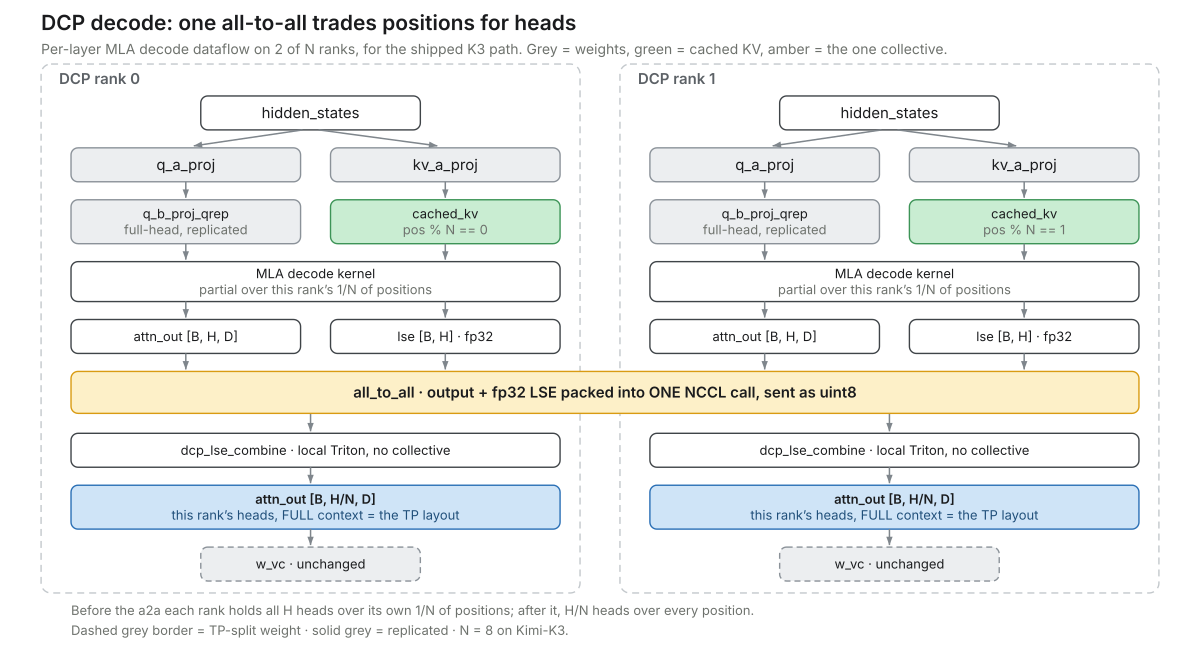
The decode step, per layer. Each rank projects the full-head query locally, attends over only the positions it owns, and ships partial outputs and their log-sum-exps in a single packed all-to-all. A local merge leaves the standard TP head layout; nothing downstream of attention changes.
Everything else is left alone. DCP groups are built inside the TP group, so TP8 with DCP8
is still 8 GPUs, and the MoE runs whatever parallelism it already had. KDA is the
exception that explains the rule: its state is one fixed-size matrix per request rather
than per token, so there is no position axis to shard, and the KDA layers stay TP-sharded
by head. The whole feature is one flag, --dcp-size N.
What this buys shows up on agentic traffic, where hundred-thousand-token sessions pile up in the cache. Replaying real coding-agent sessions on 2×4 GB300, with a host-memory KV tier on both arms and DCP as the only difference:
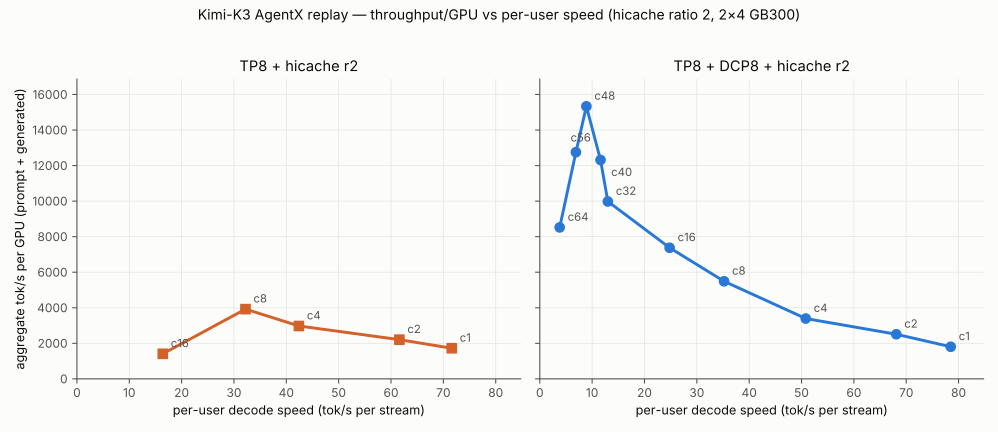
DCP removes the active-set wall. The host tier rescues re-prefill traffic, but at 16 concurrent sessions the active working set outgrows TP8’s device KV and throughput collapses. DCP8 lifts logical KV from 1.5M to 12.2M tokens and carries the same workload to 541 tok/s at 48 sessions.
DCP composes with the rest of the stack. A DSpark verify step is a decode step, so it rides the same replicated-Q, one-all-to-all path; under PD disaggregation the prefill side stays DCP-unaware and each decode rank simply pulls the positions it owns at the transfer boundary, which is what lets PP or TP prefill feed DCP decode. The remaining ceiling is KDA: its per-request state cannot be position-sharded, so once DCP lifts the MLA wall the running-request cap becomes the binding limit; the unified-memory design in the memory section above takes that on.
Combining all strategies together
How the pieces compose is ultimately a measurement. Putting PD disaggregation in the loop, with the prefill topology, decode topology and prefill:decode ratio varying, gives the serving frontier:
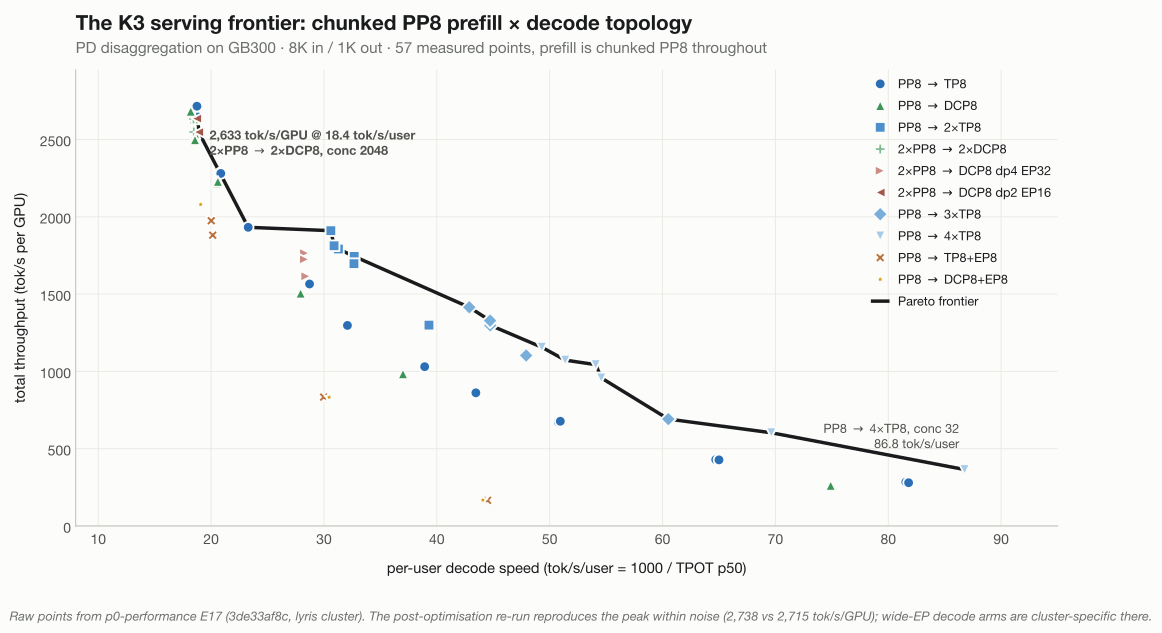
The serving frontier. At the throughput end one PP8 prefill worker feeding one TP8 decode node delivers 2,808 tok/s per GPU on the fp4 arm, with the DCP composition, two PP8 prefill workers feeding two DCP8 decode nodes, just behind at 2,633. Moving right is the prefill:decode knob at work: one prefill worker feeding two, three, then four independent decode instances trades aggregate throughput for per-user speed, out past 116 tok/s per user.
RL: LoRA Training on the Native MXFP4 Base
Day-0 RL for K3 is colocated LoRA training with Miles: a BF16 trainer on Miles’s Megatron backend and native packed MXFP4 SGLang rollout engines sharing the same 64 GB300s. The backend covers KDA, NoPE-MLA, the attention-residual bank and the latent MoE, with TP/SP/PP/CP/EP.
LoRA serving and weight sync
The engines serve the checkpoint as shipped and never rewrite it. Each step transfers only BF16 LoRA adapters, and the engine applies the delta as a separate BF16 B(Ax) term on top of the quantized base GEMM, so the policy update reaches inference at full precision over 4-bit base weights. Dense projections go through SGLang’s Triton LoRA backend, the 896 routed experts through a fused MoE-LoRA kernel on the Marlin path, and the shared-expert delta is folded into the fused MoE front GEMM. Adapters live in a GPU memory pool that each sync replaces in place, so there is no resident BF16 copy on the rollout side, no full-weight resync, and no requantization step in the loop.
Parallelism
Pipeline parallelism. K3’s attention-residual snapshot bank has to cross stage boundaries, but Megatron’s point-to-point carries one hidden-states tensor, so the stage boundary packs [prefix_sum, bank] into it and unpacks on entry. Megatron is untouched.
Context parallelism. The bank shards for free, since every attention-residual operation is per-token. MLA needs no K3-specific code either: rotary-table slicing is the only CP-aware work in Megatron’s MLA and K3 has no rotary embedding, so its projections sit on the stock TE attention core and inherit CP. KDA is the part that needs work, going through fla’s CP context for the recurrent state and the convolution halo. It wants a contiguous rank-local chunk where Megatron stores the zigzag order ring attention expects, so the relayout runs only around KDA.
Expert parallelism. The adapter shares its latent-side factor across all 896 routed experts and keeps the other per-expert, matching the engine’s fused MoE-LoRA contract. That shared factor is replicated across EP but tagged expert-parallel, so DDP reduces it only over expert-DP, and the EP sum is the one gradient reduction the release adds itself.
Memory
A native-MXFP4 rollout peaks near 225 GiB/GPU and the BF16 trainer near 155 at initialization, on a 277 GiB card, so the two are never both resident: each sleeps while the other runs, and colocation depends on every handoff leaving nothing behind.
The base never moves. The engines keep their base weights resident on the GPU for the whole run, and only the KV cache and CUDA graphs are released while the trainer works. Since the base is never released it is never restored either, and the LoRA path ships no base bytes at all: base sync is skipped entirely.
The process groups stay up. The trainer’s NCCL communicator buffers are not torch-allocator memory, so offloading cannot release them, and the obvious answer is to destroy the groups on sleep and rebuild them on wake. That trades a resident few GiB for a per-cycle rebuild and EP warmup, which is only worth paying when the engines need those bytes back — and they do not here, because no base weights cross the update path. The groups stay up.
Adapter transfer is bounded per chunk. The adapter is about 2,800 tensors. Each chunk ships as one flattened CUDA IPC bucket, 278 in total, and is collected as soon as the receiver acknowledges it and every producer rank has crossed an engine-group barrier. That bounds transient IPC memory per chunk instead of letting it integrate across the transfer, worth about 48 GiB/GPU at the peak.
Host copies exist only where something reads them. The engine releases each adapter’s CPU copy once it is installed into the GPU pool, taking scheduler RSS from 76–88 GiB to about 17; an adapter whose CPU copy is gone cannot be reinstalled, so pool eviction is refused with an error rather than silently serving a stale slot. On the trainer side the DDP buffers split by lifetime: adapter parameter buffers stay in the CPU-backed region because the weight update reads them while the trainer sleeps, while gradient buffers are rebuildable and go to a no-backup region that sleep discards.
Validation
Training correctness is the most important part of an RL support stack. We built these checks before the recipe work.
Train/rollout KL, logged every rollout, is a Schulman k3 estimate of KL(rollout ‖ train) over the sampled tokens, computed from the log-probabilities the engine returned and the trainer’s recomputed ones. It is a diagnostic, not part of the objective, which carries no KL penalty. Its floor is about 2e-3, set by serving the base in MXFP4; growth with step count is the divergence signature.
A canary lockstep probe. One trajectory is pinned from the first rollout and scored every step by both the engine, under the live adapter, and the trainer, at the same policy version. Co-movement of the two curves is what proves the trained adapter reaches inference: a transfer checksum proves the bytes arrived, not that anything reads them.
Tensor-level dump comparison. The same tokens run through two builds or two parallel layouts, dumping every forward activation and every parameter gradient, compared by relative L2 and cosine against a measured noise floor. Bit-exactness is not the bar, since the same arithmetic on two different GPU sets already differs at the ulp level. This is how the pipeline boundary and the context-parallel layout were validated: where CP=2 and CP=1 build the identical call the two are bit-identical, and a forward-kernel swap lands at cosine median 0.996.
Weight-sync assertions. Per-tensor SHA256 manifests between trainer and engine, a validator that errors if an adapter update changes no exported tensor, a check that every B factor is zero at version 1, and adapter gradient and optimizer-step checks.
Training result
The reported run is DAPO math on 16 nodes × 4 GB300: BF16 trainer at TP8 / PP8 / EP8 colocated with native MXFP4 rollout engines, 4096-token responses, 64 samples per rollout, one optimizer step per rollout, rank-32 / α-64 LoRA at lr 1e-5, GRPO with no KL term, run to a 12 h wall-clock limit. AIME-2024 greedy eval climbs 43.3% to 76.7% over 60 steps, 13 of 30 problems to 23, and is still rising at the cutoff, while train/rollout KL holds flat at the ~2e-3 MXFP4 floor for the whole run.
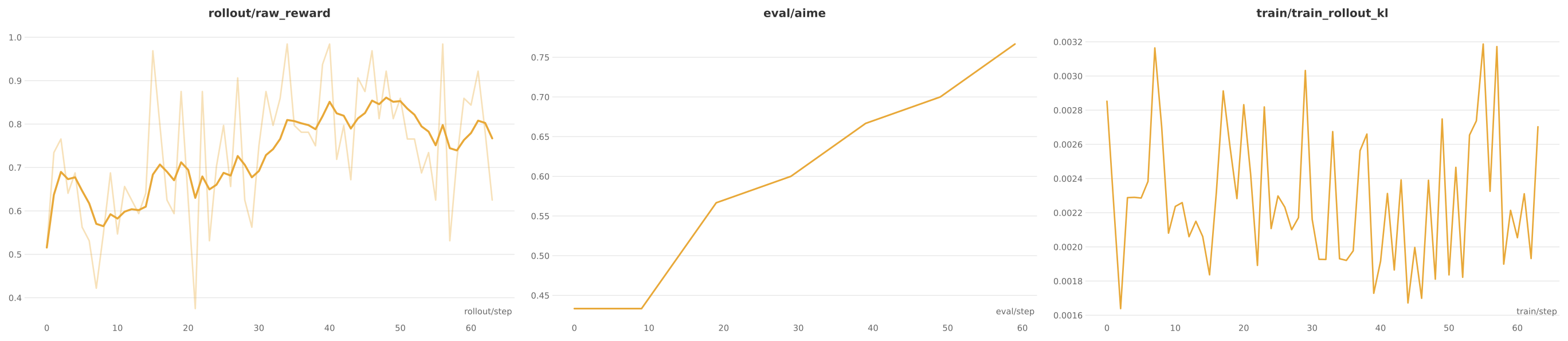
The 12-hour DAPO run. Left: mean reward over the 64 sampled responses per rollout, graded on the response channel; each rollout draws a different prompt batch, so the trend is the signal and the per-step value is noise. Middle: AIME-2024 greedy pass rate, evaluated every 10 rollouts under the same 4096-token limit as training, so a correct solution that runs past the limit scores as a miss. Right: a Schulman k3 estimate of KL(rollout ‖ train) at the sampled tokens, reported only and never added to the loss; flat at the quantization floor is the target, and monotonic growth is the divergence signature.
Acknowledgments
This work was a collaboration between the SGLang & Miles team at RadixArk and the Moonshot AI team, together with NVIDIA, AMD, Approaching AI, Baseten, and Modal.
AMD: Wun-guo Huang, Xinyi Song, Hai Xiao, Soga Lin, Duyi Wang, Thomas Wang
Approaching AI: Huanming Shen, Xiaohao Zhang, Nan Li, Mingxing Zhang
Thanks to DigitalOcean for providing AMD instances for our testing.
Thanks to Google Cloud, DigitalOcean, Nebius, fal, RunPod, DeepInfra and GMI Cloud for serving Kimi K3 on SGLang.