DSpark in SGLang: Speculative Decoding with Confidence-Driven, Variable-Length Verification
Speculative decoding trades extra compute for fewer decode steps, and the trade
sours as load grows: at batch size B with K speculative tokens the target
verifies B * K tokens every step, and past a point that costs more than it saves.
DSpark attacks both ends — a semi-autoregressive block drafter (a whole block per
draft forward, so acceptance stays high) and a variable per-request verify length
driven by the draft model's own confidence, which stops verifying tokens the workload
is unlikely to accept. The algorithm and its gains are from the DSpark paper.
SGLang now supports DSpark on both dense and sparse models (e.g. Qwen3 and DeepSeek-V4). This post is about the integration (sgl-project/sglang#30261). We reproduce the shape of the paper's gains on an open serving engine — the per-user speedup, and the verify budget shrinking as load rises — and describe the engineering that turns that schedule into wall-clock time: full CUDA graphs over a ragged, per-request verify (so a trimmed batch replays a genuinely smaller graph, not a padded one); an overlap-aware speculative path that hides the scheduler behind the forward; a cost-table profiler that lets the scheduler size each request's verify budget online; and observability for the acceptance ceiling that trimming would otherwise hide. Hardware, engine, and traffic all differ from the paper, so we reproduce the mechanism and the curve rather than its numbers to the digit, and every "faster" below is measured against our own controls — identical except for the speculation config.
The speedup over MTP and non-spec
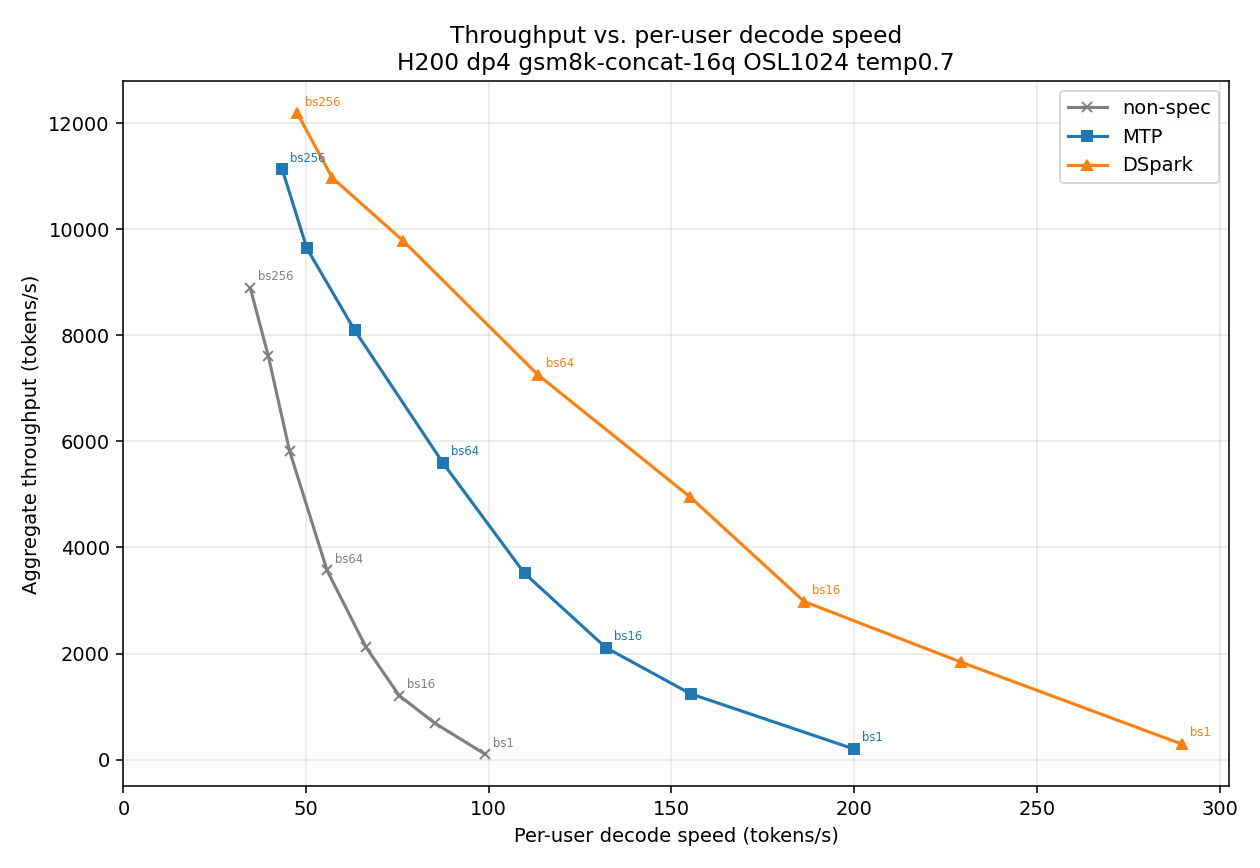
Figure 1. Aggregate throughput (y) vs. per-user decode speed (x); each curve sweeps concurrency from batch 1 to 256, one curve per arm. Higher and to the right is better.
DSpark delivers the best throughput/latency trade-off across the whole concurrency sweep, clearly ahead of both MTP and the non-spec floor in the Figure 1 example. All three arms run DeepSeek-V4-Flash on H200 with DP-attention over four ranks, identical except for the speculation config — a non-speculative floor, MTP (the EAGLE-style baseline, the per-batch-size best of the 1-1-2 and 3-1-4 configs), and DSpark.
Adopting DSpark in SGLang
The DSpark algorithm, adopted from the paper, lives in three draft-side pieces:
- Block drafter — a dense line (e.g. Qwen3) and a sparse line (e.g. DeepSeek-V4);
one forward emits a
gamma-token block, with a lightweight sequential head (Markov or RNN) conditioning each step on the previous token, so the block is semi-autoregressive. - Confidence head — scores each drafted token's chance of surviving verification; the product across the block is the block's survival probability.
- Sequential Temperature Scaling (STS) — calibrates those scores so survival reflects the true acceptance rate the scheduler budgets against.
Around that, SGLang adds the serving support surface:
- Confidence scheduler — converts per-block survival into a per-request verify budget each step.
- Per-request ragged verify — a variable verify length per request within one batch (
static/compact/cap-accept). - Full CUDA graph — captured over the ragged, variable-length verify.
- Observability — acceptance ceiling under trimming and other metrics.
- Additive SPS cost table — an offline-profiled step-time model, read online by the scheduler.
- Data-parallel attention — supported alongside the other parallelism dimensions.
- Zero-overhead scheduling — integrated into SGLang's overlap scheduler with almost no DSpark-specific special-casing.
- Performance optimizations — fused Triton kernels and a sharded block-drafter matmul.
Verify modes
The three verify modes are the axis the rest of this post turns on. static
verifies the full drafted block every step (the baseline). compact verifies only
the per-request window the scheduler picked — the production path. cap-accept
verifies the full block but commits only up to that window: same output as
compact, while exposing what a full verify would have accepted — how we measure
the ceiling under trimming.
Ragged verify under full CUDA graphs
Per-request windows don't fit a fixed-shape CUDA graph: a batch where one request verifies two tokens and another six has no single query length, and padding everyone up to the full block width just pads the trim back in. So we keep the batch ragged and key the graph on the total token count — front-pack the variable-length requests into one compact buffer and round up to the nearest captured tier. When budgets trim, the packed total drops to a smaller tier and DSpark replays a genuinely cheaper graph (fewer attention and MLP rows, not a masked full-width forward); under DP attention the ranks share one tier (the largest any rank needs) and step down together.
The packed buffer is a cu_seqlens-style varlen input, so the compact verify reuses
attention kernels the backend already has — on DeepSeek-V4 the model's own sparse-MLA
path (flash_mla), with no new kernel; each supported backend just rebuilds its
varlen metadata from the packed layout on graph replay.
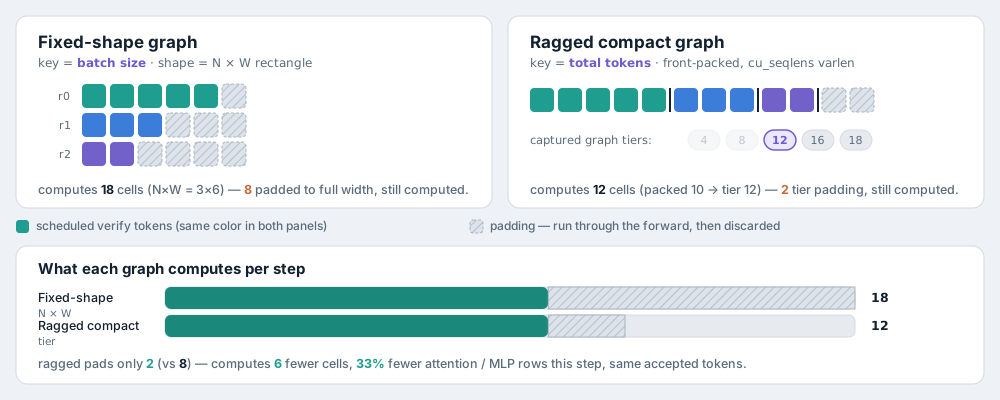
Figure 2. Fitting a batch with per-request-variable verify lengths into a captured CUDA graph. A fixed-shape graph pads every request to the full block width (N x W); the ragged path front-packs the scheduled tokens and rounds only the total up to the nearest captured tier, computing far fewer padded cells for the same accepted tokens.
Observability
Trimming censors the ceiling: compact mode only verifies a block's first few positions — the scheduler's window — so how many tokens a full-block verify would have accepted at that step is never observed — and without it you cannot tell a good trim from a lossy one. A cap-accept run recovers it: it verifies the full block but commits only up to the window, so it commits exactly what compact commits while exposing the ceiling. We also surface per-request confidence and calibration metrics (e.g. ECE) for post-hoc analysis.
Estimating the ceiling under trimming
A block-accept estimator, designed for production runs or other scenarios where an extra companion run is unwanted, recovers the estimated censored ceiling directly inside a compact run. It is implemented with the utilization of the target tokens in the future steps with its logprobs, and computes estimation intervals for the counterfactual tail, assuming property similarity of anchor tokens in the trimmed versus untrimmed trajectory.
A preliminary look at dynamic vs. fixed scheduling
The confidence scheduler is a first, vanilla version, and we treat it that way — a
proof that the mechanism works end to end, not a highly tuned result.
We compare compact (the per-step
SPS-argmax budget) against no-trim — the static full-block schedule run through
the same ragged path — on two example workloads that differ in acceptance.
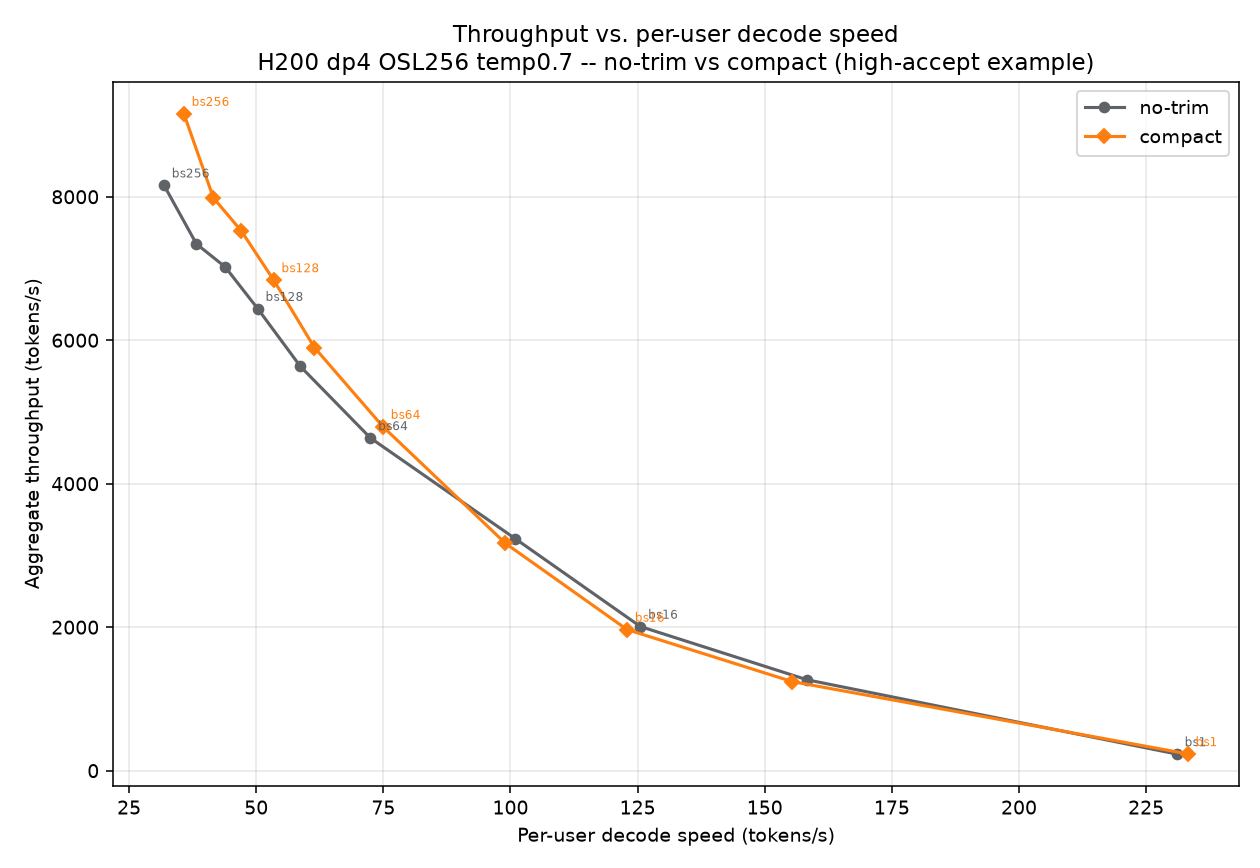
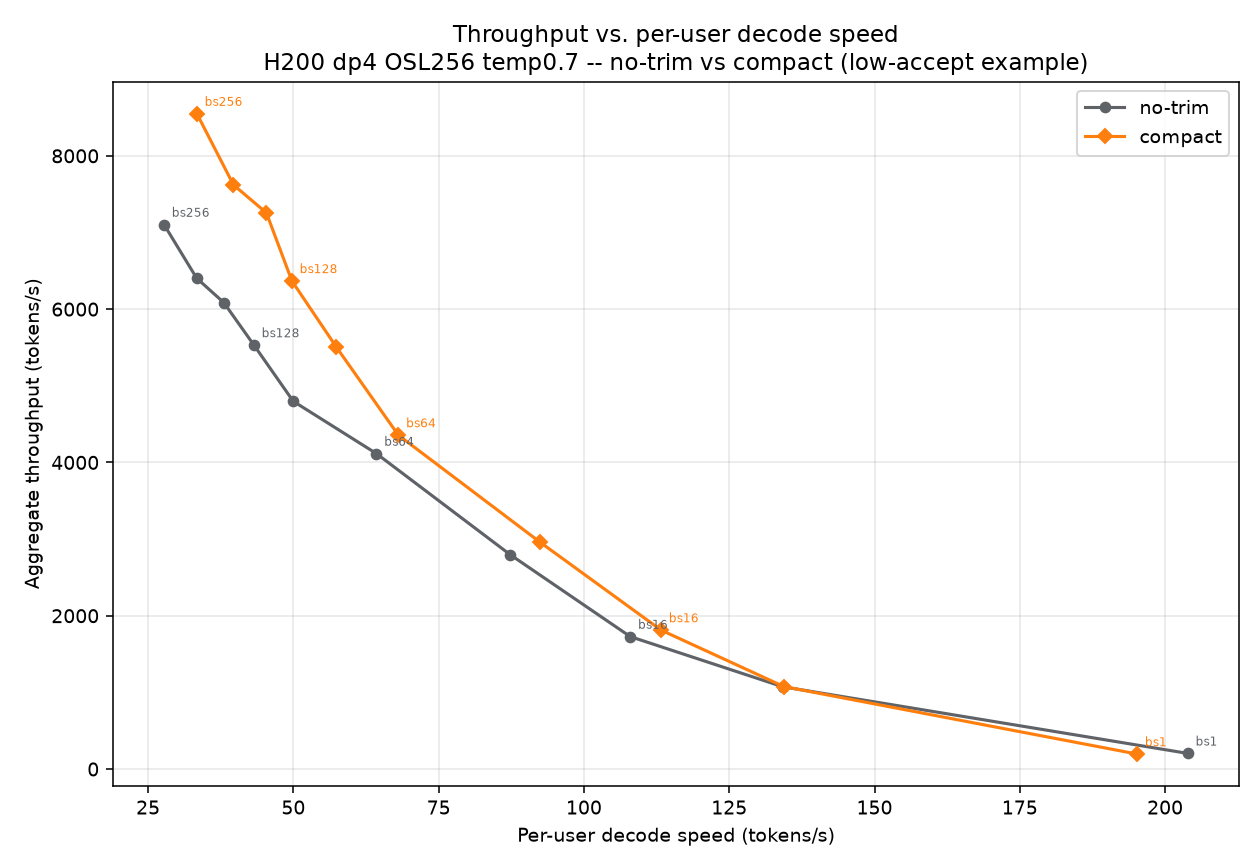
Figure 3. compact (dynamic trim) vs. no-trim (full block), batch 1 to 256 at DP4, on two examples that differ in acceptance. Higher and to the right is better.
The dynamic budget's win is primarily a high-batch effect. At batch size 1 the target verify does
not slow down much with more tokens, so trimming saves little and the two arms tie. As
concurrency grows and throughput starts to plateau, trimming shortens the step
and compact pulls ahead. The gap is larger, and
opens earlier, on the lower-accept example — lower acceptance leaves more tail to
trim, exactly as the cost model predicts.
Each panel is a clean compact-vs-no-trim A/B (identical setup within a panel),
but the two examples are not a strict single-variable pair: beyond acceptance they
also differ slightly in setup (prompt formatting and per-arm round count), so we
read the trend across them, not absolute cross-panel numbers.
These budgets are also only as good as the cost tables behind them. Our current SPS (and calibration) fit is a first approximation, and it may not yet fully account for how step cost varies with context length — so the exact operating point the scheduler lands on is likely improvable, and we present the mechanism here rather than a tuned number.
Per-request differentiation on mixed traffic
Homogeneous sweeps hide the real point of confidence scheduling. Two requests in the same batch should not get the same verify window if one is far more predictable than the other. Mixed traffic is where that matters.
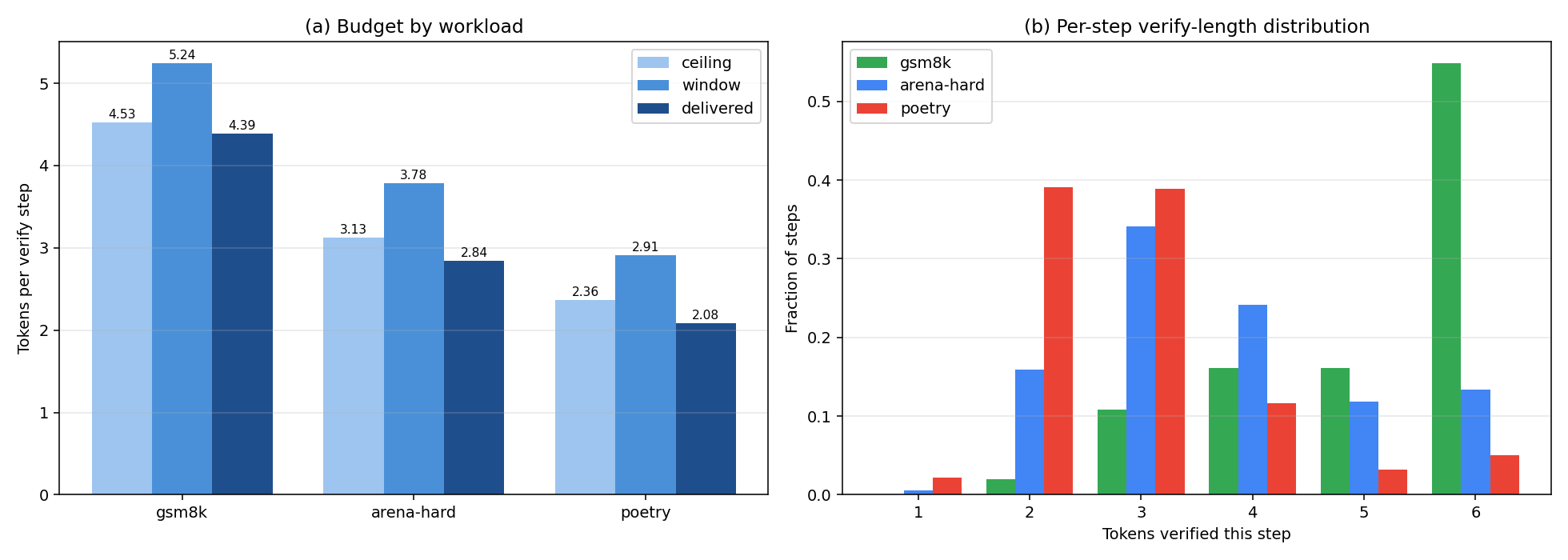
Figure 4. Budget by workload (left) and per-step verify-length distribution (right).
As an example, we mix three workloads by acceptance difficulty: gsm8k (high), arena-hard (mid), and poetry (low). The window contracts with difficulty — 5.24, 3.78, 2.91 tokens — while utilization against the ceiling (what the block would accept untrimmed) stays high (0.88–0.97). The scheduler is sizing each request, not applying one batch average. The right panel shows it step by step: about 55% of gsm8k steps fill the full window of six, while about 80% of poetry steps use three or fewer.
Performance optimizations and zero-overhead scheduling (ZOS)
Two kinds of engineering turn the schedule into wall-clock time: cutting the cost of each step, and hiding the scheduler behind the forward. Together they reach 383.7 tok/s at accept length ~5 at batch size 1 on DeepSeek-V4-Pro, TP=8, B300.
We rewrote the clusters of tiny ops as fused Triton kernels, such as the compact scatter, the SWA page-index, the verify-length top-k schedule, and the ragged-window packing. The block drafter's sampling path folds into fused kernels, and its matrix multiplication is sharded. In one example profile, things outside the target verify shrinks by 1.7 ms, against a 7.3 ms verify.
DSpark drops straight into SGLang's zero-overhead (overlap) scheduler with almost no special-casing, adding the paper's two-step-back confidence relay. Little of this is DSpark-specific plumbing. SGLang's spec-v2 runtime already overlaps the next step's scheduling with the current forward on separate streams, and DSpark joins as a first-class worker: forward outputs come back as async futures, cross-iteration ordering rides the runtime's device-side barrier, and on-device page tables mean no per-step host sync. The confidence relay uses the same channel, read two steps back. The decode loop then runs with no per-step bubble — about 1.5x tighter than with the scheduler off.
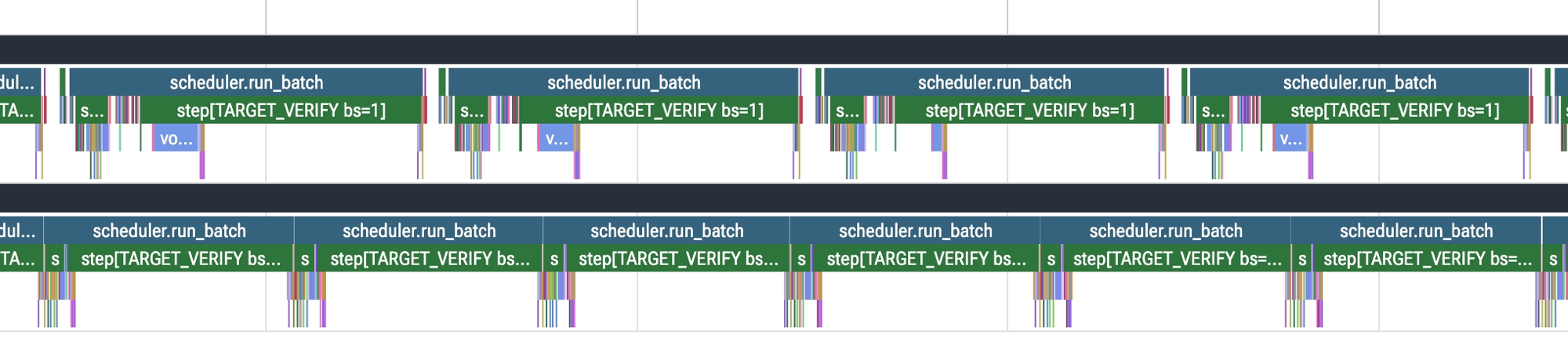
Figure 5. Decode at batch size 1, overlap scheduler off (top) vs. on (bottom). With it on, there is no bubble between run_batch iterations or between the block-draft-generate and target-verify phases inside a step.
Profiling the cost table
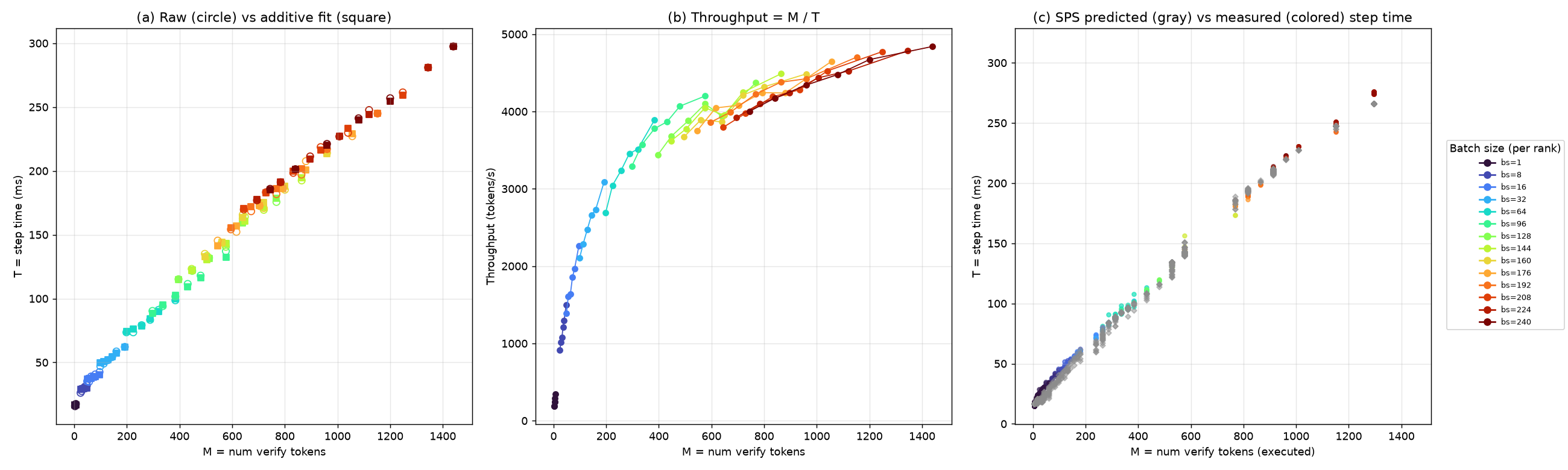
Figure 6. Additive cost model — raw vs. fit (a) and throughput (b) — and predicted vs. measured step time (c).
We express the scheduler's estimate of step time T(bs, K) — K the batch's extra
verify tokens — with an additive model:
T(bs, K) = bias + alpha(bs) + theta(M), M = bs + K,
where alpha(bs) is the request-scaling floor (draft pass plus part of attention),
unmoved by trimming; theta(M) is the target's verify-token cost, the only term
trimming recovers. The scheduler's argmax trades expected accepted tokens against real marginal cost, so trim
headroom shows up only where theta is large. Figure 6(c) validates the model's
predictions against a live server.
What's next
DSpark is in SGLang today; we track the roadmap in sgl-project/sglang#30344. What's next:
- Cost model and scheduling — a stronger, increasingly online/adaptive cost model and further improvements to the dynamic scheduler.
- Model coverage — more dense and sparse models.
- Parallelism — broader coverage across parallelism modes and serving topologies.
- Observability — productionizing metrics like the block-accept estimator and confidence calibration across checkpoints.
- Robustness — hardening the full-CUDA-graph path and broader stress / regression testing.
Thanks to the DSpark authors and to DeepSeek for the algorithm and the models.
Appendix: Reproduction
All commands below run inside the prebuilt image (docker pull lmsysorg/sglang:dev-dspark), or
build from source at sgl-project/sglang#30261,
pinned at commit 692c5f7d.
Figures 1, 3, and 6 — the frontier server (DeepSeek-V4-Flash, H200, DP4). Launch the DSpark arm:
SGLANG_ENABLE_METRICS_DEVICE_TIMER=1 \
python3 -m sglang.launch_server \
  --model-path deepseek-ai/DeepSeek-V4-Flash-DSpark \
  --speculative-algorithm DSPARK \
  --tp 4 --dp-size 4 --enable-dp-attention --enable-dp-lm-head \
  --moe-a2a-backend none --moe-runner-backend flashinfer_mxfp4 --disable-flashinfer-autotune \
  --swa-full-tokens-ratio 0.1 --chunked-prefill-size 1024 \
  --mem-fraction-static 0.8 --cuda-graph-max-bs 192 --max-running-requests 1024 \
  --disable-radix-cache --trust-remote-code --host 0.0.0.0 --port 30000
where the --disable-radix-cache is to avoid bench scripts hitting the cache.
The other arms change only the speculation config: non-spec drops --speculative-*
and loads --model-path deepseek-ai/DeepSeek-V4-Flash; MTP uses that same target
with --speculative-algorithm EAGLE --speculative-num-steps {1,3} --speculative-eagle-topk 1 --speculative-num-draft-tokens {2,4} (per-batch-size best of the two); DSpark compact or static
sets SGLANG_RAGGED_VERIFY_MODE=compact|static;
use --speculative-dspark-sps-table-path sps_table.json when executing compact mode with SPS table;
and Figure 3's no-trim arm is
SGLANG_RAGGED_VERIFY_MODE=compact with no SPS table (the ragged path at the full
window). Drive any arm with a fixed prompt swept across batch sizes:
python3 -m sglang.benchmark.one_batch_server \
  --model None --base-url http://127.0.0.1:30000 \
  --batch-size 1 8 16 32 64 96 128 160 192 256 --output-len 1024 --temperature 0.7 \
  --fixed-prompt-file frontier_prompt.txt --fixed-prompt-apply-chat-template --show-report
The fixed prompt is here
(frontier_prompt.txt), 16 concatenated GSM8K questions to allow the generation be real content.
Users may test on their own data given speculative decoding has different accept lengths for different datasets.
Figure 6's cost table comes from a profiling run: launch compact with
SGLANG_DSPARK_ENABLE_SPS_RECORD=1 SGLANG_SIMULATE_ACC_LEN=1.0, then fit the additive
model with python3 -m sglang.benchmark.dspark_sps_profiler all (sweeping a batch ×
verify-fraction grid at input-len 512).
Figure 4 — mixed traffic. The same server as Figure 1, at --mem-fraction-static 0.7
with block size six; run all three modes (static / compact / cap-accept) via
SGLANG_RAGGED_VERIFY_MODE, and drive a mixed gsm8k + arena-hard + poetry request set,
measured as non-streaming makespan throughput.
Figure 5 — zero-overhead (DeepSeek-V4-Pro, B300, TP8).
SGLANG_RAGGED_VERIFY_MODE=compact SGLANG_DSV4_FP4_EXPERTS=1 SGLANG_TORCH_PROFILER_DIR=./trace \
python3 -m sglang.launch_server \
  --model-path deepseek-ai/DeepSeek-V4-Pro-DSpark --speculative-algorithm DSPARK \
  --tp 8 --moe-runner-backend flashinfer_mxfp4 --disable-flashinfer-autotune \
  --mem-fraction-static 0.82 --chunked-prefill-size 4096 --cuda-graph-max-bs 4 \
  --trust-remote-code --host 127.0.0.1 --port 30000
# overlap off: append --disable-overlap-schedule
Capture a batch-1 decode trace, then read the GPU-only lane:
python3 -m sglang.benchmark.one_batch_server \
  --model None --base-url http://127.0.0.1:30000 \
  --batch-size 1 --input-len 256 --output-len 256 \
  --profile --profile-activities GPU --profile-steps 20