Agent-Assisted SGLang Development: An Initial Exploration
SGLang development increasingly goes beyond isolated code changes. The same repository now spans LLM serving, distributed runtime, GPU kernels, diffusion pipelines, model-specific execution paths, and production incident handling. In the past, many of these workflows depended on individual developer memory: how to launch a certain model, how to read a profile trace, which log to add first when debugging a CUDA crash, or which benchmarks a performance PR should include. As agent tools mature, this experience can be turned into executable SKILL.md files, scripts, benchmark contracts, and review loops.
Around SGLang agent development, a set of skills has already emerged for both LLM and diffusion work:
- SGLang
.claude/skillsis maintained inside the SGLang repository and captures repo-level development workflows such as CUDA crash debugging, kernel integration, tests, CI, profiling, production triage, and source-tree conventions. - SGLang diffusion
.claude/skillsfocuses on diffusion-specific workflows, including adding new diffusion models, benchmarking and profiling denoise paths, tuning performance options, and validating quantized pipelines. - BBuf/AI-Infra-Auto-Driven-SKILLS covers cross-framework serving benchmarks, capacity planning, profile and pipeline analysis, model compute simulation, SGLang human-style review, production incident triage, SOTA loops for SGLang and other open-source inference frameworks, and model PR history.
- kernel-design-agents is the KDA project and the winning solution for the MLSys 2026 FlashInfer Kernel Contest.
- BBuf/KDA-Pilot applies KDA-style agent kernel workflows to SGLang. Its public B200 diffusion summary now tracks 10 SGLang kernel tasks. Most rows come from KDA-Pilot's public benchmark ledger, while
residual_gate_adduses the B200 speedup reported by the merged SGLang integration PR after the original task baseline moved. KDA-Pilot-derived work has now landed in three SGLang integration PRs.
Viewed together, these efforts point to the same direction: the value of agents comes from procedural engineering knowledge, including executable steps, reproducible experiments, and reviewable evidence.
1. TL;DR
- Agents are most useful in SGLang when they can keep moving along a well-defined workflow. Benchmarking, profiling, kernel API logging, adding diffusion pipelines, production incident replay, and SOTA loops can all be encoded as skills.
- An SGLang skill is an executable development procedure. In
debug-cuda-crash,sglang-diffusion-benchmark-profile, andllm-torch-profiler-analysis, the important content is preflight checks, hard failure gates, artifact contracts, reproduction commands, and result formats. - Profile evidence is central to performance work. The SGLang profiler skills produce fixed kernel tables, overlap-opportunity tables, and fuse-pattern tables. KDA-Pilot extends this into same-ABI baseline/candidate comparison, real workloads, correctness gates, NCU evidence, and per-shape results.
- Long-running optimization has started to move into Loop Engineering. The SGLang SOTA Performance Loop decomposes "chasing SOTA" into fair benchmarking, gap decision, profiling, patching, and revalidation. Humanize/RLCR adds external review, while Codex Goal can run the same loop with lower coordination overhead.
- Review becomes more important. Agents can run more experiments, but they also generate more changes that look plausible and still need careful review. Developers increasingly define problems, choose evidence, design workflows, and decide whether results are ready for production paths.
2. Why SGLang Is a Good Fit for Agent-Assisted Development
SGLang is a high-performance serving framework for LLMs and multimodal models. As model families and hardware paths expand, several recurring problems show up in development:
- LLM paths are complex. A single performance issue may cross the Python runtime, scheduler, CUDA graph, Triton/CUDA kernels, FlashInfer/FlashAttention, distributed collectives, and model-specific wrappers.
- Diffusion paths are also complex. A slower denoise pass may involve pipeline/stage partitioning, DiT blocks, attention backends,
torch.compilegraph breaks, CFG/SP parallelism, VAE, or custom fused kernels. - Validation is expensive. Many changes must be tested on real models and real workloads on H100, H200, B200, or RTX 5090. Local unit tests alone are not enough.
- Profiles are hard to reuse manually. A single trace may contain hundreds of kernel launches. Reading Perfetto by hand can miss kernel-to-Python-source mappings and can easily mix up prefill and decode. Developers accumulate know-how while reading profiler output, such as which kernel names map to which model logic, which launch patterns suggest graph breaks, and which NCCL/attention/MLP layouts are normal. If that knowledge remains only in one person's head, the next task cannot reuse it.
- Performance conclusions depend heavily on context. GPU type, shape, batch size, parallelism, precision, backend, and compile state can all change the result. An isolated microbenchmark often cannot prove real model-level benefit, so an end-to-end long-running test process is needed to repeatedly validate throughput, latency, memory, accuracy, and stability under fixed workloads. That process is both labor-intensive and time-consuming.
These problems are a natural fit for agents. Launching servers, fixing workloads, collecting traces, triaging profile rows, adding tests, and recording experiment results all have clear inputs and outputs and are well suited to scripting and repeated execution. Developers need to define the boundaries: the same benchmark setup, the same profile interpretation rules, the same accuracy gates, and the conditions under which the agent should stop changing code.
The agent discussed here is therefore an executor constrained by engineering workflows. Repeated SGLang development procedures can be captured as skills, letting the agent handle repetitive execution, evidence collection, and state tracking. Developers remain responsible for defining goals, judging evidence, and reviewing whether a change belongs in the real serving path.
3. From Prompt Engineering to SKILL: Protocols and Examples
In the SGLang framework, a useful skill should at least answer the following questions:
| Question | What the skill should capture |
|---|---|
| When to use it | Trigger scenarios, supported models, supported hardware, and hard-stop cases |
| How to start | Preflight checks, environment variables, repository state, dependency checks, and model configuration |
| How to validate | Benchmark commands, profile commands, test entry points, and accuracy gates |
| How to decide | Output tables, failure modes, priorities, risk categories, and fallback conditions |
| How to deliver | Artifact directories, result schemas, PR descriptions, reproduction commands, and review requirements |
SGLang agent-related skills cover different layers. Some are close to source changes, such as debugging, testing, adding diffusion models, and benchmark/profile workflows. Others target cross-framework benchmarking, capacity planning, compute simulation, production incident triage, PR optimization knowledge, SGLang human-style review, and higher-level workflows such as Humanize/RLCR.
3.1 Current Skill Stack
The commonly used SGLang agent-related skills fall into the following groups.
| Layer | Representative skill / project | Problem it solves |
|---|---|---|
| CUDA crash | debug-cuda-crash | Records inputs, exceptions, and dumps around custom op/kernel API boundaries, turning transient crashes into samples that can be analyzed offline |
| LLM benchmark | llm-serving-auto-benchmark | Runs fair, bounded, resumable serving benchmark search across SGLang and other OpenAI-compatible inference stacks |
| Capacity planning | llm-serving-capacity-planner | Parses SGLang and other inference-framework startup logs to explain weight memory, KV cache budget, CUDA graph overhead, request capacity, and OOM pressure |
| Trace triage | llm-torch-profiler-analysis | Produces fixed kernel, overlap-opportunity, and fuse-pattern tables, and maps kernels back to Python source; the same unified workflow also lives in AI-Infra for cross-framework use |
| Pipeline/layer analysis | llm-pipeline-analysis | Slices torch profiler traces into forward passes, layers, and kernel flows to locate steady-state passes, bottleneck layer types, and Perfetto time ranges |
| Model compute simulation | model-compute-simulation | Builds operator-level compute templates for LLMs and estimates tensor shapes, FLOPs, MFU, kernel-to-op mapping, and parallelism what-ifs |
| Diffusion benchmark/profile | sglang-diffusion-benchmark-profile | Captures denoise latency, perf dumps, and torch profiler traces, while first checking that execution is actually using the native SGLang diffusion backend |
| Add diffusion model | sglang-diffusion-add-model | Adds a new diffusion model from a Diffusers/reference pipeline into the SGLang pipeline/stage/model/config structure |
| Diffusion performance tuning | sglang-diffusion-performance | Chooses performance settings such as torch.compile, warmup, SP/CFG parallelism, offload, attention backend, and quantization |
| Production triage | sglang-prod-incident-triage | Collects live-server bundles, saves failing requests, replays them, and then routes to focused crash/hang/profile tools |
| SGLang review / PR history | sglang-humanize-review and model-pr-history-knowledge | Reviews SGLang patches against real maintainer discussion patterns and keeps PR-driven model evolution histories close to the changed source |
| SGLang SOTA Performance Loop (Loop Engineering) | sglang-sota-humanize-loop | First compares SGLang fairly against the requested open-source inference frameworks, then puts gap decision, profiling, patching, and revalidation into a Humanize/RLCR loop |
These entries turn easy-to-miss steps into executable protocols so the workflow can run, resume, and be reviewed.
3.2 Recent Optimization and Workflow Examples
The following examples come from recently merged SGLang PRs. The table focuses on the full engineering path: benchmarking, profiling, localization, code changes, tests, and revalidation.
| Case | Result | Key point |
|---|---|---|
| Router long-context tokenization deduplication, SGLang PR #28744 | On a DeepSeek-V4-Flash deployment, idle TTFT for 60k/125k-token prompts dropped by about 29% / 41%; under 60k-token load, TTFT dropped by 34%–49% | The agent handled cache-aware routing, chat-encoder parity, engine-side input_ids fallback, and proxy body construction together, avoiding duplicate tokenization in the router and engine |
| Qwen3-Next FlashInfer allreduce fusion, SGLang PR #22664 | On H100 TP=4, request throughput improved from 5.49 req/s to 9.41 req/s, about +71.4%; mean TTFT dropped from 456.24 ms to 167.54 ms | This is a profile-driven LLM collective optimization: unfused cross-device reduce dominated prefill, and the fused allreduce path was validated with MMLU/GSM8K accuracy checks |
| Cohere2Moe NVFP4 fused-MoE path, SGLang PR #27401 | For CohereLabs/command-a-plus-05-2026-w4a4 on 1x B300, request throughput improved over the previous SGLang default by +26% on chat and +21% on summarization, and beat another open-source inference framework in that setup by +4.1% / +6.8% | The change completed the routing semantics so the existing flashinfer_trtllm NVFP4 fused-MoE kernel could be used correctly in the real model path, with GSM8K/MMLU checks |
| Kimi Delta Attention CuteDSL prefill kernel on SM100, SGLang PR #27488 | For moonshotai/Kimi-Linear-48B-A3B-Instruct, Delta Attention prefill on B200 became 1.08x–1.52x faster than Triton; GSM8K moved from 0.915 to 0.920, with a new regression test for realistic gate magnitudes | This kernel task had to cover the model's gate distribution, numerical overflow, host overhead, real-model accuracy, and unit tests before the optimization was ready to merge |
| Spectral Progressive Diffusion, SGLang PR #27524 | Denoising speedups for FLUX.1, FLUX.2, Z-Image, Wan, and Qwen-Image reached 1.63x, 1.77x, 2.07x, 2.32x, and 1.6x respectively in the reported RTX A6000 setup | This is a diffusion-side system optimization: early denoising runs at lower latent resolution, then GPU DCT upsampling restores full resolution when high-frequency details start to matter |
| LTX-2 VAE decode channels-last-3d, SGLang PR #27431 | The LTX-2 decode stage improved from 5.41 s to 3.84 s, about 1.41x; peak reserved memory dropped from 71.81 GiB to 62.12 GiB, saving about 9.7 GiB | The profile pointed to Conv3d and layout conversion, so the fix preserved memory format in causal padding and connected the loader policy to single-GPU LTX-2 |
In these examples, the agent mainly contributes by executing the workflow: running benchmarks, reading profiles, locating Python source, changing code, adding tests, revalidating, and preparing PR descriptions. Without skills, many steps rely on manual reminders. Once encoded as skills, the workflow becomes much easier to repeat.
4. Profiling, Review, and Loop Engineering
A common mistake in SGLang performance work is to look only at total runtime, or to open Perfetto for a few minutes and decide by intuition that something "should be fused." This is even riskier for agents, because they can easily mistake a visually hot kernel for the real bottleneck.
In practice, two profiler skills are usually used together. llm-torch-profiler-analysis handles the first layer of trace triage and turns a global profile into three fixed tables:
Kernel Table: summarizes GPU time share, launch count, and kernel category by stage, and maps kernels back to Python source and CPU ops when possible.Overlap Opportunity Table: uses exclusive/hidden time share, dependency risk, and kernel category to identify remaining overlap or headroom.Fuse Pattern Table: compares the trace against a source-backed pattern catalog of fusion/overlap paths in SGLang, other open-source inference frameworks, and kernel libraries.
These tables answer the first set of questions: which stage and which kernel take how much GPU time, which Python line they map to, and whether there is an existing fuse/overlap path to learn from. If SGLang trails another inference framework, the profiler table should explain the gap before any code change starts.
The next step is llm-pipeline-analysis. Once global hotspots are known, we still need to know which forward pass, layer type, and kernel flow they belong to. This skill reads Chrome trace JSON and the model config.json, uses layer-boundary anchor kernels to split the trace into forward passes and layers, and then produces several tables for deeper analysis:
Forward pass summary: separates cold-start from steady-state so warmup does not become the optimization target.Per-layer timeline: reports wall time, sum duration, and the share of categories such as MLA, MoE, GEMM, NCCL, MHC, and Hadamard for each layer.Layer cluster statistics: especially useful for models with alternating layer structures, such as NSA/hybrid-attention models withcompress_ratios, where C4_LIGHT, C128_HEAVY, HASH, or other layer types may dominate latency.Compute flow table: expands representative layers into concrete kernel flows with hotness, relative timestamps, and input dimensions, making it easy to jump back into Perfetto.
Profile analysis therefore becomes a two-step process. First, llm-torch-profiler-analysis identifies the main conflict in the full trace. Then, llm-pipeline-analysis grounds the problem in steady-state forward passes, representative layers, and concrete kernel flows. The first step avoids choosing a direction by intuition. The second avoids staring at one global hot kernel while missing layer-type differences in the model structure.
4.1 Humanize/RLCR: Adding External Review to the Loop
Humanize addresses state and review in long-running tasks. A high-risk SGLang performance task usually does not finish in one implementation pass. It may go through many rounds of benchmarking, profiling, patching, reverting, changing direction, and validating again. Humanize splits this process into two stages:
- Run gen-plan first.
humanize-gen-planturns a draft requirement into a structuredplan.mdcontaining the goal description, acceptance criteria, positive/negative tests, path boundaries, milestones, and implementation notes. - Run the RLCR loop next.
humanize-rlcrstarts the loop fromplan.md. In each round, Claude Code reads.humanize/rlcr/<timestamp>/round-<N>-prompt.md, implements, commits, and writes a summary. Codex Review then checks state files, summaries, git cleanliness, review results, open questions, max-iteration conditions, and other gates. A single sentence claiming "task complete" is not enough to exit the loop.
This mechanism provides the execution and review foundation for the SGLang SOTA Performance Loop. Claude Code runs benchmarks, reads profiles, changes SGLang code, and revalidates. Codex Review checks evidence, state, and risk at the end of each round. It is a good fit for tasks that will become PRs, affect serving correctness, or require multi-day, multi-round experiments.
In practice, the command order should be explicit so the agent does not jump directly into implementation:
1. Write a task draft under artifact_root/draft.md.
2. Run humanize-gen-plan to generate artifact_root/plan.md.
3. Start humanize-rlcr from artifact_root/plan.md.
4. Keep all decisions, summaries, and review state in the local Humanize workspace.
4.2 SGLang SOTA Performance Loop (Loop Engineering)
A single skill can stabilize one task. After a dozen rounds of experiments, however, another problem appears: which candidate is best, which directions have already failed, what the previous NCU report showed, whether the benchmark still matches the baseline, and when to stop. This state cannot live only in chat context.
The SGLang SOTA Performance Loop is a Loop Engineering workflow built on Humanize/RLCR. Here, SOTA means the best reproducible result under fixed experimental conditions: the same model, hardware, GPU count, precision, workload, SLA, framework commit, and serving parameters. The question is whether SGLang can reach the current best reproducible result under those conditions.
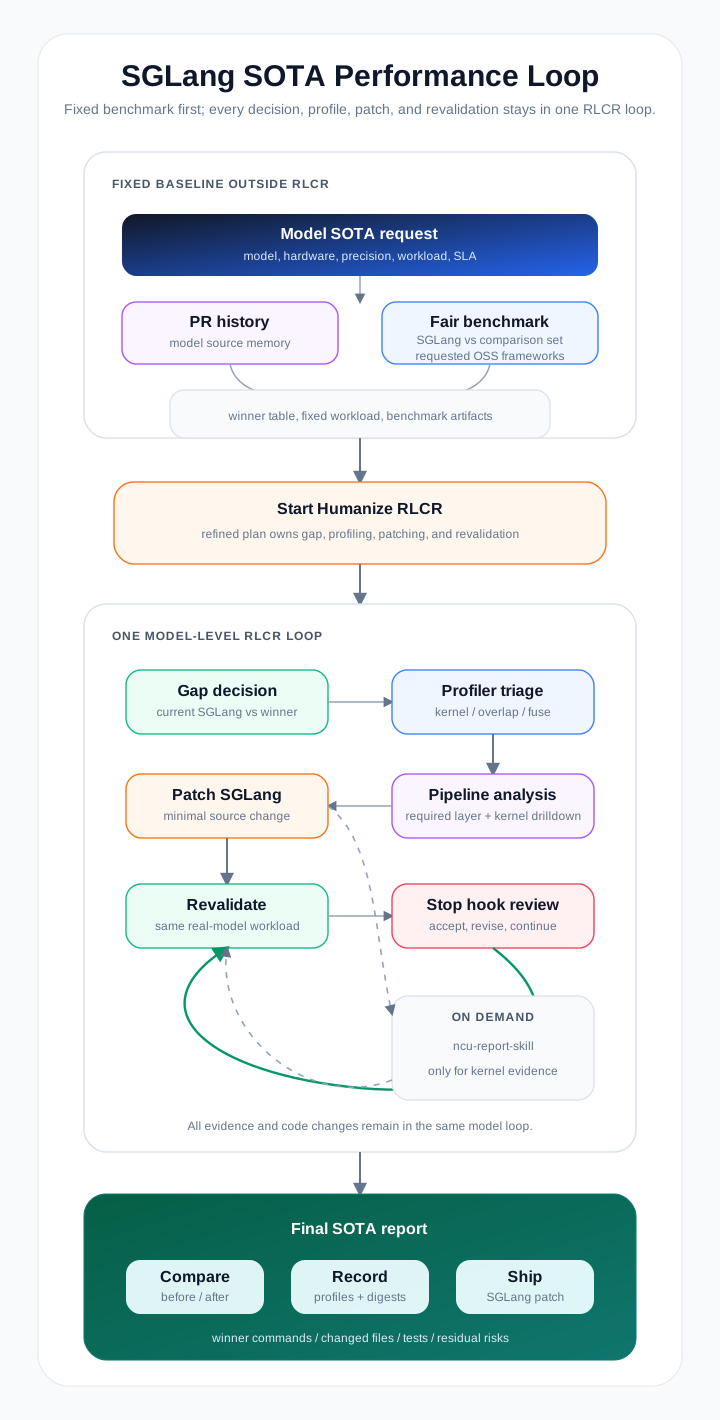
Figure 1: SGLang SOTA Performance Loop. A fixed fair benchmark first establishes a reproducible baseline. The subsequent gap decision, profiling, pipeline analysis, patching, and revalidation are driven by the Humanize/RLCR loop.
A full SGLang SOTA Performance Loop contains the following stages:
- Define the target boundary. For example,
Qwen/Qwen3-Next-80B-A3B-Instruct-FP8, single-node 2x B200, FP8, SGLang TP=2, and comparison against the requested open-source inference frameworks under the same 2-GPU budget. - Run fair search first. Before patching SGLang, search for the best reproducible commands for SGLang and each requested open-source inference framework under the same workload and resource budget.
- Decide the gap. If SGLang already matches or leads, record completion evidence. If it is consistently behind by more than the threshold, move to profiling.
- Use profiles to explain the gap. Do not rush into code changes. First produce kernel tables, pipeline tables, overlap/fuse tables, and NCU reports when needed.
- Patch only evidence-supported paths, such as hybrid attention, Mamba/GDN, radix cache, target verify, CUDA graph, MoE/EP, quant kernels, or model wrappers.
- Revalidate on the same workload. Every round records benchmarks, profiles, accuracy, failed attempts, environment information, and cleanup actions.
For a target such as Qwen/Qwen3-Next-80B-A3B-Instruct-FP8 on 2x B200, the loop matters because benchmark results, profile traces, failed patches, and intermediate conclusions all need to stay attached to the same model, hardware, workload, and framework commits. If this type of task is split into many independent prompts, it is easy to lose which command produced which result or whether a later profile still matches the original baseline. A loop with evidence and review keeps conditions aligned across rounds.
4.3 Codex Goal: A Lower-Cost Loop Implementation
The SGLang SOTA Performance Loop above uses a two-role setup: Claude Code executes benchmarks, profiling, patching, and revalidation, while Codex Review checks each round at the end. This setup is suitable for serious PR work, but every round consumes both an execution model and a review model, increasing cost and waiting time.
Codex Goal offers another implementation. Once "fair benchmark -> gap decision -> profile -> patch -> revalidate -> artifact ledger" is written into a persistent Goal, a single Codex Goal can carry execution, self-checking, and revalidation without the two-role execution/review setup. The core constraints of the SGLang SOTA Performance Loop remain: fixed workload, evidence-driven patches, revalidation under the same experimental conditions, and artifact manifest updates after every round.
The two approaches differ as follows:
| Dimension | Humanize/RLCR SOTA Loop | Codex Goal |
|---|---|---|
| Execution | Claude Code handles implementation and experiments; Codex Review reviews each round | One Codex Goal continuously executes, self-checks, and revalidates |
| State location | Plan, prompt, summary, and review results under .humanize/rlcr/... | Current Goal thread plus manifest/evidence under artifact_root |
| Review method | Stop hook, Codex Review, and git/state/schema checks | Goal-level self-checks, artifact contracts, and human spot checks |
| Cost | Two model roles participate, so each round costs more | One Goal carries both execution and checks, reducing cost |
| Main risk | More complex loop setup and longer waits per round | Goal drift or premature completion unless hard-stop conditions are explicit |
Below is a 2x B200 model optimization prompt example from AI-Infra-Auto-Driven-SKILLS/prompts.
Humanize/RLCR version:
Use the sglang-sota-humanize-loop workflow.

Task:
Optimize SGLang serving performance for Qwen/Qwen3-Next-80B-A3B-Instruct-FP8
on a single node with 2 NVIDIA B200 GPUs, FP8 precision, and initial SGLang
TP=2. SGLang should match or exceed the best reproducible result from the
requested open-source inference frameworks under the same 2-GPU budget, workload, SLA,
model, precision, and environment constraints.

Required workflow:
1. Create a draft task document under artifact_root.
2. Run humanize-gen-plan to turn the draft into a structured plan.md.
3. Start humanize-rlcr from that plan.md in the Claude Code session.
4. Keep benchmark, profile, patch, and revalidation decisions inside the same
   Humanize workspace.

Evidence and safety requirements:
- Before patching, run a fair bounded search for SGLang and the requested open-source inference framework set.
- Check relevant open PRs in sgl-project/sglang and BBuf/sglang before choosing
  the SGLang baseline.
- If SGLang is behind by more than 1%, profile before patching.
- Prioritize evidence around hybrid attention, Mamba/GDN, radix cache, target
  verify, and CUDA graph.
- Record benchmark commands, profile artifacts, failed attempts, and cleanup
  evidence for every round.
- Patch only evidence-supported SGLang code paths.
- If a PR is needed, push/open it only against BBuf/sglang and include benchmark,
  GSM8K, and full MMLU accuracy tables.

artifact_root:
/workspace/sglang-agent-artifacts/b200_qwen3_next_80b_a3b_instruct_fp8_sota_humanize
Codex Goal version:
/goal Keep optimizing SGLang serving for
`Qwen/Qwen3-Next-80B-A3B-Instruct-FP8` on a single node with 2 NVIDIA B200
GPUs until SGLang matches or exceeds the best reproducible result from the
requested open-source inference frameworks under the same 2-GPU budget, FP8 precision,
workload, SLA, model, and environment constraints. The current Codex Goal is the loop: fixed fair
benchmarking, gap decision, profiling, pipeline analysis, evidence-backed
patching, revalidation, final report, and optional PR preparation all happen
inside this Goal. Completion requires benchmark evidence, profile evidence when
SGLang was behind, correctness/accuracy evidence, a final artifact manifest,
and no regression in environment safety constraints.

model_id: Qwen/Qwen3-Next-80B-A3B-Instruct-FP8
root_dir: /workspace
target_hardware: single-node 2x NVIDIA B200
minimum_gpu_count: 2
precision_quantization: FP8
initial_deployment: SGLang TP=2
artifact_root:
/workspace/sglang-agent-artifacts/b200_qwen3_next_80b_a3b_instruct_fp8_sota_goal

Requirements:
- Use the current Codex Goal as the only persistent loop.
- Before patching, run a fair bounded search for SGLang and the requested
  open-source inference frameworks under the same 2-GPU budget.
- If SGLang is behind by more than 1%, profile in the same Goal, then use
  llm-torch-profiler-analysis, llm-pipeline-analysis, and ncu-report-skill when
  needed before patching.
- Focus on hybrid attention, Mamba/GDN, radix cache, target verify, and CUDA graph.
- Update the artifact manifest, benchmark evidence, profile evidence, failed
  attempts, and next-step decision after every round.
- Stop and report a blocker if resources are unavailable, evidence is
  untrustworthy, the budget is exhausted, or no defensible next patch exists.
The Goal version preserves the same benchmark, profile, accuracy, and artifact requirements. The difference is that execution and review are folded into one persistent target. With clear hard-stop conditions, it can carry the same SGLang SOTA Performance Loop with less orchestration.
5. KDA-Based CUDA Kernel Optimization for SGLang Systems
Beyond model-level optimization for LLMs and diffusion, kernel optimization has a harsher scaling problem. There is no single best kernel independent of hardware and workload. The same operator can prefer different implementations on H100, H200, B200, or B300; different model architectures expose different tensor shapes and layout constraints; and serving workloads change batch size, sequence length, precision format, wrapper overhead, synchronization behavior, and fallback paths. In practice, the search space is a Cartesian product of hardware, model, and workload definitions.
This creates a combinatorial optimization burden. For each candidate kernel, a developer needs to extract representative production rows, build a same-ABI harness, run A/B measurements, check correctness across shape buckets, read NCU metrics, decide whether a bucket deserves specialization, and then revalidate in the real SGLang path. Doing this by hand for every hardware/model/workload combination is expensive. It is also exactly the kind of repetitive, evidence-heavy workflow that agents are good at, as long as humans define the invariants and review the final path.
Asking an agent to write CUDA directly, however, can easily lead to benchmark reward hacking: changing the benchmark, using a lighter wrapper, enabling fast math that the baseline does not use, optimizing only one shape, breaking numerical semantics, or producing no gain in the real SGLang path.
KDA-Pilot separates kernel optimization into isolated tasks so the agent does not freely modify the whole SGLang repository:
- Workloads come from real SGLang diffusion models. The process first runs 20 diffusion models and summarizes actual kernel metadata.
- The baseline is copied from upstream SGLang main, with source lineage recorded.
- Baseline and candidate must use the same local ABI and the same build/export path.
- Benchmarks use fixed production rows, A/B interleaving, and CUDA event or wall timing.
- Correctness covers production rows, a canonical regression grid, NaN/Inf checks, poison output checks, and fallback contracts.
- Each iteration refreshes the task prompt, benchmark evidence, KernelWiki, and ncu-report-skill.
- Shape-specialized dispatch is allowed, but each bucket must document its condition, path, latency, and fallback.
A concrete snapshot makes the scale easier to see. The public KDA-Pilot B200 diffusion summary currently lists 10 tracked SGLang kernel tasks. Most rows have stable numeric B200 evidence in the KDA-Pilot ledger, with wall-geomean speedups ranging from 1.1341x to 2.7499x on extracted production rows. The residual_gate_add row is shown at 1.11x, matching the merged upstream LTX-2.3 B200 result.
As of June 27, 2026, three KDA-Pilot-derived optimizations have landed upstream in SGLang. The first was SGLang PR #27392, a B200 native diffusion norm-scale-shift CUDA fast path for Qwen-Image-2512. Two more landed later that week: SGLang PR #29281 for the Cosmos3 VAE causal Conv3D cat/pad copy path, and SGLang PR #29361 for the LTX-2.3 residual-gate update path.
| Upstream PR | Target path | Kernel-level evidence | Model-path evidence |
|---|---|---|---|
| #27392 | Qwen-Image norm-scale-shift | Target kernel group improved by 1.279x in profiler attribution | On one B200, five interleaved runs per side showed 1.125x full-request speedup and 1.130x denoise-wall speedup |
| #29281 | Cosmos3 causal Conv3D cat/pad | B200 weighted kernel group improved from 10.621 ms to 5.240 ms, or 2.03x, across traced VAE decode calls | With torch.compile enabled on Cosmos3-Nano T2V, median E2E time improved from 181.521 ms to 177.687 ms, or 1.021x |
| #29361 | LTX-2.3 residual-gate update | Large B200 LTX-2.3 rows improved 1.108x to 1.130x over the existing Triton path, with neighboring diffusion rows up to 2.587x | On LTX-2.3 HQ T2V, E2E time improved from 46644.08 ms to 45198.37 ms, or 1.032x |
The key takeaway is not that every standalone kernel win becomes a large end-to-end win. It is that the same KDA-Pilot evidence package -- fixed production rows, correctness gates, same-ABI comparisons, profiler attribution, and real-model checks -- can move a kernel task from an isolated benchmark into a reviewable SGLang serving path.
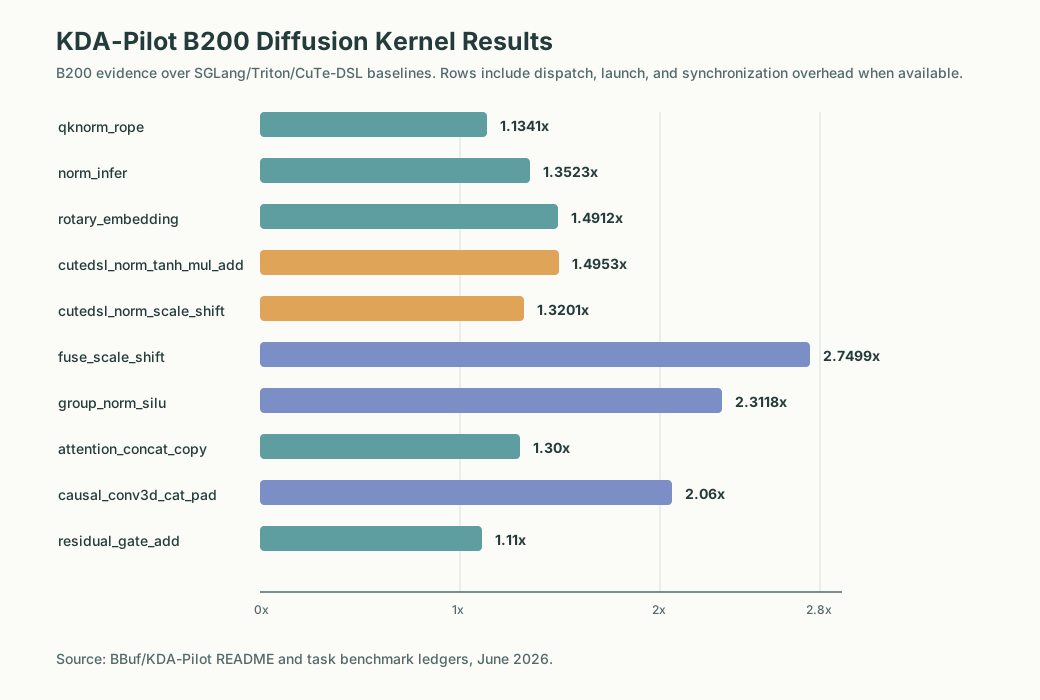
Figure 2: B200 evidence for 10 tracked SGLang diffusion kernel tasks optimized by KDA-Pilot. Most rows report KDA-Pilot wall-geomean speedup; wall time includes Python dispatch, wrapper overhead, kernel launch, and synchronization overhead visible through cuda.synchronize(), which is closer to the real call path than pure kernel device time.
| Kernel task | B200 evidence | Main optimization direction |
|---|---|---|
qknorm_rope | 1.1341x | Shared RoPE staging, Q/K reuse, large-row fast path |
norm_infer | 1.3523x | Warp-row RMS, tiled persistent RMS, 8B/16B vector path |
rotary_embedding | 1.4912x | 128-bit vector I/O, cos/sin hoisting, LTX2 block matching |
cutedsl_norm_tanh_mul_add | 1.4953x | Row-invariant math hoisting, launch-bounds tuning, exact tanh |
cutedsl_norm_scale_shift | 1.3201x | Operand-class dispatch, 16B/32B vectors, two-pass variance |
fuse_scale_shift | 2.7499x | rowgrid/flatvec/exact-C paths, cache hints, one-pass reduction |
group_norm_silu | 2.3118x | Split-group stats, channels-last direct path, fallback for giant rows |
attention_concat_copy | 1.30x | Single-launch region copy, pitched 16B block gather, strict layout/device rejection |
causal_conv3d_cat_pad | 2.06x | Flat chunking, 16B vectorized stores, stride-aware fallback, bitwise-exact gate |
residual_gate_add | 1.11x | One-pass CUDA fusion, pinned-GPU correctness, SGLang PR #29361 B200 Triton-row re-benchmark |
The chart and task table should be read with the experimental setting in mind: they report kernel-task speedups on extracted production rows, not full model end-to-end gains. They are still useful. Once baseline, workload, correctness, profiling, and review are fixed, agents can produce reviewable incremental improvements on real framework kernels.
Two rules from the KDA-Pilot experiments are worth keeping:
- Do not leave room for benchmark reward hacking. Results become unreliable when baseline and candidate use different ABIs, different fast-math settings, or different wrapper paths. Another common issue is changing the benchmark shape set after seeing the results, for example removing shapes where the candidate is slower. Such results should not be used.
- Buckets close to the Roofline should allow no-go or fallback decisions. A good kernel optimization task should not force the agent to win every shape. For giant contiguous buckets or paths already close to the bandwidth limit, recording a fallback may be better than adding more complexity.
6. Practice Rules
-
Define the task boundary before starting the agent. "Optimize SGLang" is too broad. "Match another open-source inference framework for
Qwen/Qwen3-Next-80B-A3B-Instruct-FP8on 2x B200 under fixed1000->1000and8000->1000workloads" is an executable target. -
Fix the benchmark before reading profiles. If the workload can change after results are known, the agent may accidentally optimize an easier problem. Both the SOTA loop and KDA-Pilot put fixed workloads before patching.
-
Interpret NCU results according to the kernel's compute characteristics. For memory-bound kernels, focus on DRAM/L2 throughput, load/store efficiency, and memory pipe utilization. For compute-bound GEMM/attention kernels, focus on Tensor Core utilization, SM busy, eligible warps, and the main stall reasons. For small latency-bound kernels, check launch count, per-kernel duration, synchronization points, and possible fusion opportunities. A single trace screenshot is not enough; the next code change should be supported by specific metrics.
-
Check backend and fallback gates before trusting a profile. If an LLM run silently switches attention backend, disables CUDA graph, or takes a wrapper path different from the benchmarked one, the trace is no longer describing the target serving path. The same rule applies to diffusion: if logs show fallback to the diffusers backend, that trace cannot be used as evidence for native SGLang diffusion. These hard-stop conditions should live in the skill.
-
Kernel optimization must use the same ABI, wrapper, and compile flags. In particular, the candidate should not silently take a lighter path, and
--use_fast_mathshould not be enabled on only one side. -
Review matters more than before. Agents can create more PRs, and they can also create more plausible mistakes. Review for a high-performance system like SGLang needs to check shape, dtype, distributed execution, CUDA graph behavior, fallback behavior, accuracy, serving APIs, metrics, and benchmark setup.
Agent-era SGLang development will not remove developers from the system. The more realistic change is to write developer experience into workflows, hand repetitive execution to agents, and leave judgment, design, and review to people. The saved time can go into harder performance problems, model paths, and production stability, or back into improving the agent workflow itself. For an open-source inference framework, this kind of infrastructure is worth sustained investment.
7. Acknowledgments
We thank the SGLang Team members and contributors who helped build the SGLang agent skills: Xiaoyu Zhang (BBuf), Lianmin Zheng, Liangsheng Yin, Ke Bao, fzyzcjy, Kangyan Zhou, DarkSharpness, Mick, Alison Shao, Baizhou Zhang, Bingxu Chen, Cheng Wan, Ratish P, shuwenn, ykcai-daniel, Yuhao Yang, and Artem Savkin.
We thank the KDA team: Dongyun Zou, Ligeng Zhu, Sihao Liu, Junxian Guo, Yixin Dong, Zijian Zhang, Hao Kang, and Song Bian.
We thank the Humanize team and contributors: Sihao Liu, Ligeng Zhu, Zijian Zhang, Zenus Zhang, shinan6, DYZhang, Chao Liu, Zhou Yaoyang, gyy0592, AcrossForest, Emin, Qiming Chu, jiaxiaoyu, tastynoob, and zhenwei.
8. References
- SGLang GitHub Repository
- SGLang
.claude/skills - SGLang diffusion
.claude/skills - AI-Infra-Auto-Driven-SKILLS
- AI-Infra-Auto-Driven-SKILLS prompts
- Kernel Design Agents (KDA)
- KernelWiki skill
- ncu-report-skill
- KDA-Pilot
- SGLang Diffusion Advanced Optimizations, LMSYS Blog
- OpenAI Codex Prompting: Goal mode
- Humanize